
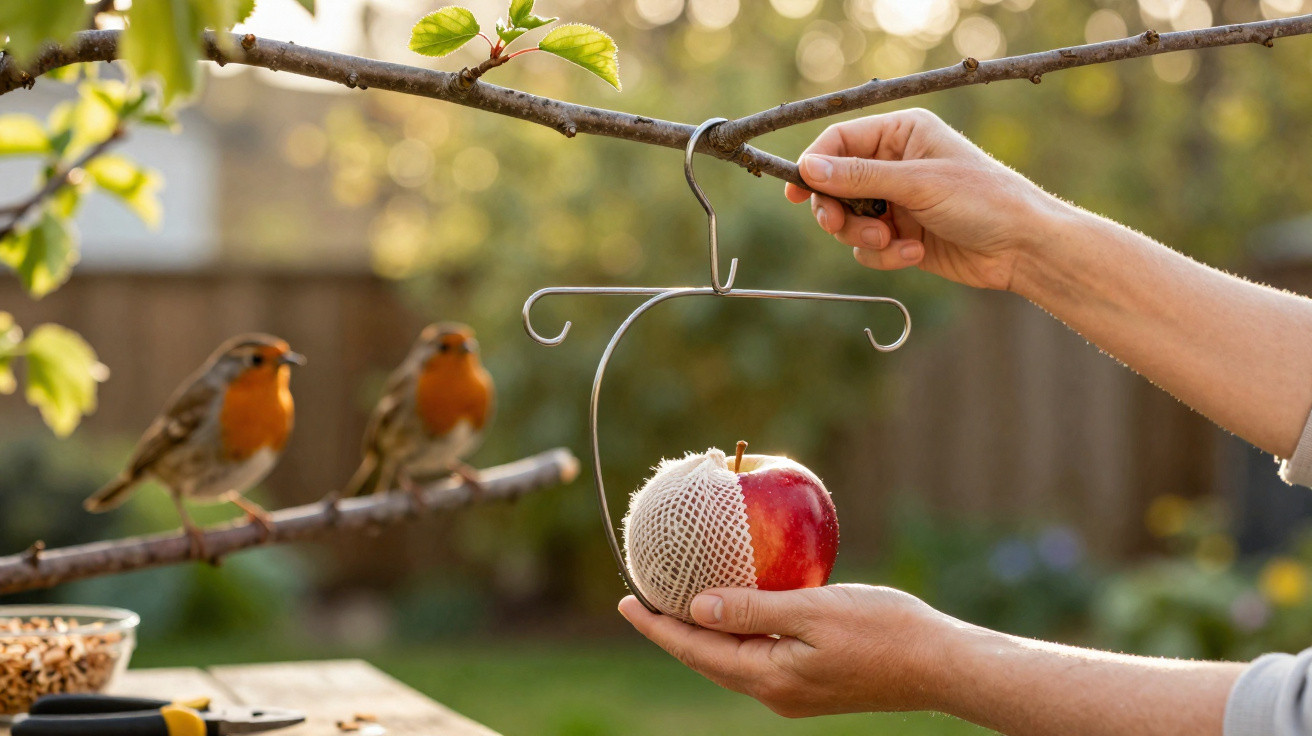
Many gardeners want to help songbirds, yet are put off by the cost of shop-bought feeding stations. Often, however, the makings of a sturdy, useful and free feeding point are already in the wardrobe: an ordinary metal coat hanger. With just a few adjustments, it can become a small “aerial beer garden” for birds that is durable, hard-wearing and easy to fill in different ways.
Turning a coat hanger into a bird buffet
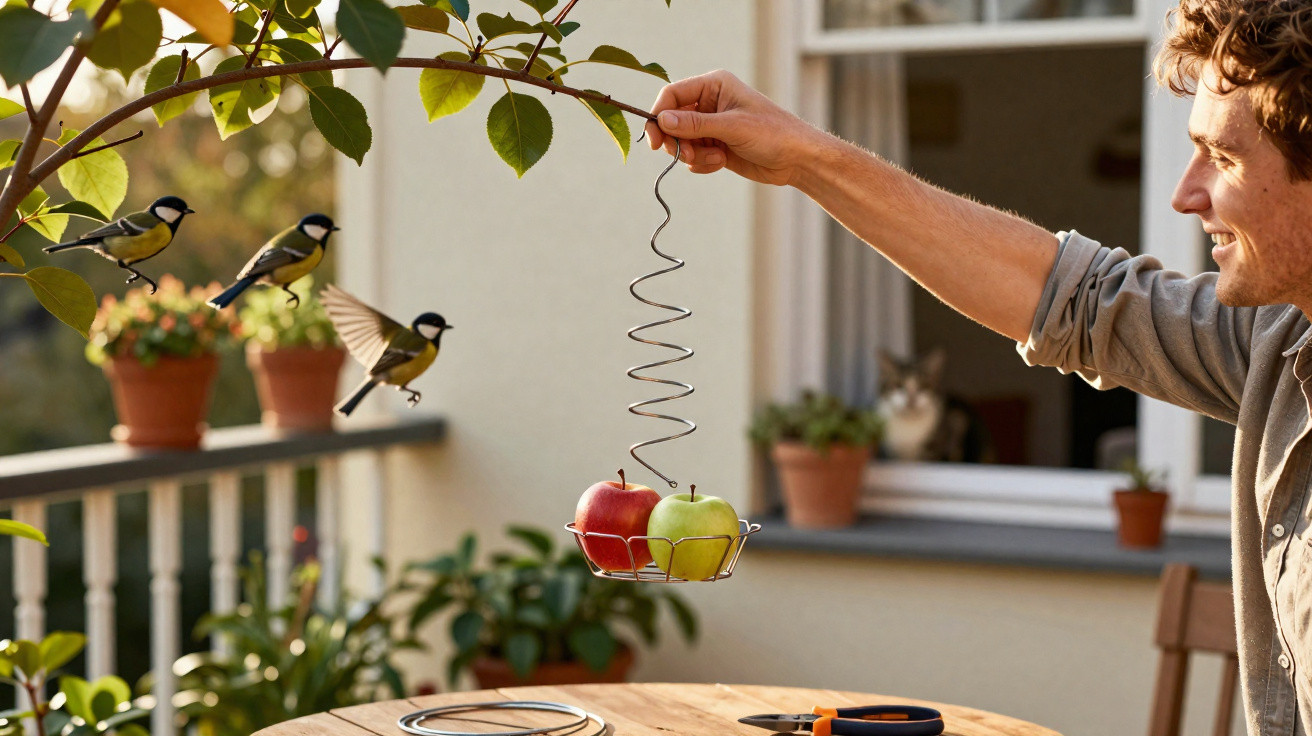
The principle is straightforward: use pliers to reshape a thin metal hanger into a support for half an apple or a suet ball. The hanger acts both as the suspension point and the food holder – it could hardly be more minimalist.
“An old wire hanger can become a functional feeding station in three minutes, providing targeted support for small garden birds.”
What you need for this £0 method
The main benefit is that there is nothing to buy. Almost everything should already be in the home or toolbox.
- 1 metal coat hanger, ideally a thin dry-cleaning type
- 1 pair of combination pliers or flat-nose pliers
- 1 pair of side cutters, optional if you want to shorten the wire
- 1 apple, whole or halved, or 1 plant-based suet ball for birds
Thin hangers work particularly well. They are strong enough to support fruit or a suet ball, while still being pliable enough to shape by hand with pliers. This makes it possible to create a tailored feeding frame with very little effort.
Step by step: make your own bird feeder in three minutes
Step 1: Reinforce the hanging point
Start by preparing the part used for hanging. Keep the hanger hook intact, as this will later attach to a branch.
- Place the hanger on a solid surface.
- Using flat-nose pliers, carefully undo the twisted section immediately below the hook until it forms one long, straight length of wire.
- Squeeze the hook firmly closed with the pliers so it cannot open when a bird lands or wind moves the hanger.
You now have a secure basic frame: the hook at the top and a freely shapeable wire section below. The neater this foundation is, the easier the remaining steps will be.
Step 2: Shape a holder for an apple or suet ball
This is the creative stage. The shape you choose depends on the food you intend to offer.
Option A: A holder for an apple or other fruit
If you prefer to use fruit, such as a whole or half apple, make a U-shaped or pointed support at the bottom end:
- Bend the lower end of the wire firmly upwards.
- Create either:
- a broad, sturdy U that can hold half an apple, or
- a pointed, gently curved spike for impaling the apple.
- Make sure the apple is held securely and cannot fall off.
Anyone with several hangers can try different fruits, such as pear or a piece of dried rosehip, to see what proves most popular in their own garden.
Option B: A holder for a suet ball
For standard suet balls, preferably net-free so birds cannot become tangled, wind the wire into a small basket or spiral:
- Use the pliers to coil the bottom third of the wire into a tight spiral.
- Leave a little room at the centre so that the ball can be pressed into place.
- Turn any sharp wire ends inwards to prevent injuries to birds.
“Important: Always bend open, pointed wire ends inwards. This lets birds land safely without injury.”
Simply push the suet ball into the spiral. It will sit securely enough to withstand even blustery weather.
The best location: safe for birds and interesting for observers
Protection from cats and birds of prey
Even the safest feeder is of no use if it becomes a trap. That makes its location especially important.
- Hang the coat hanger from a sturdy branch around two to three metres above the ground.
- Avoid nearby routes that cats can use to climb, such as walls, shelving or low branches.
- Pick a position where birds can approach from several directions and leave quickly when needed.
A slightly isolated tree or a larger shrub is particularly suitable. Birds can spot possible threats early and have sufficient escape routes.
Distance from windows and walls
Glass creates a separate hazard. Birds can fail to notice it when startled and collide with it. A few simple rules can help:
- Keep at least ten metres away from large windows or patio doors.
- Do not hang it directly beside exterior walls, where birds may become trapped in corners.
- Where possible, use visual markers or curtains on very large glazed areas.
Positioning the hanger outside the direct line of nearby glass considerably reduces the risk of collisions. At the same time, the feeding point can still be watched easily from indoors.
Why small garden birds love this bird feeder
Ideal for tits, sparrows and robins
The lightweight design of the hanger is especially appealing to smaller species. Great tits, blue tits, house sparrows, tree sparrows, greenfinches and robins are often among the first visitors.
The metal hanger gives them several advantages:
- Narrow bars are easy for climbing species to grip.
- Larger, heavier birds such as pigeons are more likely to be discouraged.
- Its height above the ground makes access harder for cats and martens.
As a result, the food is used more specifically by species that contribute to a balanced garden ecosystem, for example by eating insects or acting as pollinators.
More than food: a small eco project
The benefits extend beyond feeding. Regularly providing food brings birds closer to the garden. This also increases their presence during breeding season and while hunting insects. Many species will incidentally reduce numbers of aphids, mosquitoes and caterpillars.
“A simple wire construction can noticeably strengthen biodiversity in your own garden – without plastic waste or extra cost.”
Practical tips for long-term use
Food that is genuinely suitable
Even a free feeding station needs good contents. Particularly suitable options include:
- unseasoned, net-free suet balls
- sunflower seeds, hulled or unhulled
- apple halves or small pieces of fruit, ideal during frosty weather
- specialist seed mixes for wild birds
Avoid salted nuts, seasoned leftovers and bread. Many of these foods swell in birds’ stomachs or contain ingredients that they tolerate poorly.
Cleaning, rust and safety
Metal coat hangers generally last a long time. A little care can extend their usable life further:
- Remove leftover food and fruit regularly to prevent mould.
- Rinse it briefly with hot water once a week, then allow it to dry.
- Replace the hanger if rust becomes severe, so that sharp edges cannot develop.
If desired, lightly sand the wire beforehand and coat it with a thin layer of non-toxic metal paint. This slows rusting while also improving the feeder’s appearance.
Upcycling ideas: other shapes to make from coat hangers
Options for more experienced makers
Once you have taken to the method, you can experiment with additional hangers:
- A double spiral to hold two suet balls one above the other
- A cross-shaped structure made from two hangers for several pieces of apple
- A small “parking space” for millet spray, made by bending a side support
With a little practice, you can create an entire “bird buffet” from discarded materials that might otherwise have ended up in the bin or at the back of a dark cupboard.
Why this principle suits the times
Many people are trying to cut waste and live more resource-efficiently. This small project combines several approaches at once: upcycling rather than throwing things away, supporting local wildlife, using less plastic and spending nothing extra. It is also an effective quick craft activity for introducing children to nature conservation. They can immediately see whether birds use their creation and learn along the way how sensitively a garden ecosystem responds.
Looking out of the window and seeing busy flight activity around the repurposed coat hanger makes it very clear how much impact even an unassuming three-minute task can have.


Comments
No comments yet. Be the first to comment!
Leave a Comment