
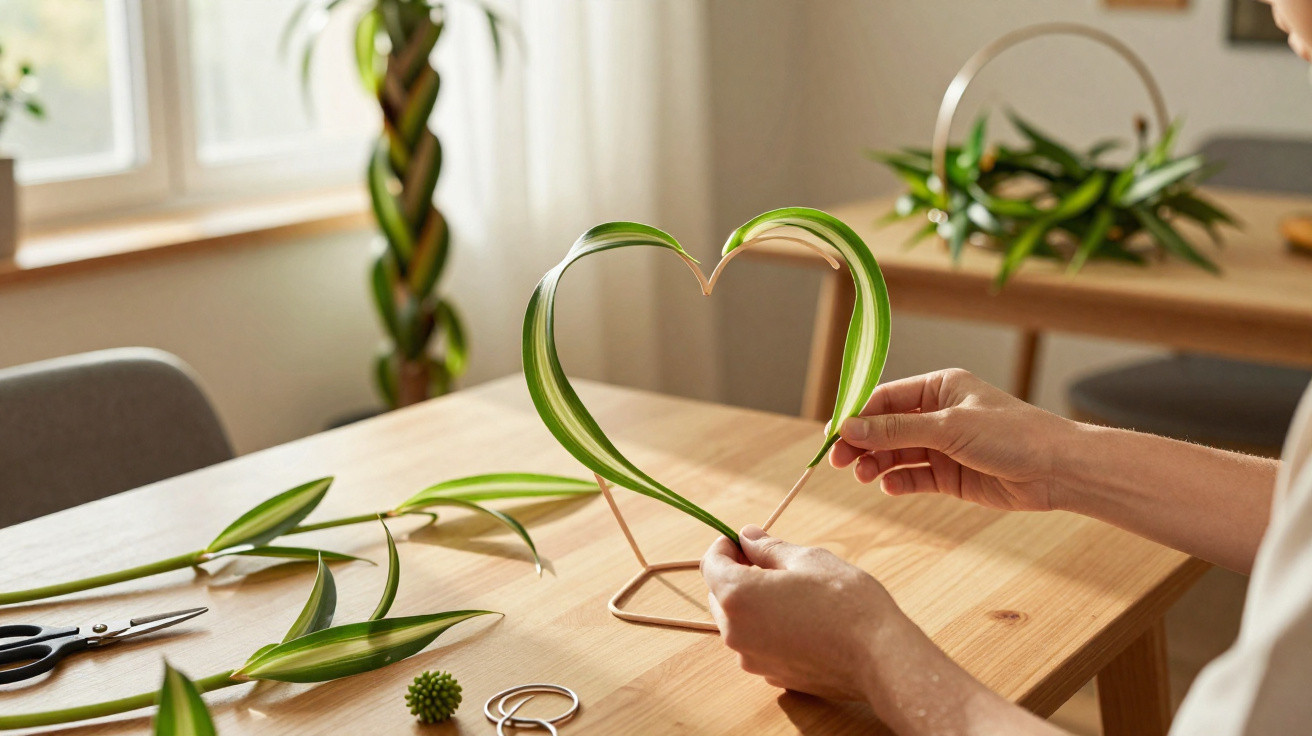
The spider plant is often seen as an indestructible classic: easy to care for, pet-friendly and found almost everywhere – yet rarely regarded as a real showstopper. Anyone who sees it merely as air-purifying greenery in their décor is overlooking its potential. With a little deft handling, this plant can become a living artwork that takes over any table or shelf.
Why the spider plant is secret decorative gold
Botanically, the spider plant is known as Chlorophytum comosum and originally comes from South Africa. In UK homes, it is usually displayed in a hanging planter or spilling from a pot on top of a cupboard. Its defining features are the green-and-white striped foliage and long, slender runners, each carrying small rosettes at the tips – the familiar plantlets.
Those plantlets are precisely what makes this transformation possible. They normally just dangle downwards, but rather than allowing them to hang without direction, you can guide them deliberately. This turns the plant into a kind of living green craft material that can be shaped, woven and arranged.
“Anyone who does not simply let a spider plant’s runners grow, but guides them instead, gets a living sculpture rather than an everyday houseplant.”
The runners are remarkably flexible. With a little patience, they can be bent without snapping. That makes the plant especially suitable for graphic shapes, from hearts and wreaths to a true green column.
Turning trailing runners into a green sculpture
A light metal frame: heart, ring or crown
The easiest approach uses a slim frame. Thick aluminium wire from a craft shop is ideal: it is sturdy enough to retain its shape, while still being easy to bend by hand.
- Bend the wire into a ring, heart or oval shape.
- Push the wire into the pot, or secure it so that it stands firmly.
- Choose several strong runners with plantlets and loosely place them around the frame.
- Fasten them using soft plant clips, craft tape or small silicone rings.
Aluminium barely rusts and is extremely lightweight, so the plant can support the construction with no difficulty. Over time, the delicate rosettes develop into dense little clusters that almost completely conceal the wire frame. The result is a green heart or ring that looks like a finished designer piece.
A braided column as a living totem pole
If you would rather work upwards, several runners can be braided into a column. This method is best suited to larger plants with plenty of long offshoots.
Method:
- Select three to five longer runners, preferably with healthy plantlets.
- Place a sturdy wooden cane vertically in the pot for support.
- Gather the runners loosely at the base and braid them like hair.
- Secure the braided section to the wooden cane at regular intervals, without pinching it.
This creates a green column that slightly resembles a totem pole. It needs very little floor space and is ideal for narrow corners of a living room, beside the television or at the edge of a bookcase.
“A braided column can turn even a narrow strip of a room into a striking green stage.”
Preparing your spider plant: observe, select and thin out
Before shaping the plant, it is worth inspecting it closely. Not every runner is equally suitable for creating a sculpture.
- Choose strong runners: Long, vigorous offshoots with several plantlets work best.
- Remove surplus plantlets: Too many rosettes can quickly look untidy. Some can be cut off without any problem.
- Reuse the plantlets: The removed baby plants can be planted straight into a new pot or positioned around the edge of the existing one. After a few weeks, they will form a denser base there.
The important thing is to guide the runners rather than force them. If they are kinked too sharply or bent too tightly, they can split. It is better to acclimatise them gradually to the intended shape. A small adjustment every few days is usually enough.
Where a green sculpture makes the greatest impact
Hearts and wreaths as table centrepieces
A densely covered wreath quickly becomes the natural centrepiece of a dining table. The plantlets fall gently outwards without obstructing eye contact between people seated around it. Add candles in the middle and it becomes a kind of green frame.
A spider plant heart suits celebrations, romantic dinners or simply works as an unexpected eye-catcher in the hallway. On a narrow console table, the shape looks almost like an art object – except that it is alive.
A braided column for small rooms
Every square centimetre matters in a small room. A tall, slim spider plant column on a bedside table or beside an armchair has far more presence than a broad clump at floor level. Its height allows more light to reach the leaves, giving the whole plant a more elegant appearance.
If space is limited, the column can also be placed inside a tall, narrow decorative planter. This strengthens the sculptural effect while also concealing the original nursery pot.
Care after shaping: support rather than stress
After bending and braiding, the spider plant needs a little extra care to cope well with its new look. A simple liquid feed containing two main nutrients – nitrogen and potassium – is enough to support growth and keep the leaves resilient.
Importantly, do not shape it immediately before or during a heatwave; choose a relatively mild day instead. The plant will then cope better with mechanical stress. Waterlogging is far more harmful to a spider plant than short periods of dryness, so water moderately.
In very mild regions roughly corresponding to climate zone 10 or 11, the spider plant may also go outside in summer, provided temperatures do not fall below around 13°C. A braided column on the balcony then becomes a small garden feature that visually extends straight out from the home.
Common mistakes and simple ways to avoid them
| Problem | Cause | Solution |
|---|---|---|
| Runner breaks during shaping | Bending too quickly or too forcefully | Position it gently, then make small adjustments every few days |
| Shape looks sparse | Too few plantlets or a weak plant | Plant additional plantlets and wait before securing the final shape |
| Plant develops drooping leaves | Stress from repotting, shaping and moving location at the same time | Separate these changes over time, place it in shade and water evenly |
| Wire remains visible | Not enough growth yet | Be patient, feed the plant and gently direct new runners into gaps |
Why the effort is genuinely worthwhile
The spider plant is non-toxic to dogs and cats, filters pollutants from the air and is considered almost foolproof. That very resilience makes it ideal for shaping and experimentation. Even if an attempt goes wrong, the plant will produce new growth in most cases.
Giving away plantlets also lets you share the plant-sculpture trend: a small pot, a curved piece of wire and a young runner fixed to it are all it takes to make a personal living gift. Over time, it develops into an individual figure that continues growing in the recipient’s living room.
It is also effective when combined with other houseplants. A trained spider plant column beside a large-leaved monstera or a compact fern creates strong contrasts. Even familiar classics then suddenly look like part of a carefully planned interior scheme, rather than a random collection of pots.
Anyone who has only known the spider plant as an undemanding trailing houseplant can have a real revelation with wire, a little courage and a few hours of patience: an easy-going plant becomes a small living artwork that surprises every visitor.




Comments
No comments yet. Be the first to comment!
Leave a Comment