
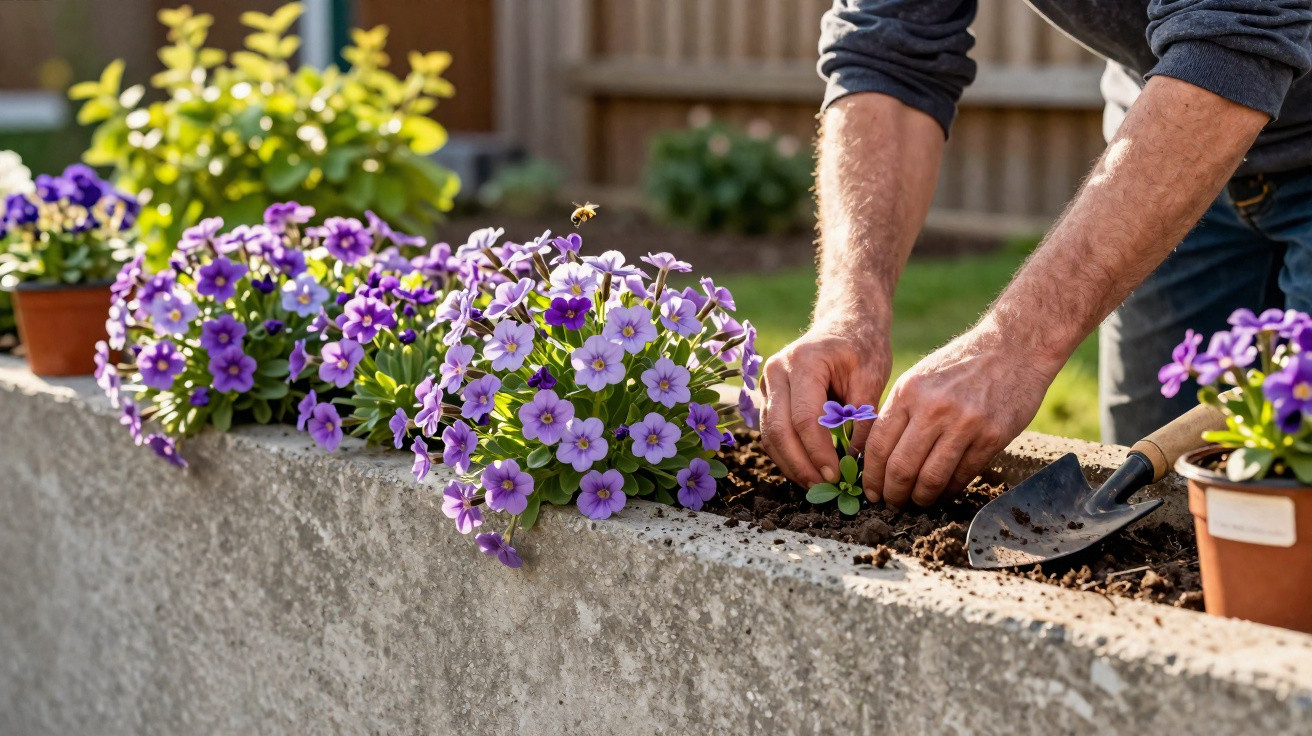
A grey strip of retaining wall can spoil an entire garden – yet the right plant can turn it into a vivid ribbon of flowers within just a few weeks.
Many amateur gardeners recognise the issue: the slope is secured and structurally sound, but the retaining-wall blocks look out of place among flowerbeds, lawns and hedges. Rather than creating an idyllic scene, a cold stone wall takes centre stage. Ironically, an unassuming cushion-forming perennial thrives precisely where there is little soil, plenty of sun and constant drainage – transforming a problem area into an eye-catching feature.
Why Aubrieta loves a retaining wall
The star of the show is Aubrieta, botanically known as Aubrieta deltoidea and often called rock cress. It originates from rocky regions with poor, free-draining soil and abundant sunshine. These are exactly the conditions it encounters on top of a retaining wall.
Growing to only around 10 to 15 centimetres tall, this plant stays very low while spreading widely sideways. It bursts into bloom in spring, usually from mid-April into early summer: hundreds of tiny violet, purple or pinkish-purple flowers cover the cushion, almost completely concealing its foliage.
“A grey block of stone becomes a flowing purple carpet – without high costs or intensive maintenance.”
Its flexible shoots creep into every crevice, take root there and then trail over the edge. This creates the characteristic “flower cascade” that spills from the top of the wall. The stones themselves are not harmed, as the plant roots only in joints and loose pockets of soil.
The ideal position: sunny, poor and well drained
Aubrieta needs full sun. A south- or west-facing aspect is ideal, allowing the wall to warm during the day and release stored heat in the evening. The soil can be decidedly poor:
- plenty of mineral material, such as gravel or grit
- only a moderate proportion of humus-rich soil
- no waterlogged areas – water must drain away quickly
If the site is too fertile or remains wet for long periods, the plant ages more quickly and flowers far less profusely. In typical garden climates with winters well below freezing, however, it proves remarkably hardy.
How to plant Aubrieta on top of a retaining wall
For the quickest possible before-and-after transformation, use young container-grown plants rather than seed. Their root systems are already well established in the compost, so they get going much faster.
Step by step to a flower cascade
- Choose the planting line: Mark a line along the top edge of the wall, spacing the plants as they will eventually be positioned. Depending on the variety, allow approximately 20 to 30 centimetres between plants.
- Create planting pockets: Open up small gaps between two stones or behind the final row of blocks. With a concrete block wall, shallow, narrow hollows can be dug out behind it.
- Prepare the growing medium: Blend garden soil with plenty of gravel, grit or coarse sand. A small quantity of well-rotted compost is sufficient; excessive nutrients reduce flowering.
- Plant the Aubrieta: Ease the plants carefully from their pots, loosen the roots slightly and plant them at an angle towards the wall edge. The shoots should be able to grow over the edge later.
- Water thoroughly: Give them a generous watering immediately after planting so that the soil settles closely around the roots. Afterwards, allow the surface to dry out again.
Suitable planting times are spring, after the last severe frosts, or a mild autumn. In each case, the plants then have several weeks to establish before heat or frost challenges them.
Care: very little to do – apart from pruning at the right time
Once Aubrieta has established itself, it is largely self-sufficient. It rarely needs watering, copes with dry spells far better than continual moisture and performs well without regular feeding.
Pruning for dense cushions
The key maintenance task comes straight after the main flowering period, usually in late May or June. This is the time for a decisive trim:
- cut every cushion back by around half with shears or hedge trimmers
- remove spent shoots and dead material
- sweep loose clippings from the wall to prevent anything rotting
Pruning stimulates fresh, young growth. It keeps the cushions compact and prevents the plant from becoming woody and sparse from the centre outwards. Leaving this task undone for years can result in gaps in the middle and bare patches.
Correcting winter damage
Following harsh winters, some cushions may look slightly straggly or grey. A light shaping cut in early spring restores their form. Individual dead sections can simply be cut away; over the course of the season, the plant will usually fill small gaps by itself.
“Regular pruning takes only a few minutes each year, but extends the life of the cushions by many seasons.”
Combinations that turn the wall into a planted feature
The purple flower cushions are impressive enough on their own. The wall becomes even more interesting when other drought-tolerant species are added. Particularly suitable choices include:
- Houseleek (Sempervivum): Rosettes in red shades or light green provide structure beyond the flowering period.
- Stonecrop and biting stonecrop (Sedum species): These also form carpets, flower later in the year and therefore extend the season of colour.
- Thyme or other cushion-forming herbs: They add fragrance and attract additional insects.
With a little planning, this creates an attractive scene throughout the year: Aubrieta first in spring, followed by Sedum flowers in summer and autumn, with evergreen rosettes providing a framework in between.
How quickly the retaining wall changes visually
Many gardeners underestimate just how dramatic the result can be after only a short time. Even in the first year, the individual cushions grow noticeably closer together. By the second or third season, a continuous edge forms along the whole top of the retaining wall. On steep, sunny sites, a few weeks of spring sunshine are enough for the plants to visibly “spill” over the stones.
Planting slightly more densely from the start, and investing in a few additional pots, speeds up this process. Later, sections can be easily lifted and replanted elsewhere, allowing the plant to spread across the garden without extra cost.
Useful side benefits for the garden and wildlife
Aubrieta is not merely attractive; it also performs practical functions. Its cushions protect the narrow strip of soil from erosion, reduce dust in dry positions and keep the temperature at the wall surface somewhat steadier. The stones heat up less intensely, benefiting plants growing above them.
Insects benefit too. The early flowers provide an important spring food source for many wild bees and butterflies, at a time when little else is in bloom. Deer and rabbits, by contrast, generally leave the cushions alone – they simply do not like the taste.
What to consider when choosing Aubrieta varieties
Garden centres sell a range of varieties and cultivars under the name Aubrieta. They differ mainly in:
- flower colour, from soft violet to deep purple
- flower size
- spread and density of growth
- single or double flowers
For a particularly “picturesque” wall, combine several varieties in subtly different shades of violet. This gives the planting a livelier, less uniform appearance. Double flowers may look lush, but they provide less food for insects. Those prioritising bee-friendliness should instead choose single-flowered varieties.
Ultimately, one factor matters above all: the combination of poor soil, full sunshine and the right cushion-forming perennial works in the gardener’s favour. With comparatively little effort, the hard line of a retaining wall disappears behind a soft purple curtain – and what seemed a flaw becomes the garden’s secret main attraction.





Comments
No comments yet. Be the first to comment!
Leave a Comment