
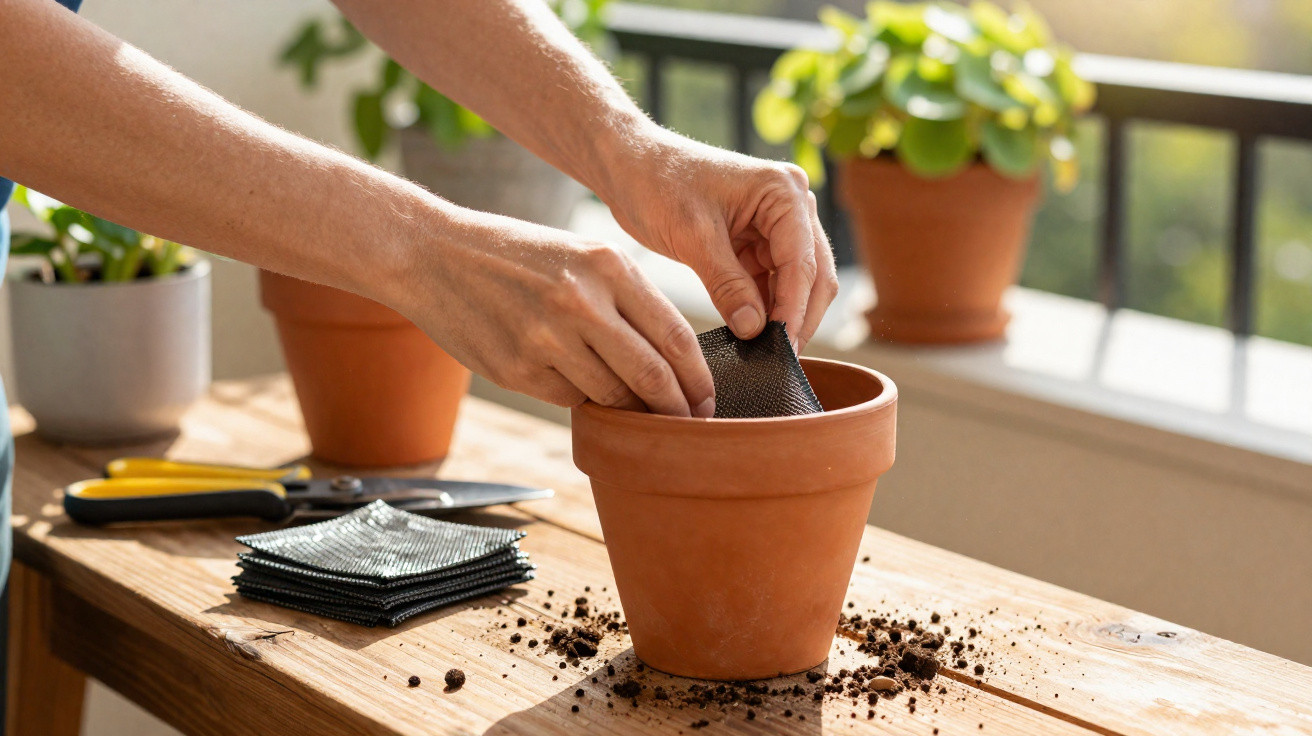
Offcuts of leftover mesh can serve a straightforward purpose in gardening: placing them over the drainage holes in plant pots. The material may prevent potting mix from washing out through these openings during watering, without completely obstructing the flow of water.
Why put mesh over a pot hole?
Holes in the base of pots are vital because they allow surplus water to drain away. If the potting mix is particularly loose or made up of fine particles, some of it can be carried out through the opening when the plant is watered.
A small piece of mesh can act as a physical barrier, retaining the potting mix inside the container while still allowing water to pass through. The mesh size should suit both the potting mix and the pot’s drainage hole.
How to fit mesh without stopping drainage
Cut a piece of mesh that is slightly larger than the opening in the pot. Put it over the hole before adding the potting mix, while leaving a clear route through the centre.
Do not press the mesh down so firmly that it sticks tightly to, or seals, the opening. The aim is to cover the hole without turning it into a waterproof cap. Water must still be able to find a way out.
Which types of mesh can be reused?
The material should be durable, clean and suitable for damp conditions. Plastic or synthetic mesh can work well if it has an appropriate gauge and does not break down easily.
Other gardening materials designed for the same purpose may also be used. Avoid pieces that are rusty, brittle or likely to release fragments into the potting mix.
Does this trick replace pot drainage?
No. Mesh does not create drainage if there is no opening in the first place. It can only help limit excessive loss of potting mix through a hole that has already been made to drain water.
The pot still requires suitable drainage holes and a potting mix that matches the plant’s needs. It is also important not to form an impermeable layer at the bottom. Therefore, mesh at the bottom of a pot can be a simple reuse option, provided that it keeps the holes clear and lets excess water drain away.




Comments
No comments yet. Be the first to comment!
Leave a Comment