
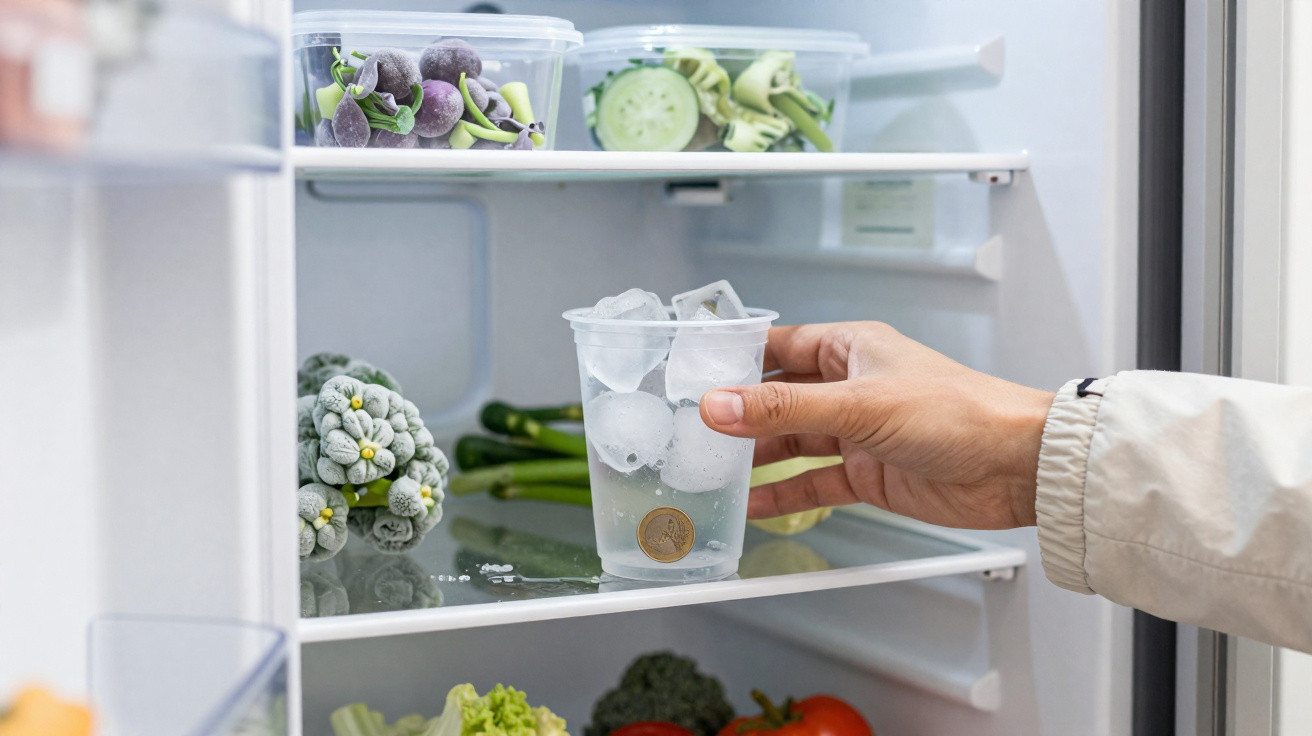
Keeping a coin on a glass of ice in the freezer provides a straightforward indication that food may have thawed during a power cut, then refrozen before you noticed. When the ice layer melts, the coin sinks into the water; once electricity is restored, the water freezes again and traps it at a lower level. This trick can be helpful after storms, trips away or blackouts, but it cannot by itself establish whether every item is still safe to eat.
How does the coin-on-ice trick work?
Start by filling a freezer-safe glass or container with water and wait until it has frozen solid. Next, place a coin on top of the ice and keep the container in a stable area of the freezer. As long as the temperature remains low enough to preserve the ice, the coin will stay on the surface.
- First, freeze a glass that is partly filled with water.
- Put a coin on the fully solid ice.
- Keep the container inside the freezer.
- Following a power cut, check where the coin is positioned.
What does it mean if the coin is at the bottom of the glass?
If the coin has sunk a significant distance, some of the ice must have melted at some point. If the container has frozen again, this shows that the temperature rose during the outage before dropping once more. The method is particularly useful when power is restored while nobody is at home and there is no other visual sign that thawing occurred.
A coin sitting only slightly below the surface points to partial melting, whereas one close to the bottom suggests that almost all the ice may have turned to water. However, the trick does not reveal how many hours the freezer stayed warm or the temperature the food reached.
Does a coin at the bottom mean all food must be thrown away?
Not necessarily. The coin’s position is a thawing alert, not a food-safety test. Food that still contains ice crystals or has remained at 4 °C or below can often be refrozen safely, although its texture and quality may be affected.
- Assess each food item individually.
- Check whether ice crystals are still present.
- Use a food thermometer if you are unsure about the temperature.
- Do not taste food to find out whether it is safe.
- Discard perishable food that has been above 4 °C for more than two hours.
How long does a freezer keep food cold without power?
With its door kept shut, a full freezer can hold a safe temperature for roughly 48 hours; when half-full, this falls to around 24 hours. Opening the door during a blackout allows warm air in more quickly and greatly reduces this window, so it is best to leave it closed until the power returns.
The volume and arrangement of the food also make a difference. Large items stored together stay frozen longer than small packets kept near the door. As a result, two foods stored in the same freezer can be in different conditions after an extended interruption.
Why is the coin on a glass of ice useful during trips, storms and blackouts?
The coin on a glass of ice addresses a particular problem: electricity can fail, the freezer can warm up, and then it can resume normal operation before anyone gets home. In that situation, meat, ready meals and other items may be hard and frozen again, concealing the fact that they went through a period of thawing. The coin’s location provides physical evidence that the ice melted.
The approach is most effective when used alongside safety checks, especially the temperature, the presence of ice crystals and the known duration of the outage. A sunk coin is a prompt to inspect the freezer’s contents, rather than an automatic verdict on every food item; a dedicated freezer thermometer, meanwhile, gives far more precise information about storage conditions after a power cut.




Comments
No comments yet. Be the first to comment!
Leave a Comment