
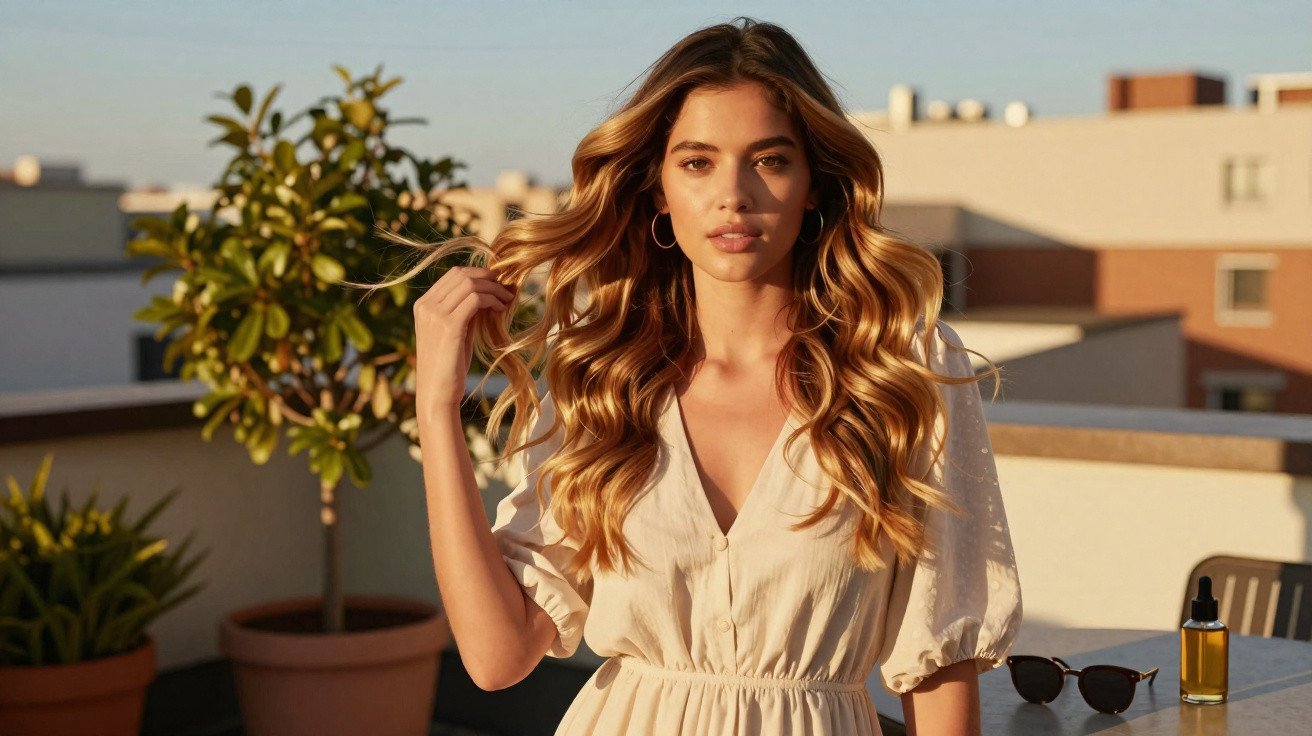
Sunshine may still be in short supply, but salons are already embracing a fresh way to recreate that just-back-from-holiday radiance.
With daylight hours increasing, hairdressers throughout Europe are moving away from deep winter brunettes towards brighter, sun-warmed shades that illuminate the face without over-processing the hair. At the heart of this spring-summer 2026 movement is “Indian sun”, a balayage method intended to deliver a gentle holiday glow, limited damage and an immediately healthier-looking complexion.
What is Indian sun balayage?
Indian sun is a targeted, low-impact balayage technique created in French salons and promoted in particular by stylist Franck Provost for spring-summer 2026. Rather than applying blonde highlights throughout the hair, it uses only a small number of lighter strands positioned where the sun would naturally brighten the hair.
Think of Indian sun as a gentle sun filter for your hair: a few precise highlights, carefully positioned to fake a week on the beach.
Between six and eight fine sections are used, with each lifted only a few shades lighter than the base colour. The colour is painted around the face and through the lengths to produce a delicate halo and understated dimension, rather than a complete blonde change.
Importantly, Indian sun is created as a “sun effect” for both virgin and previously coloured hair. It complements the existing colour instead of attempting to remove it, helping to explain why colourists regard it as more polished and current than previous high-contrast balayage looks.
Why Indian sun is gentler on your hair
Traditional salon lightening commonly relies on powerful bleach and heat, whereas Indian sun is carried out without either heat or ammonia. Instead, the colourist works with a clay-based lightener, which raises the pigment more gently.
The goal is glow, not shock: just enough lift to mimic summer light, without pushing the hair to breaking point.
As the treatment is applied to only a small selection of strands, the hair has far less overall chemical exposure than it would with a full balayage. This can mean reduced dryness and fewer split ends, while helping the hair retain its shine and natural movement during a warm summer.
Key features at a glance
- Partial balayage: 6–8 sections rather than a full head of highlights
- No heat or ammonia added during the lightening process
- A clay-based product for a gentler, more controlled lift
- A soft sun-kissed finish instead of a dramatic blonde transformation
- Created to merge naturally with your existing base colour
Face-framing light: when balayage meets hair contouring
Indian sun stands out not only because of its formula, but also because of where the colour is placed. Colourists describe the approach as a combination of balayage and “hair contouring” - hair’s version of carefully placed bronzer and blusher.
Indian sun behaves like a complexion hack: light where you want lift, depth where you want structure, for a built-in makeup effect.
The lighter strands are arranged to shape the face, rather than merely to make the hair appear lighter. Along the hairline, these gentle ribbons act rather like a ring light, enhancing brightness at the cheekbones, eyes and jawline.
How Indian sun adapts to different face shapes
| Face shape | Typical placement with Indian sun | Visual effect |
|---|---|---|
| Round | Lighter pieces around and just beneath the cheeks | Adds definition and discreet vertical lines |
| Square | Softer ribbons by the temples and near the jaw | Reduces the appearance of angles and brings warmth to pronounced features |
| Oval | Fine halos around the face and through the mid-lengths | Highlights natural balance and increases radiance |
| Angular/long | Carefully placed brightness at the sides and around the cheekbones | Makes the face appear wider and creates a “blush” effect |
Colourists frequently liken the finished effect to a soft sweep of blusher: enough warmth to raise the whole face without appearing visibly “coloured”. The result is hair that looks naturally sun-kissed and skin that appears more refreshed.
A trend built for low-maintenance summer hair
A major drawback of conventional blonde balayage is its distinct regrowth line. Once the roots begin to show, the contrast can be noticeable, creating the need for frequent appointments. Indian sun has been designed to prevent this.
Because the lift is moderate and the blending is subtle, the regrowth line blurs into the base instead of screaming for a salon visit.
With just a few lightened strands woven into the natural colour, hair can grow for months without developing a stark dividing line. Instead of becoming a solid stripe through the mid-lengths, the colour gradually fades into a softer effect.
This makes Indian sun an option for anyone seeking a seasonal change without committing to a high-maintenance blonde look. Many stylists anticipate that clients will wear it well into autumn, refreshing the brightness only when they choose to rather than because their roots demand it.
Who suits Indian sun best?
Indian sun is mainly intended for medium-to-long hair, which provides sufficient length for placing the fine lighter ribbons and building a gradient. A layered cut can also help the shimmer show as the hair moves.
In colour terms, it can suit a wide range of bases, including dark blonde, rich brunette and deeper brown, provided expectations remain realistic. On exceptionally dark hair, the outcome will be closer to caramel or hazelnut than an icy blonde - a result that suits the trend’s understated character.
The technique enhances what you already have: it does not try to turn a deep brunette into a platinum blonde in one sitting.
Complexion is relevant too. As the lightening is bespoke, the colourist can select cooler or warmer shades that reflect the skin’s natural undertone. This is when the “good skin day” result can become apparent: hair that is subtly matched to those undertones can make the face seem rested and gently illuminated.
Talking to your colourist: what to ask for
Indian sun remains a comparatively unfamiliar name beyond France, meaning your nearby salon may not include it on its service list. You can still ask for the result by explaining the desired finish instead of relying on the technique’s name alone.
- Request a partial, contouring-style balayage using 6–8 fine sections around the face and through the mid-lengths.
- Explain that you want a subtle “sun effect”, a couple of shades lighter than the base colour, with no obvious stripes.
- Say that you would like a no-heat technique and, where available, a gentler lightener such as a clay formula.
- Take photographs of softly blended, melted highlights rather than dense all-over blonde colour.
Be prepared to discuss how you usually style your hair. For people who regularly wear it tied back, a stylist may add brightness at the nape or through the ponytail. If you consistently wear a side parting, the placement can be tailored to complement it.
Care, risks and realistic expectations
Even when a milder product is used, all lightening slightly opens the hair cuticle and may cause dryness if the hair is not cared for. Using a hydrating mask once a week, applying a leave-in cream with UV filters and rinsing away chlorine or salt water can all help maintain a glossy rather than frazzled sun effect.
The key risk is feeling disappointed when expecting a dramatic colour change. Indian sun is centred on subtle variation. Anyone wanting a complete blonde transformation will require a more intensive process, preferably spread over several appointments to safeguard hair condition.
There is a cost consideration as well. Although maintenance visits are needed less often than with substantial highlights, an initial appointment with a senior colourist may cost more because of the tailored placement involved. For many people, this is an acceptable exchange: fewer salon appointments and a look that wears well throughout the season.
Extra context: what “sun effect” and “hair contouring” really mean
“Sun effect” is a French salon expression for colour that appears to have lightened naturally, as though you have recently returned from a beach holiday. It prioritises transparency and seamlessly blended tones instead of clear lines or strong contrast.
“Hair contouring” takes its cue from the make-up technique of using highlights and shadows to shape facial features. Darker pieces add depth or create slimming lines, while lighter ones bring particular features forward. Indian sun focuses on the brighter part of that principle: deliberate shimmer in place of bold, painted blocks of colour.
Together, these ideas create a discreet but effective 2026 combination: hair colour that subtly reshapes the face, eases the look of winter fatigue and suggests brighter daylight, even during a grey morning commute.



Comments
No comments yet. Be the first to comment!
Leave a Comment