
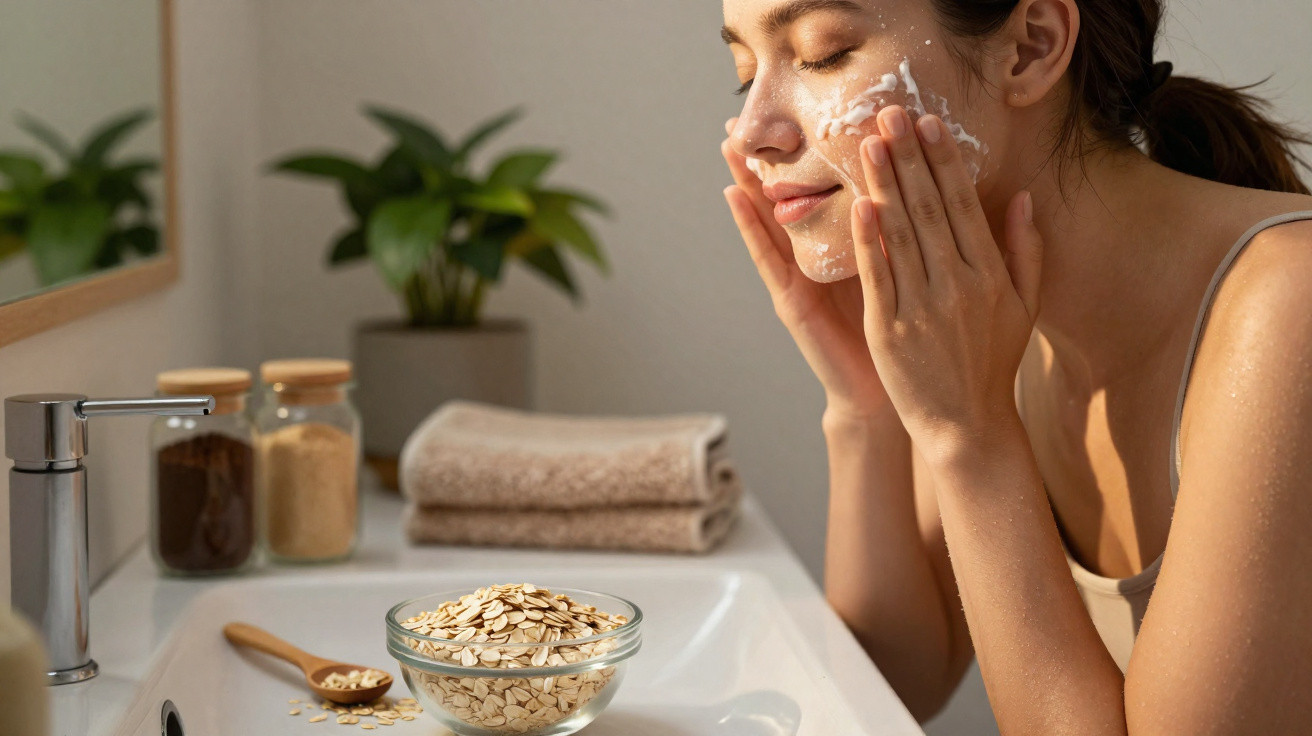
Oats are a familiar breakfast staple, but this ingredient can also play a useful part in a skincare routine. Prepared properly, they make a gentler homemade exfoliant that can lift surface residue without the roughness of sugar, salt or coffee – popular ingredients that may create excessive friction.
Why are oats gentler for exfoliation?
The key difference is largely down to their texture. Once ground into a fine powder, oats generally glide more smoothly across the skin and cause less friction than hard, uneven particles. This can make exfoliation feel more comfortable, particularly on areas that redden easily afterwards.
Oats also contain compounds linked to a soothing sensation and help create a creamy mixture when combined with water. However, being gentle does not mean it is risk-free: rubbing too firmly or using the treatment too often can still make skin sensitive.
How do you make a homemade oat exfoliant?
The simplest version requires no complex recipe. Use finely ground oats, then gradually add water until they form a soft paste. Apply the mixture using light movements without pressing on the skin, then rinse it away shortly afterwards with comfortably warm water.
- Grind the oats until they have a fine consistency, with no large or rough pieces.
- Combine a small amount with water to make a damp paste that spreads easily.
- Massage very gently for a short time, without trying to “scrape” or polish the skin.
- Rinse thoroughly, then apply a moisturiser suited to your skin type.
Making only the amount needed for immediate use is also the safer option. Water-based homemade mixtures do not contain preservatives designed to prevent contamination, so keeping leftovers for several days can turn a simple preparation into an unnecessary problem.
Why can sugar and coffee be harsh?
Sugar and salt crystals, along with coffee particles, may seem effective precisely because you can feel them during massage. The drawback is that this sense of “deep cleansing” may result from intense friction. On sensitive or already irritated skin, rubbing with coarse particles can increase discomfort, redness and dryness.
This is also a reminder that harsh exfoliation does not automatically produce better results. Skin does not need to sting, feel tight or become very red for skincare to have worked. A gentler approach often makes more sense than trying to achieve an extremely smooth surface in a matter of minutes.
Watch the video shared by the Helen Matias YouTube channel, which demonstrates how to exfoliate at home using oats.
Who needs to be more cautious with homemade recipes?
Skin affected by inflamed acne, wounds, irritation, dermatitis or sunburn needs particular care. In these circumstances, even a mixture regarded as mild can worsen discomfort. It is also best to avoid adding lemon, bicarbonate of soda, essential oils or other ingredients simply because they appear frequently in popular recipes.
Before applying any preparation across the face, it is sensible to test a small amount on a limited area and monitor the skin's reaction. If severe stinging, itching, swelling or persistent irritation occurs, stop using it and seek an assessment from a healthcare professional if necessary.
Gentleness can be more effective than force
The main lesson from oat exfoliation lies not only in the ingredient itself, but in a change of mindset: skincare does not require harshness. Gentle movements, infrequent use and attention to your body's signals can matter more than following recipes containing increasingly abrasive particles.
If your routine still relies on mixtures that leave your skin stinging or very red, it may be time to reconsider the habit. Replacing excessive friction with a gentler alternative can be a simple first step towards making daily skincare more mindful and comfortable.



Comments
No comments yet. Be the first to comment!
Leave a Comment