
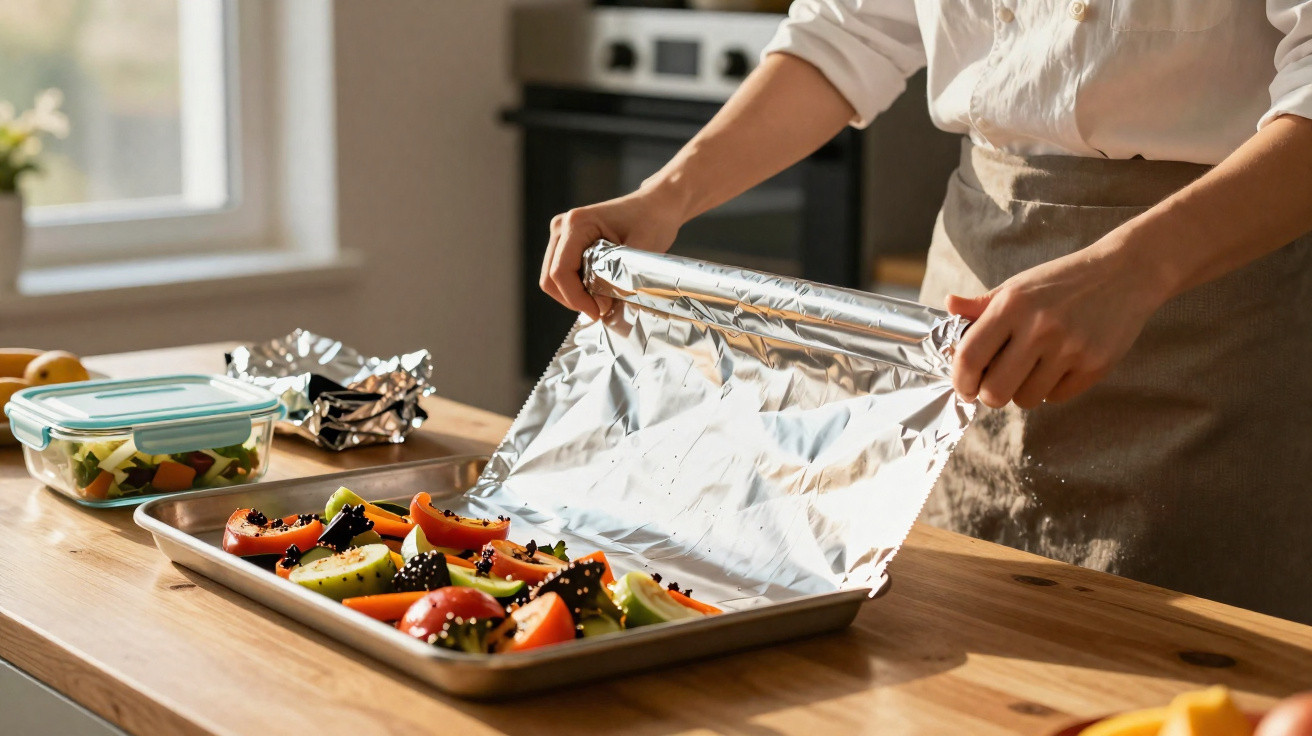
That ordinary roll in the kitchen drawer has uses beyond covering leftovers. Its glossy and matt faces differ in the way they handle heat, whether you are using it in the oven, the fridge or elsewhere around the house.
How aluminium foil actually works
Aluminium foil seems straightforward, even unremarkable: a thin silver sheet that can be torn off, scrunched up and discarded. At microscopic level, however, the two surfaces respond differently to heat and light. This can help food cook sooner, remain chilled longer or retain its temperature more effectively.
The manufacturing process behind its two sides
Manufacturers do not deliberately make one surface glossy and the other rough. The difference develops during the final stage of rolling. To make foil thin enough without it splitting, factories feed two layers of aluminium together through large polished rollers.
The face touching the rollers becomes smooth and shiny, with an almost mirror-like finish. The two inward-facing surfaces, which touch one another rather than the steel rollers, emerge matt. It involves no additional finish or special coating; it is simply a consequence of the metal-rolling process.
The shiny side reflects most heat radiation, while the dull side absorbs and transfers more of it.
This slight difference in texture affects how each surface responds to radiant heat. In everyday use, it can be more significant than expected.
Radiation, reflection and the importance of a few degrees
Heat is transferred in three ways: conduction, convection and radiation. Aluminium foil chiefly affects radiation. Its shiny face reflects roughly 80–90% of radiant heat, whereas its matt face reflects less and absorbs more, much like a dark T-shirt in sunshine.
At home, a difference of only a few degrees may determine whether lasagne arrives at the table steaming or merely lukewarm, and whether a packed lunch stays safely cool or moves into the bacterial danger zone. Choosing the appropriate side can alter that outcome, particularly when food is left for 30 minutes or longer.
Shiny side or dull side: the easy rule to remember
Treat aluminium foil as a manual thermostat operated with a turn of the wrist. The direction of its shiny surface determines whether heat is reflected away or retained.
| Goal | Which side faces out? | What happens |
|---|---|---|
| Keep food hot | Shiny side outward | Heat is reflected back towards the dish, slowing heat loss |
| Keep food cold | Shiny side outward | Foil reflects external warmth, helping maintain a lower temperature |
| Cook faster in the oven | Dull side outward | Dull surface absorbs oven heat and transfers it into the parcel |
| Stop the top from burning | Shiny side facing the food | Reflects intense grill heat away from the surface |
Keeping food cool: when the shiny side is your shield
Lunches, salads and leftovers
When wrapping chilled food, you are protecting it from the warmth of the room, your bag or a car seat in summer. With the glossy surface on the outside, foil reflects much of that incoming heat rather than allowing it to enter the food.
For cold food, shiny side out acts like a tiny heat mirror around whatever you wrap.
Wrap a salad, sandwich or cheese with the shiny side facing out and it will generally remain nearer its original temperature for longer, particularly when paired with a cool bag or ice pack. Foil alone cannot make a packed lunch function like a fridge, but it can slow down warming.
Inside the fridge, the effect is less pronounced but remains measurable over several hours. Leftovers wrapped with the shiny surface outward are less affected by repeated changes in air temperature as the door is opened. This helps the food’s surface temperature remain steadier, which is relevant for dairy-based dishes, cooked meat and creamy puddings.
Cooking with aluminium foil: when the dull side leads
Why dull side out speeds up foil parcels
In an oven, the objective is generally reversed: you want heat to enter the middle of the foil parcel. Fish cooked “en papillote”, whole garlic bulbs, beetroot and jacket potatoes all depend on consistent heat and trapped steam.
Positioning the dull face towards the heat source allows the outer surface to absorb more radiant heat from the oven walls and heating elements. That energy then passes through the thin aluminium and into the food more quickly.
- Foil parcel with dull side out: food cooks more evenly, centre reaches target temperature sooner.
- Foil parcel with shiny side out: slightly slower heating, which can help if you want gentler cooking.
Many chefs apply this approach almost without thinking when making baked potatoes. Potatoes wrapped dull-side out usually cook more consistently, producing fluffy centres and skins that are less likely to scorch quickly. It can also reduce cooking time slightly, saving energy across a winter of regular roasts.
Preventing food from burning under the grill
There is one instance in which the shiny side should point directly towards the food: when protecting delicate surfaces from a fierce grill or upper heating element. If a gratin, lasagne or roast chicken is browning too rapidly while the middle is still undercooked, place a loose foil tent over it with the shiny side facing the food. This reflects part of the intense radiation back towards the element.
The food will still cook through steam and conduction within the dish, while the cheese, breadcrumbs or skin on top can resist burning for longer. This provides more room for error and may save demanding Sunday roasts or festive dishes.
Common mistakes that undermine your efforts
Covering hot dishes with the dull side out
Many people take a bubbling dish from the oven, cover it with foil matt-side up and leave it on the table. As a result, the food cools towards room temperature faster than necessary.
For holding heat after cooking, shiny side should face the room, not the food.
With the shiny surface facing out, the foil reflects a substantial proportion of heat radiation back towards the dish instead of allowing it to escape. Food remains pleasant to eat for longer, which is useful when guests are late or the main course is waiting for slow starters.
Overlooking foil as a simple home-heating aid
The same reflective property can also support your home heating. A large piece of foil placed behind a radiator, shiny side facing the room, reflects heat that would otherwise be absorbed by the wall back into the living space. This is particularly useful on external walls in older properties with less effective insulation.
It is not a substitute for proper insulation, but it may increase the perceived temperature near cold walls by a few degrees and lessen the feeling of draughts when sitting near a radiator.
Beyond cooking: getting more from every sheet
Reusing foil: less waste, unchanged performance
Making aluminium requires considerable energy. Discarding foil that has seen only light use wastes more than a few pence. Sheets that are clean, or have touched only dry foods, can be washed in warm soapy water, dried flat and kept for a second or third use.
Many people save new foil for direct food contact, then maintain a separate folded pile of reused sheets for jobs including:
- covering oven dishes to prevent excessive browning
- lining baking trays to catch drips beneath casseroles
- serving as a temporary lid for saucepans away from the heat
This practice makes each roll last longer, reduces household waste and preserves the material’s thermal advantages.
A foil ball for polishing cutlery
Foil can also be reused in the dishwasher. A loose ball placed in the cutlery basket can react with the detergent and moisture around stainless steel. Through a mild redox reaction, it helps lift oxidation marks and dull streaks from forks and knives.
A simple foil ball in the dishwasher can nudge stained cutlery closer to its original shine without extra products.
It will not repair severely damaged items, but with everyday cutlery it can often create a noticeable improvement after a few cycles.
Health questions and when aluminium foil should be avoided
Is cooking with foil safe?
Food safety bodies in the UK, Europe and the US currently consider aluminium foil safe for routine cooking and storage. Small quantities of aluminium may transfer into food, particularly at high temperatures. For most healthy adults, these amounts remain well below levels linked with health concerns.
Certain combinations can increase this transfer, however. Highly salty or acidic foods, including tomato sauces, lemon marinades and heavily brined dishes, may draw more aluminium from foil, especially after long cooking periods or overnight storage.
To reduce this effect, many chefs advise three straightforward measures:
- use glass or ceramic for lengthy marinades containing citrus or vinegar
- avoid lining metal trays with foil for slow, salty roasts unless it is needed
- put baking paper between strongly acidic food and foil when they must remain in contact for hours
Using aluminium foil more intelligently: small everyday changes
Once you know how its two surfaces behave, every sheet of foil can be viewed as a small piece of thermal equipment rather than simple packaging. This could mean changing how you carry food on a summer train journey or how you keep a tray of roast vegetables at serving temperature during an extended family meal.
The same underlying physics applies to other household products. Survival blankets, radiator reflectors and insulated food-delivery bags all use reflective metal surfaces to redirect heat. Noticing which side of the foil faces heat sources in the kitchen brings you closer to using those professional tools, with nothing more than the roll already in your drawer.


Comments
No comments yet. Be the first to comment!
Leave a Comment