
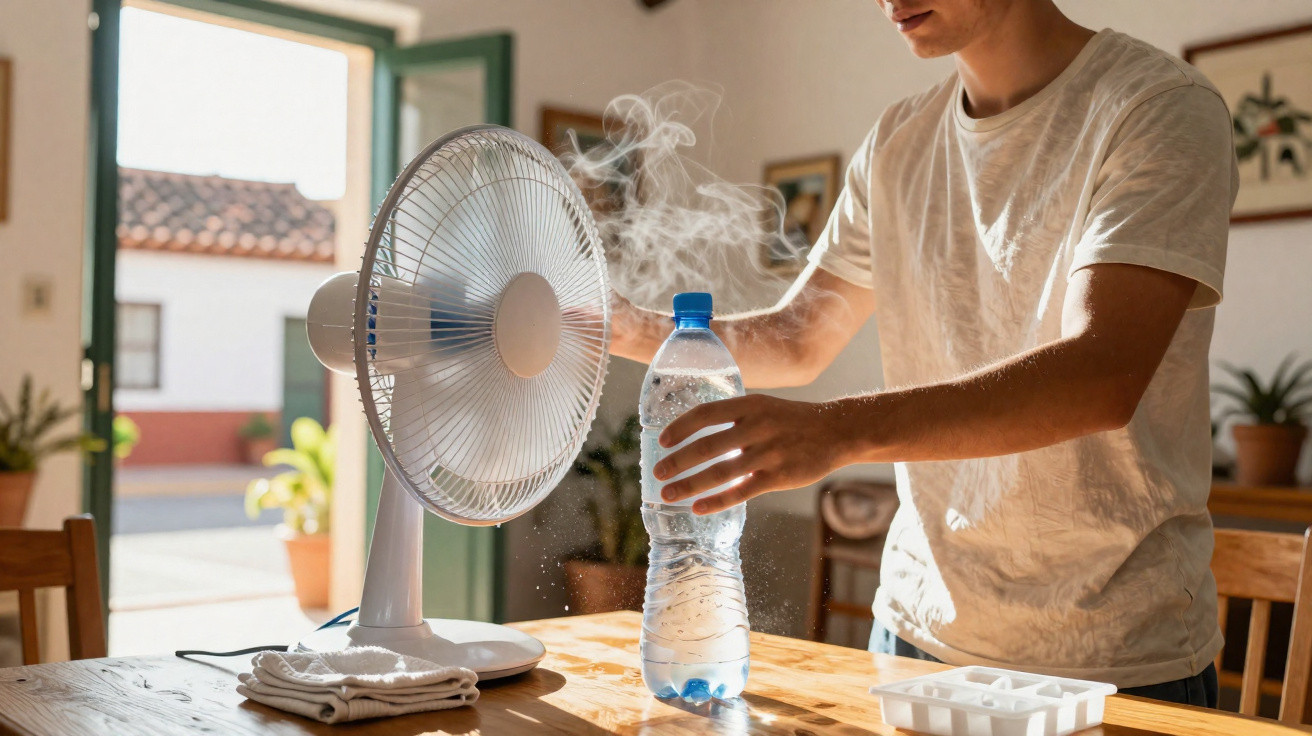
The fan is already running at full power, yet it is only shifting hot air around.
Outside, the road shimmers in the heat, cars crawl along more slowly than normal, and the neighbour opposite is watering her balcony plants for the third time today. Indoors, you have draped damp towels over chairs, shut half the shutters, opened the rest, and are now searching for a “cheap AC unit” with mounting desperation.
You glance at the tab showing your energy bill, then close it immediately. The figures no longer seem believable. Then a video appears on social media: a Spanish grandmother calmly wraps a water bottle in a tea towel and places it in front of a fan. Commenters say it has rescued their summer.
You watch it again. The idea seems almost absurdly easy. Naturally, that is precisely what makes it compelling.
Why Spain is quietly obsessed with low-tech cooling hacks
Spend a July afternoon in Seville or Valencia and it becomes immediately clear why residents have developed a whole set of ways to endure the heat without air conditioning. The air feels dense, as though it has substance. Streets clear after lunch, shutters are lowered and the city quietens almost to a murmur. Behind those closed blinds, though, people still cook, work, study and sleep.
Not every household has air conditioning. Many families depend on fans, thick walls and techniques handed down much like family recipes. The frozen water bottle method is one of them. It is not stylish and does not arrive in premium packaging, but it travels quickly because it works well enough to alter the feel of a room.
In Madrid and Barcelona, small signs tell the same story: bottles lined up in freezers beside bags of ice, ageing fans repaired rather than discarded, and neighbours exchanging advice in stairwells about when windows should be opened and when everything should be sealed tight. It is an ecosystem of small adjustments. From a distance, it may look like improvisation. For those living it, it is practical survival.
There is also a financial reality that goes beyond lifestyle preferences. Spain has experienced soaring energy costs and prolonged heatwaves in the same season. Families already monitoring every euro cannot simply “turn on the AC” as an Instagram reel might suggest. Low-tech methods therefore carry a different significance: they are not Pinterest tricks, but part of managing the monthly household budget.
Architecturally, plenty of Spanish homes offer some help through thick stone walls, small windows and cross-ventilation. Yet top-floor flats, modern glass towers and student bedrooms beneath the roof become ovens by late afternoon. That is where the water bottle trick comes in. It does not transform your home, but it can create a five-degree change where you are sitting. On some nights, that is the difference between sleeping and staring at the ceiling until 3 a.m.
The Spanish water bottle trick, step by step
At heart, this is an almost disarmingly straightforward method: place frozen water bottles in front of a fan to act as small cold batteries. Take one or two robust plastic bottles, fill them nearly to the top and leave enough space for expanding ice. Put them in the freezer until they are completely solid. No specialist equipment or clever app is needed, only water and time.
When the bottles are frozen, place them on a tray or in a shallow bowl directly in front of the fan. Air moves across their cold surface, taking on cooler, slightly moist air before blowing towards you. Sit in that airflow and the difference is instantly noticeable on your skin. It is not Arctic cold, but it feels distinctly gentler and less harsh.
Distance and positioning matter. In many Spanish homes, the bottles are set around 10–20 cm from the fan grille rather than pushed up against it. Some people cover them with a thin cloth, which can make the cold last a little longer while preventing condensation from reaching the floor. At a desk, position the fan and bottles at leg height so cooler air moves upwards over your body. It is essentially a portable breeze built on a shoestring.
In theory, it can sound almost childish. In practice, it occupies an ideal space between the effort required and the result. A student in Granada began using it during an especially punishing revision period. Her room was tiny, beneath a sloping roof, without air conditioning, and her fan largely circulated warm air. Having seen the method online, she tested it using two 1.5-litre bottles.
She did not use a sensor to check the temperature; she simply noticed what her body was telling her. Her laptop no longer overheated as quickly. After an hour, her thighs were not sticking to the chair. She could revise beyond lunchtime without becoming dizzy. When her flatmate returned from work, her first words were: “Why is it less suffocating in here?” That evening, they froze every spare bottle available.
Research into DIY cooling arrangements points to a similar outcome. One frozen bottle will not turn a 32°C room into a fresh 22°C lounge. Instead, it can provide roughly a 2–4°C perceived cooling effect exactly where the airflow reaches you. That may appear minor on a graph, but the body experiences it very differently. Sleep researchers say that even a small reduction in skin temperature may help you fall asleep sooner and remain asleep for longer.
Let us be honest: nobody really does this every day of the year. However, on peak heatwave days, when a fan by itself feels pointless and air conditioning seems like a luxury that will cost you all winter, the bottle method occupies a genuinely useful middle ground. It costs almost nothing, can be scaled up easily with more bottles and can be used wherever you happen to be: beside the sofa, at the kitchen table or next to the bed.
How to make the Spanish water bottle trick work for you
The effectiveness lies in the finer details. Begin with the bottles: choose 1–2 litre plastic bottles rather than smaller ones. Thin plastic freezes quickly and gives off cold at a steady pace. Fill them to about 90%, leaving space at the top so expanding ice does not distort or split the bottle. If you have a chest freezer or generous freezer space, maintain a rotation of 3–6 bottles.
Positioning makes a substantial difference. Angle the fan slightly upwards so that cool air rises rather than blowing directly at your knees before fading away. In bedrooms, many Spaniards place the fan and bottles at the foot of the bed, allowing the airflow to travel along the mattress. Some even make a basic channel with a sheet or lightweight blanket to direct the breeze. It may be DIY engineering, but it can feel surprisingly purposeful.
A few small errors can quietly ruin the result. The fan may be positioned too far from where you are sitting. You may use bottles at room temperature because the frozen ones “aren’t ready yet”. Or you might forget to close shutters facing the sun in the afternoon, allowing the room to warm faster than the bottles can cool the air. On a difficult day, that can feel less like poor set-up and more like defeat.
On a personal level, frustration belongs to this experience. You test something new because the heat is exhausting you. If it does not instantly turn your flat into an icebox, it is tempting to write it off. Many Spaniards would make the same point: see the bottle trick as one tool among several, rather than a miraculous gadget. That mindset tempers expectations and, oddly, can make the method seem more effective.
“You learn to think like your grandparents,” laughs Ana, 42, from Málaga. “You close the house in the morning, you move to the coolest room, you freeze the bottles, you accept that summer changes how you live. The trick isn’t just the bottle. It’s the mentality.”
That mentality leads to other small habits that gradually add up:
- Run the fan with frozen bottles only in the room you are using, rather than trying to cool the whole house.
- Pair it with a slightly damp T-shirt or light cotton sheet for a stronger sensation of coolness.
- Freeze bottles overnight, then replace them in late afternoon when temperatures reach their peak.
- Keep electronics away from the airflow, so the cooling benefits your skin rather than your router.
- Open windows only when it is cooler outside than indoors, typically late at night or early in the morning.
These are not fixed rules. They are closer to notes from people who have spent enough summers in 35°C living rooms to understand what genuinely changes the feel of the day. The Spanish water bottle trick is simply the visible part of a broader principle: reduce heat where your body is, limit what worsens it and accept that comfort can sometimes mean improvisation rather than perfection.
A different way to think about comfort in a warming world
Once you begin using low-tech methods like these, a subtle change occurs: you stop expecting a room to be flawless and start recognising what feels “good enough” to your own body. Comfort becomes a more adaptable idea. It is less about achieving a fixed thermostat reading and more about reaching a temperature at which you can read, talk, cook and sleep without feeling completely drained.
That approach spreads. You mention it to friends. Someone in London tries the bottle trick during an unexpected hot spell. Someone in Berlin pairs it with a homemade cardboard wind tunnel. Your cousin in a small town with unreliable power cuts freezes metal lunch boxes because they remain cold for longer. None of these solutions fixes climate change. Yet they can create a sense of agency during summers that seem more hostile each year.
We have all had the moment of lying on the floor because it is the only remaining cool surface, wondering how we are meant to function like this for weeks. Methods such as the Spanish water bottle trick do not remove that reality. They offer something more modest, and arguably more useful: they make the next hour manageable, then the hour after that.
As heatwaves become more frequent, perhaps the smartest response is not solely to pursue larger air-conditioning units, but also to gather small, repeatable actions that cost almost nothing and spread quickly from one household to another. A frozen bottle. A fan you already own. A little curiosity. It is not a grand solution, merely the quiet, practical kind of resilience that often matters more than expected.
| Key point | Detail | Benefit for the reader |
|---|---|---|
| The basic hack | Frozen water bottles placed in front of a fan produce cooler airflow | Offers an inexpensive, quick way to ease heat without air conditioning |
| How to optimise it | Use 1–2 litre bottles, the right distance and a sensible room layout | Maximises the cooling effect using items you already own |
| Mindset shift | Treat it as one tool among several low-tech habits | Helps create realistic, sustainable heatwave routines |
FAQ:
- Does the Spanish water bottle trick really work? It will not make your home ice-cold, but it can noticeably cool the air from a fan and make a hot room more manageable where you are sitting or sleeping.
- How many bottles do I need for a small room? For a bedroom or office, one or two 1–2 litre bottles in front of a medium fan will usually be enough for you to notice a difference in the breeze.
- How long will the frozen bottles stay cold? Depending on the room temperature and bottle size, expect 2–4 hours of useful cooling before most of the ice has melted and the bottles need replacing.
- Is it cheaper than running air conditioning? Yes: you are only powering a fan and freezing water, both of which consume far less electricity than a typical AC unit over the same period.
- Can I use anything other than plastic bottles? Many people also use stainless-steel bottles or metal containers, which may stay cold for longer, provided they are leak-proof and safe to freeze.

Comments
No comments yet. Be the first to comment!
Leave a Comment