
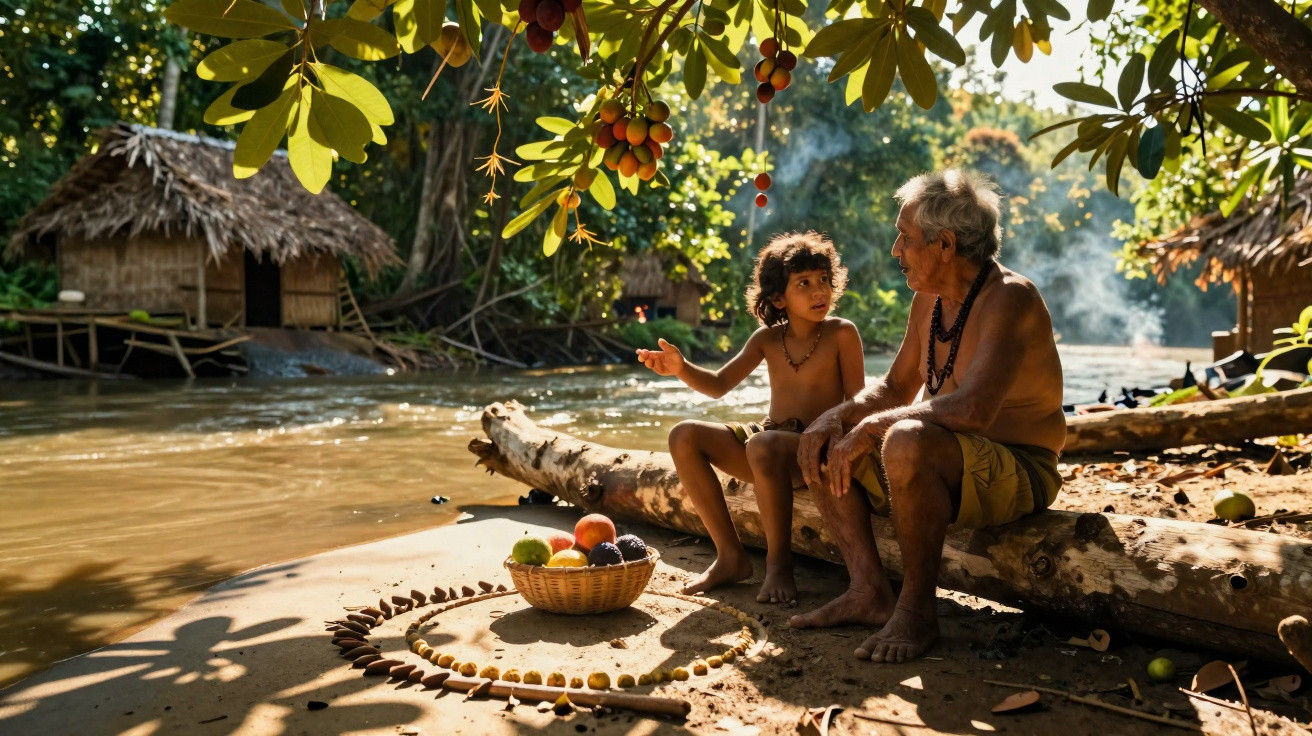
Human routines are generally organised around clocks and precise numerical divisions across much of the world. Yet the rich culture of Indigenous peoples shows that there are fascinating ways to understand reality, turning natural events into essential reference points for community life.
How do the Amondawa understand the passage of time without calendars?
The Amondawa community, whose customs are remarkable, lives in the Uru-Eu-Wau-Wau Indigenous Territory in the state of Rondônia. The linguistic structure of this group does not use abstract ideas of weeks, months or years. Instead, collective memories are arranged around striking events and ecological changes noticed in everyday life.
This lack of metric counting does not suggest any cognitive difficulty in recognising the body’s natural ageing process. On the contrary, community members identify intervals between environmental phenomena with great accuracy, revealing a deep awareness of the uninterrupted flow of periods experienced by their society.
How does using physical calendars affect the brain?
Writing appointments in paper diaries activates particular neural connections and changes the way memories are processed… Read more
Why does this community’s language not formally divide the year?
As part of the Kawahiva linguistic family, the Amondawa language has distinctive features that challenge conventional concepts in modern linguistics. Its local vocabulary contains no equivalent terms for fixed units of chronological measurement, favouring living narratives that connect the community harmoniously with its ancestral territory.
Rather than splitting days into abstract hours, the community makes direct connections with the land’s practical cycles. Everyday conversations refer to concrete moments in communal life, ensuring a complete understanding of the sequence of events without relying on rigid mathematical systems or charts.
Below is a video from the Timely YouTube channel that explores the points discussed in this topic in greater depth:
How do stages of life shape identities?
Among Indigenous people, age is not determined by the numerical accumulation of birthdays celebrated in each solar cycle. When someone reaches a new stage of social development, they take on a new name, clearly reflecting their current role within the community dynamic.
This practice safeguards generational memory while reinforcing emotional bonds among the village’s young people, adults and elders. The former name is passed on to younger relatives, establishing a continuous process of cultural transmission that values each person’s individual journey within the group.
Features of Amondawa temporal organisation
Main cultural pillars
Elements that shape everyday community life:
- Names change in line with life cycles;
- Events are directly associated with daily intervals;
- There is no numerical count for chronological age.
Which practical references guide everyday life in this culture?
Daily life in the forest follows patterns arising from the ecosystem’s own dynamics and from the productive tasks carried out by residents. Activities such as hunting, planting and harvesting create functional intervals, removing the need for artificial markers to manage duties with complete harmony and collective efficiency.
In this way, historical events and oral narratives provide crucial reference points for placing past experiences within the shared imagination. Social life is guided by the real meaning of lived moments, giving value to the present and to memories shared by every family.
Several central elements illustrate this practical organisation of everyday events:
- Observing weather changes and dry periods;
- Holding community celebrations at particular times;
- Carrying out agricultural work according to the region’s climate.
What does this perspective reveal about linguistic diversity?
Research into this ethnic group shows that human cognitive categories are not standardised across all existing societies. Brazil’s linguistic diversity demonstrates how the mind can conceive the world through new models, enriching the cultural heritage of all humanity.
Understanding these particularities makes it possible to move beyond ethnocentric perspectives and appreciate Indigenous peoples’ knowledge with respect and admiration. By recognising these different forms of expression, society learns to celebrate the remarkable richness of human thought and its boundless plurality.






Comments
No comments yet. Be the first to comment!
Leave a Comment