
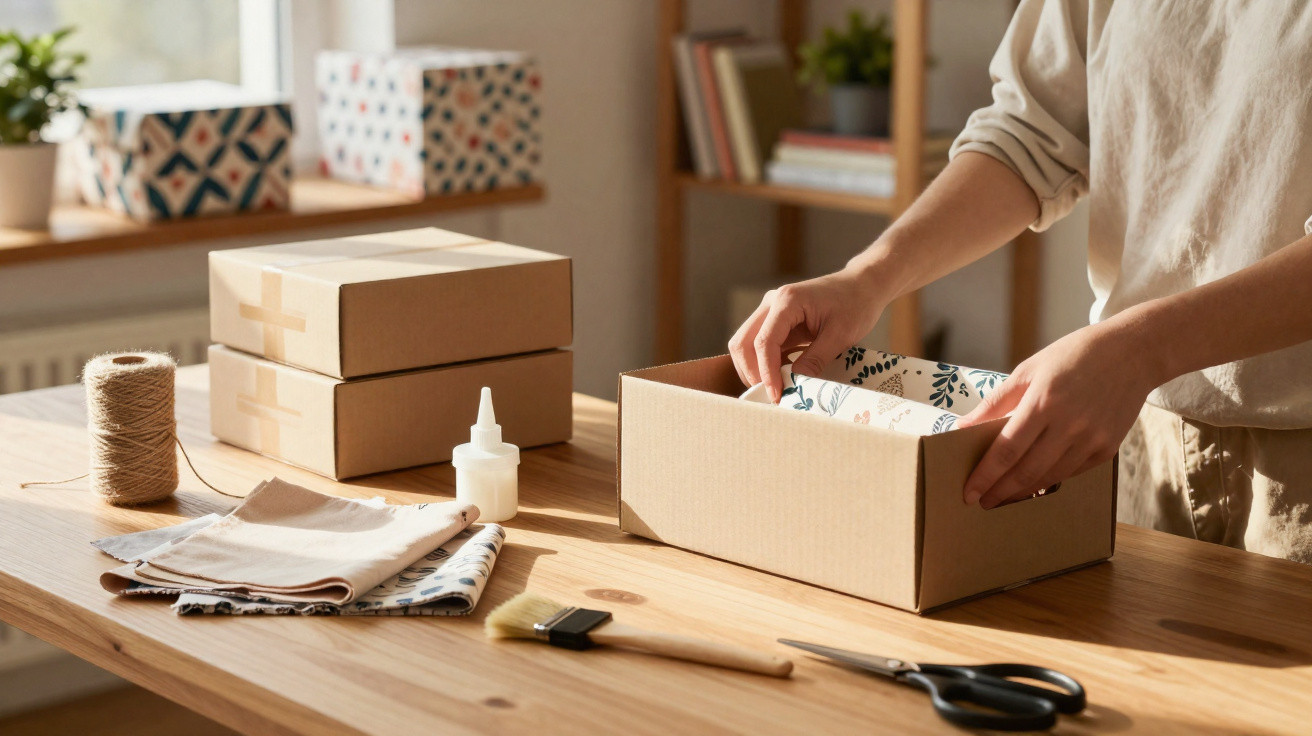
Many households pile up delivery boxes in the hallway and keep old fabrics in the linen cupboard because “they might come in handy”. Most eventually end up in the bin anyway. This is exactly where a simple idea comes in: with a few cuts, some glue and suitable fabric, a plain brown box can become a decorative container that looks as though it came from an expensive concept store.
Why cardboard upcycling makes so much sense now
The pressure to create less waste is growing. The United Nations has warned for years about rapidly rising volumes of plastic. According to current OECD figures, global plastics production could increase by around 70 per cent by 2040. Only a tiny proportion of this comes from recycled materials.
Anyone who creatively reuses cardboard boxes and fabric offcuts at home eases the burden on both the wheelie bin and their budget – while directly reducing their share of plastic décor.
Rather than buying new plastic baskets, organisers and boxes, there is an obvious alternative: use what is already available. Upcycling – giving supposed waste a higher-value purpose – has long been more than a hipster trend. It is becoming an everyday tool: fewer new purchases, less plastic and more individuality.
From cardboard to design: the idea behind the fabric box
The principle is straightforward: a flat piece of cardboard, a hard-wearing piece of fabric and glue. Together, they create a small basket or box shaped rather like a bread or bread-roll basket. The fabric you choose determines its appearance, whether rustic, minimalist, playful or boho.
Common fabric options include:
- Cotton, such as old bed linen, pillowcases or tea towels
- Linen from tablecloths or napkins
- Jute or coarse natural fibres for a rustic appearance
- Patterned shirts or blouses for colourful accents
This means every box looks different, with no piece resembling a mass-produced item.
Step-by-step guide: how to make your fabric box
Materials that almost everyone has at home
- 1 sturdy cardboard box, such as a delivery box
- Fabric offcuts large enough for the project
- Scissors or a craft knife
- Glue, such as craft glue, wood glue or hot glue
- Optional: cord, ribbon or wide gift ribbon
- A ruler and pencil for neat edges
Making the box in just a few steps
- Prepare the cardboard: Cut a rectangle from the cardboard to the size you want your finished box to be. A larger rectangle creates a larger basket.
- Cut out the corners: Remove a small square from each corner. The width of these squares will become the height of the box.
- Fold up the sides: Turn the sides upwards to form a shallow box with open corners.
- Cover the outside: Place the fabric face down on the table, position the cardboard centrally on top, then glue the fabric tightly around the outer sides. Fold the excess fabric inwards and secure it with glue.
- Finish the inside: Use the same fabric again for the interior, or choose a contrasting fabric. This gives the basket a more refined look.
- Secure the corners: Use a hole punch, or carefully use scissors, to make one hole in each corner. Thread cord through the holes and tie it together; this pulls the sides upwards and gives the box its stable shape.
The cord trick at the corners makes the once-flat cardboard look like a finished product from a homeware shop.
Everyday uses for the new fabric box
The completed box is not simply something to gather dust; it is a genuinely useful household workhorse. It can serve a practical purpose in almost any room.
| Room | Possible use |
|---|---|
| Kitchen | Bread and bread-roll basket, tea bags, napkins, snack area |
| Hallway | Keys, wallet, sunglasses, post |
| Bathroom | Cosmetics, cotton pads, hair ties, razors |
| Bedroom | Jewellery, watches, reading glasses, remote control |
| Children’s room | Pens, small toy figures, trading cards |
| Home office | Pens, note paper, cables, chargers |
Depending on their size and fabric pattern, the boxes can suit a range of interior styles. Understated linen feels clean and Scandinavian, colourful checks are more country-inspired, while dark denim has a more urban character.
How upcycling changes the way you view household items
Once you start turning cardboard boxes into decorative organisers, you begin to see everyday leftovers differently. An old men’s shirt suddenly looks like a potential source of fabric. A stained tablecloth may still be perfectly suitable for lining the inside of a box. Even leftover wrapping paper can be used in small areas, for example for labels or little appliqué details.
It also subtly changes attitudes towards shopping. When looking at inexpensive plastic boxes in the shops, a question arises: do I really need this, or is the raw material already at home?
Every box made by hand replaces a product that would otherwise need to be manufactured, packaged, transported and eventually thrown away.
What can go wrong while crafting – and how to avoid it
The project does not always run without a few pitfalls. Common issues include:
- The fabric develops creases: The glue was applied too thickly, or the fabric was not pulled tight enough. The solution is to glue in thin strips and smooth the fabric repeatedly as you go.
- The cardboard becomes soft or wavy: The cardboard is too thin, or the glue contains too much moisture. Use the sturdiest boxes possible and keep them dry before covering them.
- The box becomes misshapen: The corner squares were cut in different sizes. Measure with a ruler beforehand rather than cutting by eye.
- The cord tears through: The holes were made too close to the edge. Leave a little more distance, or reinforce the hole on the inside with a small piece of tape.
If children are joining in, it is best to use ordinary craft glue instead of hot glue and to cut the cardboard pieces yourself.
Why this simple cardboard upcycling idea is more than décor
There is more behind the fabric box than a pleasant afternoon with scissors and glue. It represents a different approach to resources. Industry has long been experimenting with upcycled textiles, circular plastics processing and new business models. At home, the same principle can be imitated on a small scale, without machinery or an app, using only items from your own cupboard.
Anyone who makes projects like this regularly can gradually create a personalised organisation system: boxes for winter accessories, containers for Christmas decorations and baskets for charging cables. Everything works together visually because the fabrics and colours are coordinated, yet every item still has its own story.
One aspect is often underestimated: handmade storage solutions lower the barrier to keeping things tidy. You use and care for something you have made yourself more consciously. An old cardboard box therefore becomes a small everyday project that combines style, sustainability and practical function in one.

Comments
No comments yet. Be the first to comment!
Leave a Comment