
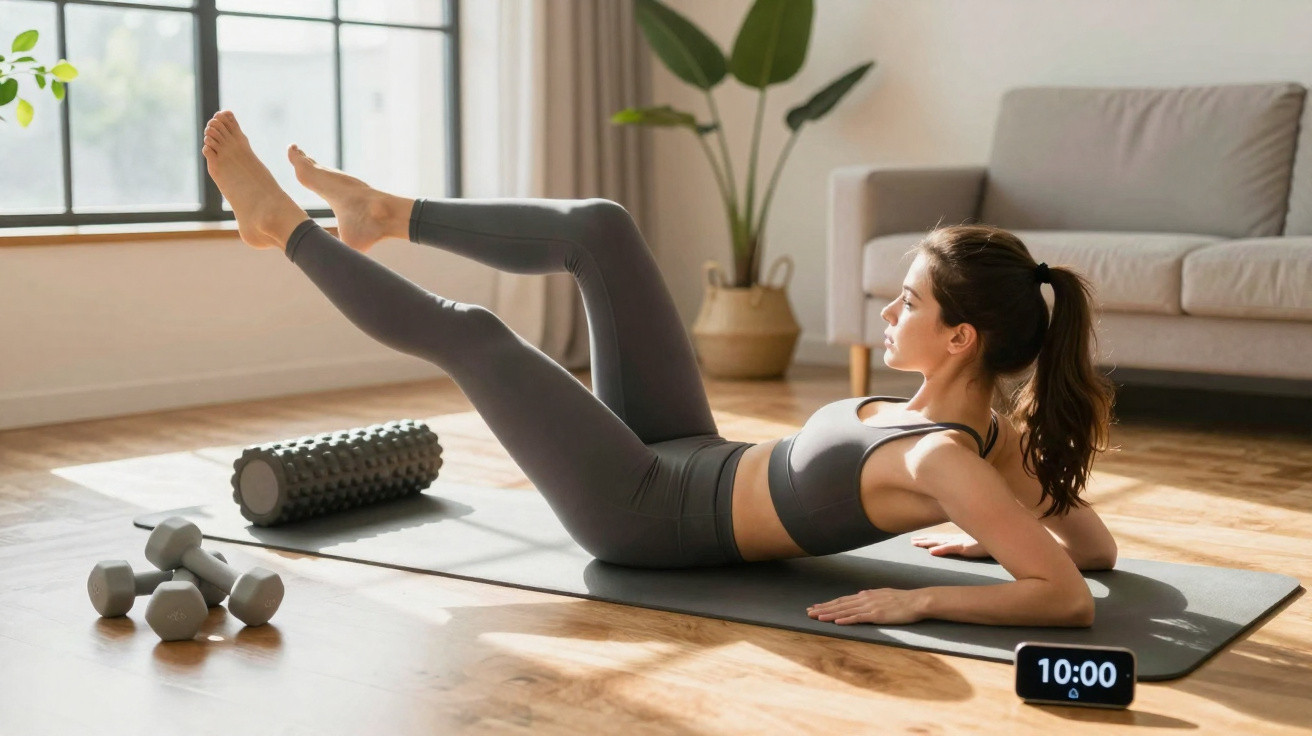
Many people struggle through traditional crunches and then wonder why nothing changes around the lower abdomen. This is often where the so-called “problem area” sits, responding mockingly to quick fixes. A short Pilates-inspired training plan targets this exact area, using controlled movements that challenge the deep core muscles and specifically shape the lower abdomen.
Why the lower abdomen is so stubborn
The area below the navel is considered one of the most persistent zones on the body. Fat often accumulates there, while conventional sit-ups only engage this area to a limited extent. The reason is anatomical: the lower abdomen is strongly affected by deep-lying muscles and pelvic positioning.
Anyone who simply rushes through exercises with poor form, performing frantic abdominal movements, will usually feel the effort in the hip flexors or neck rather than in the muscles that should actually be doing the work. This is precisely where the 10-minute plan comes in: slow, focused and with constant muscular tension.
What matters is not how spectacular an exercise looks, but how consistently the lower abdomen and deep muscles are working.
How the 10-minute lower-abdomen plan works
The training plan includes ten exercises, performed one after another. Each sequence lasts 45 seconds, followed by a 15-second rest. Begin on an exercise mat or carpet, either barefoot or in non-slip socks.
- 45 seconds of work for each exercise
- 15 seconds of rest to catch your breath and change position
- a calm pace, complete control and no jerking
- focus on the lower abdomen and a stable lumbar spine
If you are a complete beginner, you can make the start easier: work for 30 seconds and rest for 30 seconds. Over time, build up to the full programme.
An overview of the ten exercises
1. Lowering the knees while lying on your back
Lie on your back with your legs bent, feet together and knees slightly opened outwards. From this position, slowly lower your legs towards the floor before bringing them back up. Keep your lower back firmly against the floor throughout.
2. Extending the legs and lifting the pelvis
While lying on your back, alternately extend one leg just above the floor and gently raise the pelvis. Keep the movement small and calm; the effort should come from your core rather than momentum.
3. Lowering and extending one leg
Lie on your back with your abdominal muscles engaged. Lower one leg in a controlled way, then lift it back up straight. Your back should remain fully in contact with the mat.
4. Upper-body pulses in a seated position
Sit with bent legs, lean your upper body back slightly and make small pulses forwards and backwards. Keep your shoulders low, gently draw the shoulder blades together and brace your abdomen; do not return fully upright into a seated position.
5. Leaning the upper body back while extending the legs apart
From the seated position, extend your legs into a slight V shape as you lean your upper body back. Put as little weight as possible through your heels, with the core maintaining the tension.
6. Large vertical scissor movement
Lie on your back and support your upper body on your forearms. Move your legs up and down in a wide scissor action. Keep your back long, your neck relaxed and your heels off the floor.
7. Extending the legs to 45 degrees and opening the thighs
Still supported on your forearms, extend both legs forwards at roughly 45 degrees, open the thighs out to the sides and bring them back together. Keep the pelvis still and do not allow the lower back to arch.
8. Alternating leg extensions just above the floor
Lie on your back with your head slightly raised. Alternately extend your legs forwards just above the floor. For an easier option, bend the knee as you draw the leg back in. In the harder variation, keep both legs straight the entire time.
9. Alternating pelvic lifts with lowered legs
Combine lifting the pelvis with lowering your bent legs. Perform every movement slowly and with control, without using momentum.
10. Horizontal scissors with leg lifts
To finish, perform sideways scissor movements while moving the legs up and down at the same time. Keep the lower back firmly pressed into the floor; this is the key point in the final exercise.
Technique before speed: getting the most from 10 minutes
Perhaps the most important point is to breathe steadily rather than holding your breath. Tighten your abdominal muscles more firmly as you exhale, then ease the tension slightly as you inhale without letting it go completely.
Slow, precise repetitions shape the lower abdomen more effectively than frantic marathon sets.
Avoid all jerky movements. As soon as you notice that you are beginning to swing or “yank” through the exercise, reduce the range of movement or switch to the easier version. Your lower abdomen should burn, but your neck and lower back should never hurt.
How often should you do the plan?
Three sessions a week are generally a good guideline. Ideally, leave a rest day between sessions so that the muscles can adapt and return stronger. For example:
| Day | Recommendation |
|---|---|
| Monday | 10-minute lower-abdomen workout |
| Tuesday | Rest or gentle walking/cycling |
| Wednesday | 10-minute lower-abdomen workout |
| Thursday | Recovery, stretching, gentle walk |
| Friday | 10-minute lower-abdomen workout |
| Weekend | Movement as you like: hiking, swimming, walking |
What the plan can do – and what it cannot
This workout primarily shapes and strengthens muscle. Abdominal training alone does not specifically burn fat from the stomach. You will first notice the visible effect as better posture, a more stable core and a firmer feeling in everyday life. Visible definition appears when two factors come together:
- regular strength and core training
- a moderate calorie deficit and a balanced diet
Put simply: the exercises shape the muscles, while nutrition and general activity reduce the layer of fat above them. People who address both factors usually see their first clear changes after a few weeks.
Common mistakes – and how to avoid them
1. An arched lower back while lying down
As soon as the lower back arches, the lower abdomen loses tension and the lumbar spine takes over. Tip: imagine drawing your navel towards your spine and gently “pressing” your lower back into the mat.
2. Working from the neck
During exercises with the head lifted, many people shift the tension into their neck. Briefly place one hand at the back of your head and notice whether you are pulling. Keep your gaze slightly upwards rather than looking directly at your knees.
3. Too much ambition, too little control
Starting too quickly causes technique to deteriorate. When it becomes difficult, reduce the range of movement instead of continuing wildly. Quality beats quantity, especially when training the core.
Why Pilates-inspired exercises are so effective
Pilates has always focused on controlled movement, precise breathing and activation of the deep muscle layers. These muscles stabilise the pelvis, lumbar spine and abdominal wall. When they are trained well, the benefits go beyond appearance:
- everyday movements such as lifting, carrying and climbing stairs become easier
- many people experience less back pain
- sports such as running, tennis and strength training become more efficient
Sedentary jobs in particular weaken the deep core muscles. A short, focused lower-abdomen block can provide a counterbalance, without requiring much time but still offering a clear structure.
How to combine the lower-abdomen plan wisely
You can achieve even better results by combining the 10-minute programme with other elements. Here are two practical examples:
- Cardio days: 30 minutes of brisk walking, easy jogging or cycling can reduce body fat percentage.
- Full-body strength training: squats, lunges, press-ups or rowing movements build additional muscle, which in turn raises the basal metabolic rate.
After just a few weeks, many people notice not only that their abdomen looks more defined, but also that they feel more stable and “upright”. Those who stick with it can turn ten minutes of lower-abdomen focus into a lasting mini ritual – and that is what ultimately delivers the greatest progress.






Comments
No comments yet. Be the first to comment!
Leave a Comment