
A backpack lies half-open on a chair, yesterday’s post sits in a weary heap, and your keys have been banished to an unknown location. Your coffee mug weaves between crumbs and a laptop cable as your mind repeats one familiar line: “I’ll deal with it later.”
“Later” turns into this evening, then the weekend, then “when things calm down”. The problem is that life never truly settles down. Meanwhile, every misplaced item becomes another small alert in your mind. Your to-do list is no longer confined to paper; it is spread across everything you can see.
Yet one modest change can alter the whole picture. It is not about tidying more often or trying harder. It is about organising your home in a particular sequence that can quietly move your brain out of survival mode.
The hidden connection between your home, your brain and your to-do list
Think about arriving at a hotel room at 10 p.m. after a long journey. The bed is uncluttered, most surfaces are bare, and the bathroom is straightforward. Without consciously choosing to, your shoulders relax. That is not simply luxury; it is low cognitive load.
Home can feel entirely different. Every pile and unfinished area presents a question requiring an answer: “Where does this go?” “Should I keep this?” “Why is this here?” Your brain is not lazy; it is overloaded. Each choice consumes attention, the same resource needed for work, relationships and creativity.
There is a reason motivation vanishes when you look around a room. You are not putting things off because you are weak. You are postponing them because your surroundings continually demand that you decide, sort, prioritise and remember. This draws on executive function, which is limited. When clutter uses it up, little remains for the rest of your life.
A study into visual clutter and stress found that people in untidy settings had higher cortisol levels than those in orderly environments. You do not need to read the research to recognise the feeling. Open your laptop at a clear table, then compare it with working at one covered in unrelated objects. The task has not changed, but your brain’s starting point has.
Extend that principle to your whole home. When every room contains “stuff I’ll figure out later”, you are living with a constant background hum of tiny decisions. This is the mental load people often discuss, and it does not come only from children, work or family. It also comes from acting as the project manager of your physical environment around the clock.
Here is the important part: the order in which you organise your home can either increase that noise or gradually reduce it. Many people begin in the least helpful place. They tackle sentimental belongings or deep storage first, where every decision carries weight, and quickly run out of energy. The home then remains caught between disorder and “someday”.
There is a simpler path: surfaces → entry points → daily-use zones → storage → sentimental. It may sound almost too straightforward. However, this precise order can free up your mind, reduce mental load and loosen procrastination’s hold-not only this weekend, but for years.
The home organising order that changes everything (and why it works)
Begin with the areas your eyes meet first: flat, visible surfaces. That means kitchen worktops, the coffee table, bedside tables and the tops of chests of drawers. These are your home’s billboards. When they are crowded, your mind feels crowded too. Clear them before opening a drawer or cupboard. Do not try to “organise” yet. Remove anything that does not belong, then give each remaining item an obvious, sensible home.
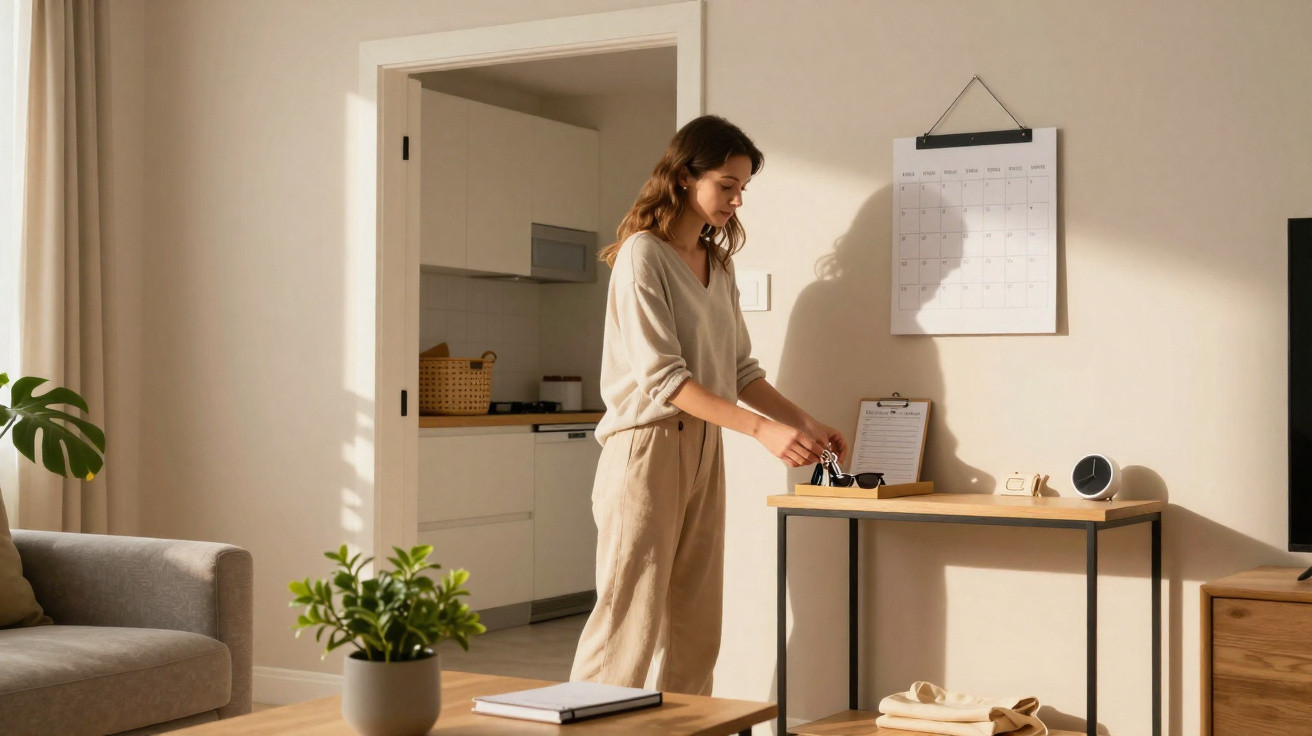
After the surfaces are under control, turn to entry points. Consider the space by the front door, the chair that collects bags and the place where post ends up. Your day starts and finishes here, so disorder in these areas can make you feel behind before the day has properly begun or ended. Use one hook for each bag, one tray for keys and one upright file for post. You do not need thirty products-just three clear purposes.
Next, focus on daily-use zones: the coffee area, the space around the bathroom sink, where you set down your laptop and where you get dressed on most mornings. These places are your routines made physical. Every item should justify being there because you use it every day, or nearly every day. If it does not, move it elsewhere. This is not merely decluttering; it is creating smooth routes for your future self.
One reader told me that she began by emptying a storage cupboard “to finally get it done.” For hours, she weighed up old ski equipment, neglected craft materials and boxes filled with unknown contents. By the end, she was drained, the hallway looked worse, and the rest of the flat had not been touched. It was a classic trap.
Another reader did the reverse and started with only her kitchen worktop. She decided that daily-use items could remain there, while everything else had to be moved or removed. It took 45 minutes. The following morning, she made coffee on an uncluttered surface for the first time in months. That small success prompted her to deal with the pile of shoes by the door that evening.
Action leads to more action, but only when the first task is easy enough to complete. That is why this sequence is so useful. Visible surfaces create quick wins. Entry points prevent future disorder. Daily-use zones make existing habits easier. Once you eventually reach cupboards and sentimental possessions, your brain has evidence that change can happen. You are not trying to organise “everything”; you are moving along a route where each stage makes the next feel lighter.
There is also a cognitive reason to leave storage and sentimental items until later. Storage is packed with “someday” and “I might need this”. Sentimental possessions are tied to memory and identity. Both groups can trigger decision fatigue at remarkable speed. Starting with them exhausts motivation before you have seen a worthwhile result. In this order, however, everyday life is already easier by the time you reach them, making it less difficult to say, “No, I don’t actually need this.”
How to use the sequence room by room without burning out
Choose a single room and work through it in this order: surfaces, entry point, daily-use zone. In the living room, that could mean dealing with the coffee table and TV unit first, then the area where bags are dropped, followed by the sofa space where you work or unwind. In a bedroom, begin with the top of the chest of drawers and bedside table, move to the doorway or chair, and then address the side of the bed where your morning begins.
For every surface, follow a three-part mini-method: clear, group, decide. Take everything away first. On the floor or bed, sort it into categories such as papers, miscellaneous objects, clothes, tech and beauty items. Then decide what genuinely belongs in that spot and what belongs in another zone. That is all. At this point, skip colour-coded containers and complicated labels. The aim is speed and clarity, not Pinterest perfection.
Keep each session to 20–30 minutes as you work. Stop even when you feel capable of continuing. Finishing with some energy left teaches your brain that organising does not mean sacrificing half a weekend. Short, regular sessions completed in this intentional order will do more for your long-term mental load than one frantic “deep clean” undertaken when you are already worn out.
The most frequent mistake is trying to be comprehensive everywhere at the same time. You begin in the kitchen, open a drawer, spot old receipts, go to the office to file them, find a disorganised shelf, and before long you are in the hallway holding a screwdriver and wondering what you meant to do in the first place. That kind of zigzagging quietly destroys motivation.
Buying organising products prematurely is another pitfall. Baskets, trays and dividers can feel productive, but without understanding your real categories and routines, they simply become additional clutter. Reducing mental load does not require acrylic storage boxes. It requires fewer choices whenever you enter a room.
Try to be kind to yourself about what counts as finished. A clear bedside table holding only a lamp, book and hand cream is better for your brain than a perfectly folded underwear drawer that remains out of sight. So it may be sensible to shut the door on a chaotic wardrobe for a few weeks while you improve the areas used every day. That is not failure; it is strategy.
“Organizing your home isn’t about being tidy. It’s about designing an environment where your future self has fewer decisions to make on a tired Tuesday night.”
For a practical reminder, make a small cheat sheet of the sequence. Stick it inside a cupboard or on the fridge, and refer to it whenever you feel stuck.
- Step 1 – Surfaces: Clear the things you notice first.
- Step 2 – Entry points: Make arriving home and leaving home more stable.
- Step 3 – Daily-use zones: Simplify your morning and evening routines.
- Step 4 – Storage: Streamline wardrobes and cupboards.
- Step 5 – Sentimental: Review memories with a rested mind.
Let’s be honest: nobody really does this every day. You will miss a week. You may go through a difficult month. Real life will come through the door in muddy shoes without warning. The aim is not to maintain a permanently perfect home. It is to know exactly where to begin again without having to think, rather than rebuilding your system every time your energy returns.
The long-term effect on your mind, your time and your future self
On an ordinary Tuesday six months from now, you may spot something small. You arrive home, place your keys in the same tray automatically, put the post into the upright file and hang your bag on its hook. There is no internal debate and no “Where did I put…?” This is what reduced mental load feels like: fewer questions, fewer small choices and greater quiet in your head.
That quiet can have an unexpected effect on procrastination. Jobs that once felt overwhelming become slightly smaller. Replying to emails at the table is easier when it is not covered by a collage of unfinished tasks. Beginning a workout no longer means shifting a week of laundry from the sofa. The friction has not disappeared, but it has dropped enough that you do not need extraordinary willpower simply to begin.
At a deeper level, this organising order can reshape how you view yourself. You are not “the messy one trying to become neat.” You are a person creating better defaults. You are someone who values their future tiredness enough to make life easier beforehand. That quiet, practical form of self-respect may be more powerful than any motivational quote displayed on a wall.
On a very human level, we have all experienced how one small, clear area can become an anchor. It may be a kitchen corner that is always ready for breakfast or a bedside table containing only what you genuinely use at night. These small islands of order are not decorative. They signal to your nervous system that you are safe, capable and allowed to rest.
You may even find that, as clutter’s background noise fades, your brain begins asking different questions. There is less “Where did I put that form?” and more “What do I actually want next year to look like?” This is not magic. It is cognitive bandwidth, quietly freed up and returned to you.
This is not about turning into somebody else. It is about changing the order of your actions so that your current self does not have to struggle as much. Begin where your eyes naturally land. Then address where your day starts and ends. After that, work on where your habits happen. Everything else can wait, and by the time you reach the difficult parts, they may no longer seem quite so impossible.
| Key point | Detail | Benefit for the reader |
|---|---|---|
| Start with visible surfaces | Clear and simplify worktops, tables and bedside tables before dealing with anything else. | Immediate visual relief, a quicker feeling of progress and less mental noise. |
| Stabilise entry points | Set up straightforward spaces for keys, bags, shoes and post near doors. | Reduces daily disorder and “where is my…?” stress at busy moments. |
| Finish with storage and sentimental items | Deal with wardrobes and memory-related belongings only once daily-use zones are working smoothly. | Prevents burnout, makes difficult decisions easier and supports lasting change. |
FAQ:
- How long does it take to see a real difference in my mental load? Most people notice a change after two or three focused sessions on surfaces and entry points. The complete effect on procrastination generally emerges after a few weeks of following the sequence.
- What if I have kids, pets, or roommates who undo everything? In that case, entry points and daily-use zones are even more important. Give items extremely simple homes-one basket for toys and one hook per person, for example-and accept that a “reset” takes 5–10 minutes rather than requiring museum-level perfection.
- Do I have to declutter aggressively for this to work? No. The focus is clarity rather than minimalism. As daily-use zones become simpler to use and you identify what is never touched, you will naturally choose to let more go.
- Can I hire a professional organizer and still use this order? Yes, and it can often make their work more effective. Ask them to use the sequence: surfaces, entry points and daily-use zones first, then storage and sentimental items at the end.
- What if I keep losing motivation halfway through a room? Make sessions shorter and reduce the scope. Instead of choosing “the bedroom”, choose “the top of the chest of drawers” or “just the bedside table.” Complete one micro-zone before beginning another.




Comments
No comments yet. Be the first to comment!
Leave a Comment