
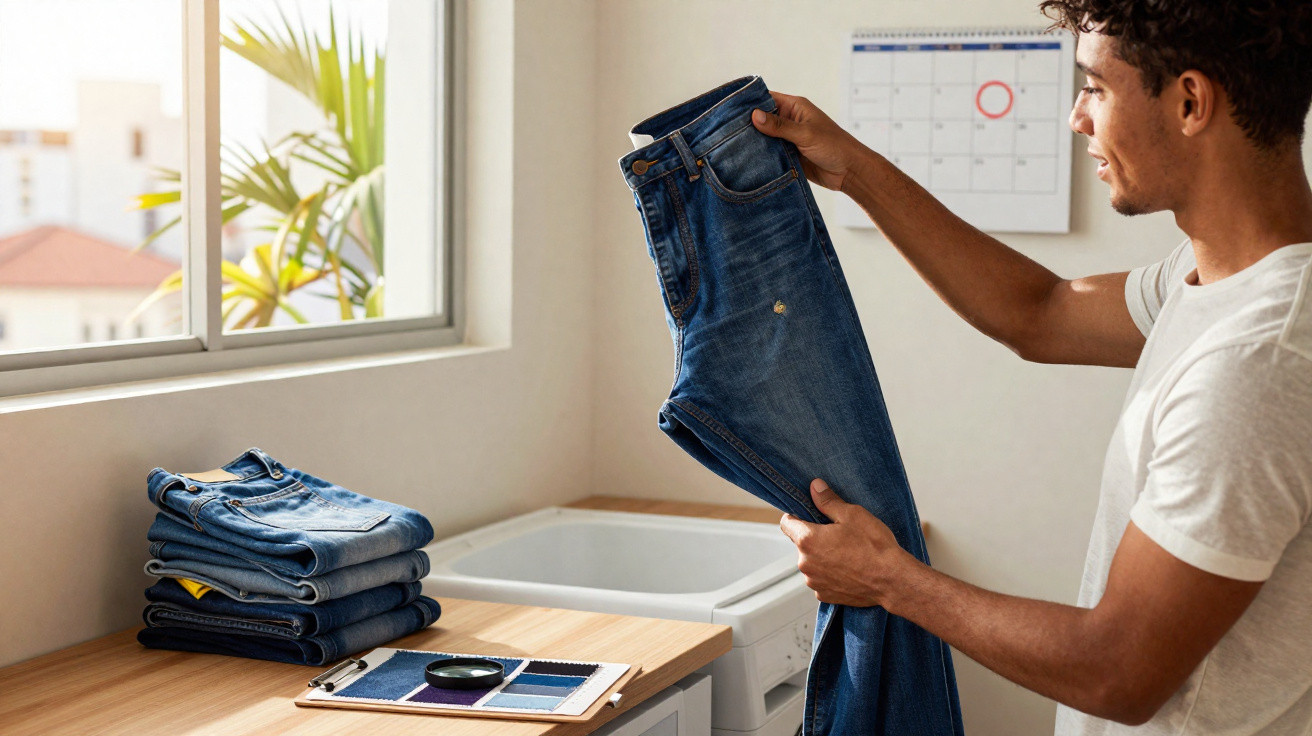
The question is straightforward, if slightly taboo: must you really wash your jeans every week, or can a monthly wash keep away the pong, fading and disapproving glances? British denim makers argue that once a month is not merely acceptable but the more sensible approach. They have put it into practice, too.
It starts on a rainy Sunday in London, the sort of day when the washing machine provides the flat’s background noise. My selvedge jeans were slung over a chair, carrying the week’s evidence: coffee-run marks, the sheen from a bus seat and a slightly damp Tube smell. A friend who mends denim in Walthamstow glanced at them and said, “Don’t wash them yet.” Instead, he showed me how to brush the cloth, hang the jeans near an open window and allow the moving air to do its work. By the following morning, they smelt of absolutely nothing: only fabric and fresh air. Later, at a Hackney workshop, Blackhorse Lane Ateliers explained that denim should be allowed to live between washes, so it moulds to its wearer rather than to the washing machine. Then somebody challenged me to make it through four weeks.
What really changes when you wash jeans monthly rather than weekly
The first difference is in how the fabric responds. Washing every week shocks the cotton, causing it to expand and shrink while stripping away dye that cost you good money. A monthly schedule allows those sharp creases-whiskers and honeycombs-to develop where your body moves, rather than where the machine drum rubs the fabric. After four weeks, my jeans felt more “mine” and less standard-issue. They had not collapsed into a dispiriting baggy shape; instead, they retained their form and looked cleaner on the surface.
There is a practical benefit that shows up on your water bill, too. A standard UK 40°C cotton wash uses about 50 litres of water and roughly half a kilowatt-hour of electricity. Reducing denim washes by half or even three-quarters over a month saves meaningful resources, as well as a few pounds in energy costs at current prices. A barista in Manchester told me he wore raw denim for 30 days, airing it each night and treating a latte splash with a damp cloth. There was no fuss, no odour and no customers asking, “are you okay?”
Then there are the less visible effects. Cotton fibres suffer the most abrasion when they are wet and tumble against other fabrics, so washing less often means fewer shed microfibres and slower colour loss. The yarn retains more indigo, creating the rich, inky shade people chase on Instagram. Natural skin oils spread through the fabric and help the warp threads settle into place. Odour-producing bacteria do appear, of course, but much of what you can smell is volatile: time and circulating air disperse it. A well-known Canadian laboratory comparison found similar bacterial levels in jeans worn for months and jeans worn for a single day; British makers have applied that principle through wear trials and open-studio sniff tests. It is not glamorous, but it is remarkably effective.
How to make a monthly jeans-washing routine work-and how British makers tested it
This is the approach denim enthusiasts in London and Wales recommend. Establish an easy routine for days off: use a clean clothes brush to remove surface dust, then suspend the jeans by their belt loops overnight somewhere with airflow-by a slightly open window rather than in a humid bathroom. For spills, use cool water with a drop of mild soap, blotting instead of rubbing. After every seven to ten wears, steam the jeans for 20 minutes with a garment steamer, or hang them in the bathroom while you take a hot shower. This combination of airing, brushing, spot-cleaning and steaming takes on the work that a weekly machine wash once did.
The biggest errors usually come from panic and belief in the freezer myth. Freezing does not kill the bacteria behind odours; it only slows them down, and the smell returns as soon as they defrost. Do not bother with it. Similarly, use fragrance sprays sparingly, as they can leave a residue and trap dirt in the fabric. When wash day eventually comes, keep it unremarkable: turn the jeans inside out, use a cool wash and short spin, choose a mild liquid detergent, and avoid fabric conditioner. Dry them flat on a line or hang them up-not across a scorching radiator, which can distort the waistband. Realistically, nobody follows perfect care instructions every time. Aim for “good enough, most days.” Your jeans will cope.
British denim makers have not simply made claims; they have demonstrated the method. Hiut Denim Co in Cardigan has created a community around infrequent washing, recording month-long wear diaries with photographs showing creases becoming more defined rather than the jeans becoming baggy. Blackhorse Lane Ateliers runs care workshops in which customers place week-one and week-four jeans side by side and-yes-smell them after airing. The conclusion remains consistent: monthly washing works when air and steam are part of the routine. As one London denim repairer puts it:
“Most smells are just passengers. Give them a draft and a little time, and they get off at the next stop.”
- First-week habit: brush and hang the jeans, and alternate your clothing on hot days.
- Emergency clean: deal with stains promptly by dabbing with cool water, then air the jeans for a day.
- Wash trigger: visible dirt, a sticky texture, skin irritation or wear after festivals.
- Skip list: freezer treatments, heavy fabric conditioner and daily machine washes.
- Upgrade: a basic clothes brush and travel steamer address 80% of problems.
Monthly vs weekly: what you are actually choosing
Weekly washing offers the reassurance of a regular routine. Monthly washing offers fabric with more character and a lighter footprint. It is the difference between continually resetting the cloth and allowing shape to build gradually, like leather moulding to your hand. The monthly approach is not about treating jeans as precious; it is about working with the fabric so that it does more for you and lasts considerably longer.
We have all had the moment when we catch a smell and think, “That’s it, into the wash.” Try a different sequence: air them first, steam them second, and decide afterwards. Many Londoners who adopted a monthly cycle say they reclaimed time on Sundays, saved a modest amount on household bills and, almost accidentally, ended up with better-looking denim. It changed the way I see laundry. It may have the same effect on you, or it may not, and that is fine. The aim is simply to discover what your jeans can do when they are given room to breathe. Everything else is habit.
| Key point | Detail | Benefit for the reader |
|---|---|---|
| Colour and fade | Fewer washes leave more indigo in the yarn, allowing whiskers and honeycombs to emerge naturally | Better-looking jeans over time without any special techniques |
| Odour control | Airflow, brushing and occasional steaming disperse volatile compounds and refresh the fabric | Confidence to extend the wash cycle without social risk |
| Cost and footprint | Every skipped wash saves ~50 litres of water and ~0.5 kWh of energy | Lower bills and a gentler impact with no extra effort |
FAQ:
- Will my jeans smell if I only wash them once a month? Most odour is volatile and disappears with airflow and time. Brush the jeans and hang them overnight; add light steam if required. If they still smell afterwards, it is wash day.
- Is monthly washing hygienic? For everyday use, yes. Treat stains locally, ensure the fabric dries completely between wears, and wash after particularly sweaty days. If you have sensitive skin, shorten the cycle to whatever feels comfortable.
- What about stretch denim with elastane? Stretch blends gain even more from gentle treatment. Cool washes and monthly laundering limit fibre fatigue and reduce wavy knees. Washing inside out keeps the outer surface looking neat.
- Does the freezer trick work? No. Skip the freezer. It temporarily pauses bacteria but does not eliminate odour. Airflow and a brief steam are more effective and gentler on the material.
- How do British experts “prove” the monthly routine? By using open wear trials, like-for-like comparisons and community demonstrations. Makers including Hiut and Blackhorse Lane show that jeans aired and steamed between washes remain presentable, retain their shape and age more attractively than pairs washed every week.

Comments
No comments yet. Be the first to comment!
Leave a Comment