
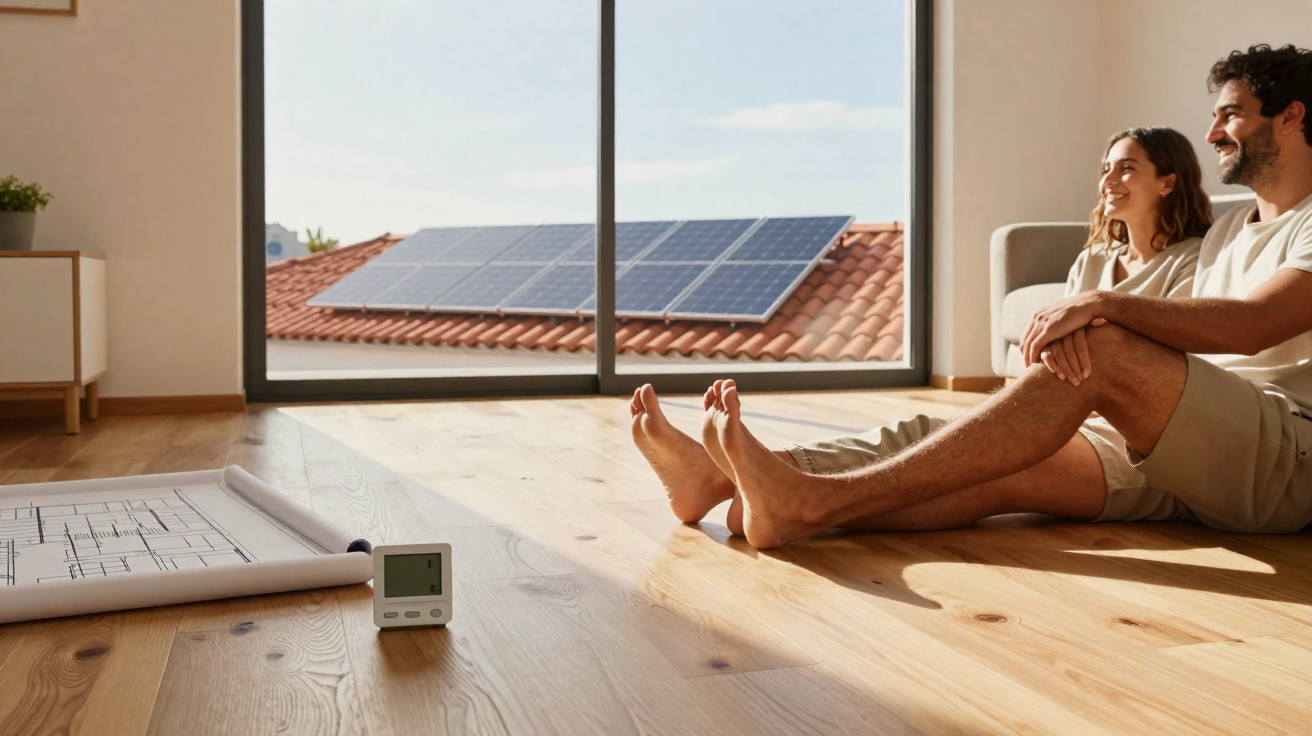
As winter grips Europe and North America, households are turning up their thermostats and seeing their energy bills rise in step. However, a new wave of solar-powered systems offers warm, comfortable rooms without bulky radiators, loud boilers or the familiar sting of a gas bill landing on the doorstep.
A heating system without radiators
Heating a home through winter without wall-mounted heaters can sound almost magical. In reality, the technology is straightforward: rooftop solar panels, highly efficient controls and, often, underfloor heating work together to convert sunlight into soft, evenly distributed warmth.
Rather than burning gas or supplying a conventional electric radiator, these systems use photovoltaic (PV) panels to make electricity from sunlight. That power operates low-temperature heating components, heat pumps or intelligent underfloor systems, which absorb and release warmth over broad surfaces.
Sunlight becomes electricity on the roof, then heat under your feet – with no traditional radiators and far lower running costs.
Scale is the key factor. Heating floors, structural slabs or purpose-made panels concealed in walls or ceilings allows the system to operate at much lower temperatures than standard radiators while maintaining a comfortable room. This change can substantially reduce energy consumption.
Turning solar power into practical “solar central heating”
Solar panels have been used for many years to provide lighting and run appliances. The more recent development is to make them the central component of a household heating system rather than merely a supplementary source.
How the system operates in practice
A standard installation brings together several main components:
- Photovoltaic panels fitted to the roof or façade produce electricity whenever there is daylight.
- An inverter changes this electricity into power for domestic systems, heating included.
- A smart controller determines when electricity should be sent to heating, used by other appliances or stored.
- Thermal storage – commonly a water tank, concrete slab or specialist phase-change material – retains heat for use later in the day.
- Underfloor or panel heating distributes the stored heat evenly throughout the property.
The arrangement is sometimes called “solar central heating”, despite having no conventional boiler. Effectively, the building itself acts as a slow-release radiator.
Once the system is installed and paid off, the marginal cost of each extra degree of warmth can fall close to zero.
Why this “future heating” is gaining interest
Clean power without a flue or fumes
Conventional heating frequently relies on fuels such as gas, oil or wood pellets. Each kilowatt of heat can bring emissions and often contributes to local air pollution. A solar-based system avoids this dependence.
PV panels produce electricity with no direct emissions. Combined with electric heating or a heat pump, they remove the requirement for a flue, gas supply or fuel deliveries. This is particularly important for densely populated cities trying to meet air-quality targets.
No gas line, no fuel tank, no chimney – and virtually no emissions during operation.
Grid electricity remains necessary during dark winter spells unless a property has an exceptionally large panel and storage system. Even so, generating part of a home’s energy on site can considerably lower its carbon footprint.
Figures that appeal to accountants
The financial case is equally compelling. Gas boilers, radiators and direct electric heaters all need purchased energy for every hour of heating. By comparison, the fuel for a solar-based system – sunlight – is free.
Research from European pilot schemes indicates that, after the installation cost has been amortised, running costs can fall sharply compared with traditional systems. In well-planned homes, heating-related energy bills can be reduced by 60–90%, depending on the climate and local electricity prices.
| Heating type | Main energy source | Typical running costs | Local emissions |
|---|---|---|---|
| Gas boiler with radiators | Fossil gas | High and volatile | Yes, at home |
| Direct electric radiators | Grid electricity | High in most countries | Depends on power mix |
| Pellet stove | Compressed wood pellets | Moderate but rising | Particles and smoke |
| Solar-powered underfloor | Solar PV + electricity | Low once installed | Very low on site |
The main financial barrier is the initial outlay. Solar panels, inverters, controls and underfloor heating demand a larger starting budget than replacing an old boiler with a new model. Government incentives and declining panel prices are starting to reduce that difference.
Why underfloor heating is so important
Warmth where it is most noticeable
Conventional radiators heat the surrounding air, producing warm areas close to the unit and cooler spots elsewhere in the room. Underfloor systems take another approach, warming the whole floor at a modest temperature, generally between 25°C and 30°C.
As warm air rises from the floor, people can feel comfortable even when the air itself is a little cooler than in a room heated by radiators. This small difference means less energy is needed to deliver the same perceived comfort.
Instead of blasting a few metal panels to 60°C, the system gently heats a large surface to a much milder level.
This provides a more consistent temperature, fewer draughts and, for many households, a more enjoyable form of heat – especially in bathrooms and living spaces with hard flooring.
More freedom for architects and renovators
Removing radiators also releases wall space. Although this may appear minor, it affects the way architects and interior designers arrange rooms. Furniture no longer needs to accommodate large heaters, windows can extend almost to floor level, and narrow hallways no longer resemble radiator-lined passages.
For new-build developments, the heating can be incorporated into the slab or screed from the beginning. Retrofitting is more involved because existing floors may need lifting or raising, although increasingly slim underfloor systems are now designed specifically for renovation projects.
Who could benefit most from radiator-free heating?
At present, solar-based heating systems are best suited to particular homes and locations:
- New low-energy houses that already offer high levels of insulation and airtightness.
- Detached or semi-detached homes with sufficient roof area for solar panels.
- Regions with cold but sunny winters, where clear days can still produce substantial electricity.
- Households planning for the long term that can allow several years to recover the initial investment.
In tightly packed urban blocks with restricted roof space, or in places subject to heavy shade, solar generation may make a smaller contribution. Hybrid arrangements, in which solar works alongside a backup boiler or highly efficient heat pump, are already widely used in such circumstances.
How do systems handle cloudy days and freezing nights?
No heating technology works under perfect conditions at all times, and solar-powered systems are no different. Rooftop panels generate less electricity through extended dull weather and none at all after dark.
Smart controls and storage address this issue. In sunny periods, the system can charge a thermal store, such as a hot-water cylinder, dense concrete slab or specialised storage material. The stored warmth is then released gradually into the home once the sun has set.
Think of the house as a rechargeable thermal battery: it soaks up heat when the sun shines, and lets it out when frost hits the windows.
In colder regions, most systems still retain a secondary source of heat, whether a grid-connected heat pump, a small boiler or even a modern wood-burning stove. The aim is not to remove every form of backup, but to greatly reduce the hours for which it is required.
Key terms explained
Photovoltaic and solar thermal compared
Two solar technologies are often confused. Photovoltaic panels use semiconductors to convert sunlight into electricity. Solar thermal collectors, on the other hand, directly warm a liquid, normally water or a water-and-antifreeze mixture.
The radiator-free systems considered here mainly use photovoltaics because electricity is versatile. It can operate a heat pump, power household appliances and export surplus electricity to the grid. Some schemes combine PV with solar thermal collectors, particularly for hot-water production, to capture every possible unit of free energy.
The advantage of pairing a heat pump with solar power
A heat pump does not generate warmth from nothing; it transfers it, rather like a refrigerator operating in reverse. In favourable conditions, it uses electricity to move heat from the outside air or the ground into a property, delivering three to five units of heat for every unit of electricity it uses.
When some of that electricity is supplied by solar panels and the heat pump serves low-temperature underfloor heating, the efficiency benefits compound. The property requires less purchased energy, solar generation is used more efficiently and residents receive steady, comfortable warmth.
Future scenarios: changing everyday life
Picture a winter morning in a near-future suburb. During the night, an underfloor slab has gradually given off heat collected from the previous afternoon’s sunshine. The indoor temperature remains even, without the usual pattern of radiators switching on and off.
When the sun comes up, roof panels start supplying electricity to the property. A smart controller detects that the living-room floor has cooled a little and provides a gentle boost. Meanwhile, it delays the washing machine until midday, when solar output is expected to be greater.
For the person living there, there is little drama. There is no roaring flame, hot metal grille or blue boiler pilot light to inspect. Instead, there is quiet, reliable warmth and an annual bill that hurts far less than it once did.
For tenants and people living in flats, the change is likely to come through whole-building systems. Developers are already trialling shared solar roofs, centralised heat pumps and underfloor heating serving complete blocks. Residents pay a stable, predictable heating charge, while landlords recover installation costs over a long period.
Challenges remain, including policy shortcomings, upfront expense and too few qualified installers. Nevertheless, as energy prices fluctuate and climate targets become stricter, heating homes without conventional radiators is moving in many countries from a futuristic discussion point to a realistic planning assumption.






Comments
No comments yet. Be the first to comment!
Leave a Comment