
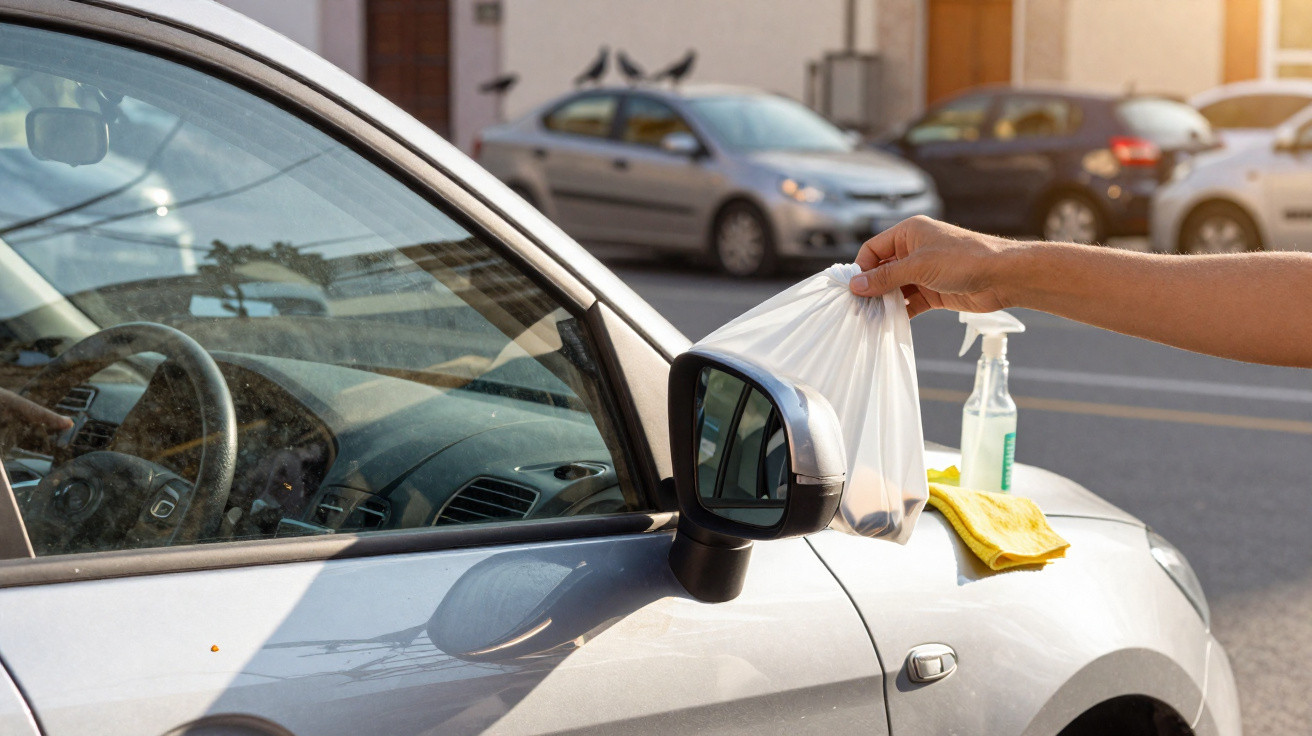
A strange trend has suddenly appeared in many car parks: wing mirrors wrapped in ordinary plastic bags.
Anyone travelling through rural areas or around the edges of towns has probably seen it before: an otherwise normal car with both wing mirrors covered by rustling bags. At first glance, it can look like carelessness, or as though someone has improvised while moving house. Yet this unusual measure addresses a very specific problem – and it is a rather clever solution.
Why plastic bags end up on wing mirrors
The main reason is an adversary many drivers underestimate: birds. They can become territorial and agitated, especially during the breeding season. In many areas, the highly reflective mirrors fitted to modern cars consequently become the target of repeated attacks.
In spring in particular, some males become so worked up that they mistake their own reflection for a rival. They attack the supposed competitor, peck at the glass, beat their wings and leave visible evidence behind.
Reflective wing mirrors can appear to some birds as an unfamiliar intruder – and they are attacked without mercy.
When drivers return to their vehicle a few hours later, they often find an unpleasant surprise: fine scratches around the mirror, loose feathers and, in the worst cases, substantial amounts of droppings on the mirror housing and door.
When bird droppings damage the paintwork
The issue is not limited to cosmetic blemishes. Bird droppings contain acids that can attack a vehicle’s clear coat. In warmer conditions, the contamination can effectively bake into the paintwork. The longer it is left in place, the greater the potential damage.
Anyone who regularly parks outside will know the pattern: repeated mess in the same areas, minor paint damage over time and potentially expensive professional detailing. The sections around wing mirrors are among the areas most at risk.
What makes wing mirrors so appealing to birds
- Highly reflective surface: Birds can see movement and shapes in it.
- Movement caused by wind: Even slight vibrations can resemble a living opponent.
- At eye level for many species: Mirrors sit roughly at the flying height of smaller birds.
- Quiet car parks: In rural locations, birds have time to “let off steam”.
For the birds, it is a territorial dispute; for the owner, it means a scratched mirror covered in acidic residue.
The simple wing-mirror trick: cover the mirror, remove the problem
This is exactly where the plastic-bag trend comes in. The principle is straightforward: once the reflective surface is hidden, birds lose the stimulus that triggers them. They no longer see a rival and turn their attention to other objects – ideally trees, bushes or natural features.
By making the mirror surface invisible, you remove the trigger that prompts birds to attack.
Many drivers simply use whatever is available: standard shopping bags, small bin bags or packaging bags. These are pulled over the wing mirrors and tied loosely. Some people use reusable protective covers, while others improvise with old fabric bags.
How drivers apply the protection in practice
- Park the car and switch off the engine.
- Pull a plastic bag or cover over each mirror.
- Tie it lightly around the mirror housing or secure it with an elastic band.
- Remove the bags before driving and store them inside the car.
The essential aim is simply to conceal the shiny surface. A towel or a piece of cardboard can also work, provided it is securely held in place and cannot blow away.
A rural trend spreading into towns and cities
Initially, this trick was mainly seen in villages, along country lanes and in mountainous areas. Cars there are often left unprotected for long periods, such as outside farms, guesthouses or walking-trail car parks. Packaged mirrors are now increasingly appearing in residential neighbourhoods too.
In some urban districts with plenty of trees or parks, birds react just as aggressively as they do in the countryside. Curious crows and magpies may also like landing on shiny surfaces. This simple DIY approach can therefore seem like a quiet form of self-protection for local residents.
What began as an improvised emergency measure in the countryside has become an increasingly visible everyday trick on urban streets too.
Owners of vehicles with especially large wing mirrors, including those fitted to some compact cars and SUVs, report particularly noticeable improvements. Fewer scratches, fewer droppings – and therefore less cleaning effort over time.
Alternatives to plastic bags
Anyone wishing to avoid single-use bags can choose other options. The basic principle remains unchanged: cover the mirror surface and remove the attraction for birds.
- Fabric covers: Reusable textile sleeves pulled over the mirror.
- Rubberised caps: Purpose-made covers in rubber or neoprene, often water-resistant.
- Homemade covers: Old socks, cut-off sleeves or fabric scraps secured with elastic.
- Foldable cardboard: A short-term option wedged between the mirror and its housing.
Many people now try to create as little additional waste as possible. Long-lasting covers that can stay in the car are a sensible choice. The key point is that they must fit securely and must not become a hazard to other road users in windy weather.
Which car colours are most often affected
Certain paint colours, as well as mirrors, seem more likely to attract attention. Lighter shades – especially very vivid or glossy finishes – appear to draw birds more strongly. They reflect more light and are more noticeable to the animals.
Anyone living in an area with lots of birds and planning to buy a new car should bear this in mind. An extremely bright finish may look stylish, but in everyday use it may be targeted more often by dropping attacks. Subtle colours with less gloss are statistically noticed less frequently.
Practical care tips to prevent damage
It is impossible to avoid contact with birds completely. However, a few regular habits can significantly reduce the risk of lasting damage:
- Remove paintwork contamination on the same day whenever possible.
- Check more frequently in spring, particularly around mirrors and roof edges.
- Keep a soft microfibre cloth and gentle cleaner in the boot.
- Consider paint sealant or wax as a longer-term measure.
Drivers who spend a lot of time on the road can also carry a small car-care kit. This makes it possible to remove fresh marks quickly, before they can bake into the paintwork.
Why the trick works so well
Birds rely heavily on visual signals and movement for orientation. A clean, reflective wing mirror provides both: it shows movement in the surroundings while also reflecting the bird itself. As soon as that visual feedback disappears, the sequence is interrupted – no reflection, no supposed rival.
From a behavioural-biology perspective, the trick therefore makes sense. It does not change the animal; it changes the environment. That is precisely why many users say the attacks and contamination noticeably ease after only a few days.
A simple everyday item can greatly reduce an irritating and expensive nuisance.
So, when you next see a car with plastic bags over its mirrors, it is not merely a sign of carelessness. It is a small, practical solution: an improvised shield against claws, beaks and corrosive deposits. For many owners, that is certainly preferable to repeatedly paying to repair expensive paintwork damage.





Comments
No comments yet. Be the first to comment!
Leave a Comment