
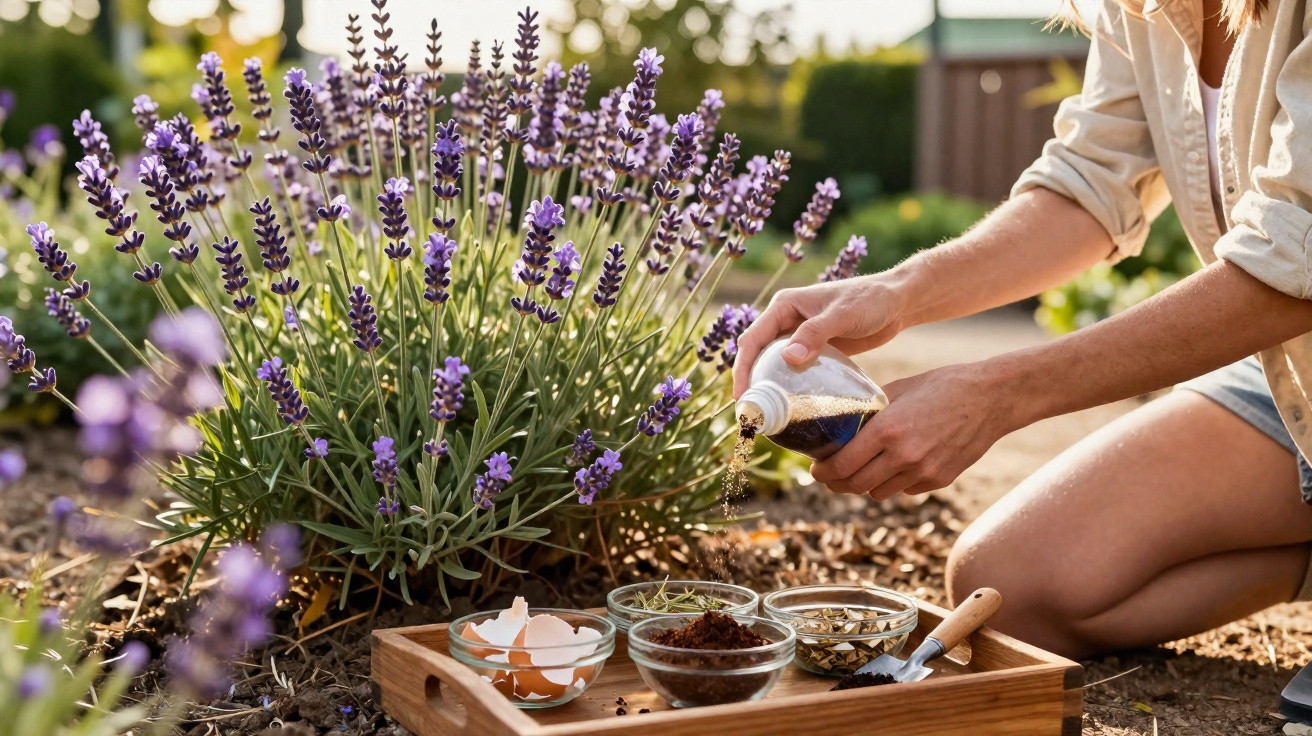
Many amateur gardeners dream of dense, violet lavender bushes, only to find themselves facing just a few spindly flower stems in July.
The good news is that, in most cases, neither sunshine, watering nor the position is to blame. The crucial mistake is made months earlier, in spring, in the soil. Anyone who fertilises too aggressively then, or does nothing at all, holds the plant back. Yet a very simple natural blend of three ingredients can encourage lavender to produce an abundant display of flowers.
Why your lavender flowers so poorly despite the sunshine
Lavender originates from sparse, stony regions around the Mediterranean. It grows there in lean, free-draining and often calcareous soils – the complete opposite of a bed packed with compost and lawn cuttings.
Many gardeners are overly kind and “pamper” lavender as they would roses or tomatoes. This quickly causes problems:
- overly nutrient-rich soil: plenty of leaves but hardly any flowers
- too much water: weak, soft shoots and a risk of rot
- thick mulch layers: a permanently damp root zone that stresses the plant
Lavender is naturally tough and undemanding. Rather than being fed continually, it needs one gentle boost each year at the right moment.
“Anyone who treats lavender like a hungry bedding plant will get green balls instead of fragrant clouds of flowers.”
The ideal timing: one helping hand in spring
Spring is the key period. Between March and April, once severe frosts have passed and the plant begins to shoot slowly, lavender sets the course for its summer flowering.
During this brief window, one application of nutrients is enough. The plant needs no more than that – and usually cannot tolerate it either. The aim is a mild boost, not a high-powered fertiliser that makes it grow unnaturally lush.
Used at the right rate, this spring signal helps lavender develop strong roots and sturdy flowering shoots. The reward arrives in July: long, densely filled spikes and a fragrance that appeals equally to bees and people.
The three-part mix: what can really make lavender stronger
Garden experts rely on a straightforward mixture that can be prepared at home without specialist products. It contains three natural components which work in very different but perfectly complementary ways.
The three ingredients for stronger lavender
- Mature compost supplies slowly available nutrients while improving the soil structure. It must be thoroughly rotted and free of coarse material. This keeps the soil airy and allows it to dry quickly after rain.
- Bone meal is rich in phosphorus and calcium. It supports root development and encourages bud formation – precisely what lavender needs to produce plenty of flowers.
- Garden lime suits lavender because it enjoys calcareous soil. Lime raises the pH, counteracts acidic conditions and makes nutrients more readily available. At the same time, it recreates the natural conditions of the Mediterranean region.
The principle is simple: compost feeds and improves structure, bone meal promotes roots and flowers, while lime creates the right soil environment.
“A small crown of compost, bone meal and lime once in spring – and the shrub thanks you with a firework display of fragrance in July.”
How to prepare the natural fertiliser for lavender correctly
The mixture is quick to make. All you need is a bucket and a small trowel.
- Mix equal parts: Use one part mature compost, one part bone meal and one part garden lime. Combine everything thoroughly in the bucket.
- Scatter it around the shrub: Do not tip the mix directly against the stem; instead, spread it in a ring around the lavender. This allows the fine roots to make the best use of the fertiliser.
- Work it in with your hand or a small rake: Gently incorporate it into the top layer of soil; two to three centimetres is sufficient. The soil remains loose and does not become compacted.
- Water thoroughly afterwards: A deep watering helps the nutrients reach the root area, where they can take effect.
Important: do not create a thick layer; scatter the mixture sparingly instead. Lavender reacts noticeably to overfeeding, and only slow, small quantities benefit it.
How much is enough? Amounts for beds and pots
The correct quantity depends mainly on the size of the plant and where it is growing.
| Lavender size / location | Quantity of the three-part mix |
|---|---|
| Young plant in a bed | about one small handful |
| Large, older shrub in a bed | two small handfuls, spread across the root area |
| Lavender in a pot (up to approx. 30 cm) | one to two tablespoons, worked in well |
| Large container (from approx. 40 cm) | no more than one small handful; use a restrained dose |
Nutrients build up far more quickly in pots because the volume is limited. Here, less is better, and the potting mix should be extremely free-draining with plenty of sand or fine gravel.
Common mistakes that cost lavender its flowers
People unfamiliar with the plant can easily fall into traps that are rarely mentioned on the label. Looking at the most common issues is often enough to rethink your own flower bed.
Too much nitrogen, too much water
Many general-purpose and lawn fertilisers contain high levels of nitrogen. This chiefly stimulates leaf growth. For lavender, that means:
- abundant foliage but very few flowers
- long, soft shoots that bend over in rain
- greater susceptibility to rot and frost damage
Fresh farmyard manure or very young compost intensifies this effect. They also usually bring more moisture than lavender can cope with. The plant loses its characteristic toughness and becomes bare from the inside.
Unsuitable soil and thick mulch
Lavender suffers especially in heavy, clay soils and beneath thick layers of bark mulch or wet leaves. Under these conditions, the roots remain damp for too long, weakening its natural resilience.
If these are the conditions in your garden, help the plant by:
- mixing in generous quantities of sand, grit or fine gravel
- choosing a slightly raised planting spot, such as a small mound
- avoiding conventional mulch layers directly around the shrub
More than appearance: why the effort is worthwhile
Healthy lavender that flowers profusely is more than an attractive feature. It provides food for bees, bumblebees and butterflies, particularly during dry, hot summer weeks. Planting several shrubs creates a kind of mini Provence outside the front door – complete with a gentle buzz and intense fragrance.
There is also a practical benefit: the flowers can be dried for wardrobe sachets, scented bowls or homemade soaps. The three-part mix of compost, bone meal and lime therefore strengthens not only the plant, but also creates fresh possibilities for the home remedy cupboard and decorative corner.
What amateur gardeners should remember
Lavender does not reward a fear of underfeeding, but restraint. Give it one targeted natural boost in spring, then leave it alone. Anyone who adapts the soil to its origins – keeping it relatively lean, stony and rich in lime – gives this Mediterranean plant exactly what it needs.
This turns a problem plant with three thin stems into a fragrant flowering bush which, in July, looks as though it belongs between a stone wall and an olive grove – except that it is in your own garden or on your balcony.




Comments
No comments yet. Be the first to comment!
Leave a Comment