
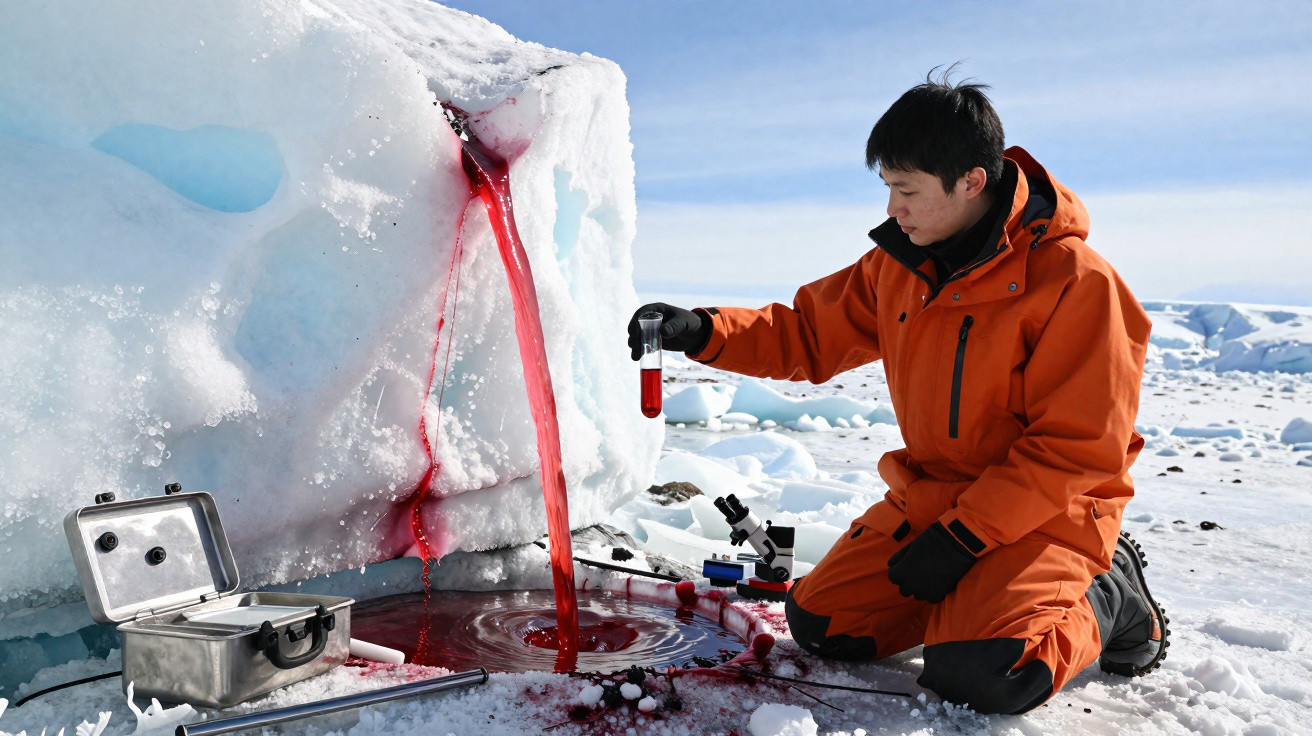
Blood Falls looks like a stream of blood cutting through Antarctica’s white ice, yet it originates from an exceptionally salty, iron-rich brine sealed beneath Taylor Glacier. Once this liquid reaches the surface and meets the outside environment, iron compounds create the reddish colour that has made the phenomenon one of the most unusual sights in the McMurdo Dry Valleys.
Why is Blood Falls such a blood-like colour?
Its colour is not caused by red algae or any blood-like organic material. The water released from the glacier carries high concentrations of iron. While it remains trapped beneath the ice, its chemical conditions differ greatly from those at the surface, including the limited availability of oxygen.
When the brine eventually reaches the open environment, the iron-rich material undergoes chemical changes on contact with oxygen. This produces orange and rust-red shades that spread across the ice and may remain visible even after the flow has weakened.
- The colour is linked to the large amount of iron;
- The liquid comes from within Taylor Glacier;
- Contact with the atmosphere alters the iron-rich compounds;
- The reddish material is left deposited on the ice;
- The flow is episodic rather than a permanent, conventional waterfall.
How can liquid water exist beneath such a cold glacier?
The key is the exceptionally high salt concentration. Some of this water has the characteristics of ancient seawater that became increasingly concentrated as ice formed. As water freezes, much of its salt is concentrated in the portion that remains liquid. This hypersaline brine has a lower freezing point, allowing it to stay liquid at temperatures where fresh water would already have frozen.
How long has this water been isolated beneath the ice?
The story of Blood Falls began long before Antarctica’s current landscape took shape. Millions of years ago, the McMurdo Dry Valleys had a different configuration, and seawater reached areas now dominated by ice and arid ground. One hypothesis under study suggests that the brine may date back to the Pliocene, around 5 million years ago.
That does not necessarily mean that every drop appearing today has remained motionless for 5 million years. Research into the reservoir and its micro-organisms indicates a subglacial environment isolated for at least approximately 1.5 million years. Taylor Glacier has therefore preserved an ancient aquatic system that continued operating far from sunlight and the atmosphere.
- The water’s origin may be connected to former marine environments;
- Glacier formation trapped salt water in the area;
- The system stayed isolated beneath the ice for immense periods;
- Its high salt concentration helped keep the water liquid;
- The reservoir also contains a microbial community adapted to this extreme environment.
How does the brine pass through Taylor Glacier?
Research has shown that Taylor Glacier contains brine channels and reservoirs within and beneath its ice. Under certain conditions, this extremely salty liquid can move through fractures and reach the glacier’s terminus near Lake Bonney. The red water appears in episodes, which is why the intensity of the stain can vary over time.
Blood Falls’ red cascade also conceals life beneath the ice
Its appearance may not even be its most significant discovery. Samples of the brine have revealed micro-organisms able to survive in a dark, intensely cold, extremely salty environment that is almost entirely cut off from the atmosphere. Without relying on light for photosynthesis, this community uses chemical reactions involving compounds available in its surroundings, including iron and sulphur, to sustain its metabolism.
Blood Falls therefore acts as a window onto an ecosystem that would normally remain hidden beneath Antarctica. The red colour visible at the surface reveals the presence of liquid water where everything appears frozen, and shows that environments isolated for enormous periods can still support biological activity. This is why the phenomenon also interests astrobiology, which seeks to understand whether similarly cold, salty, ice-protected systems might exist on other worlds.






Comments
No comments yet. Be the first to comment!
Leave a Comment