
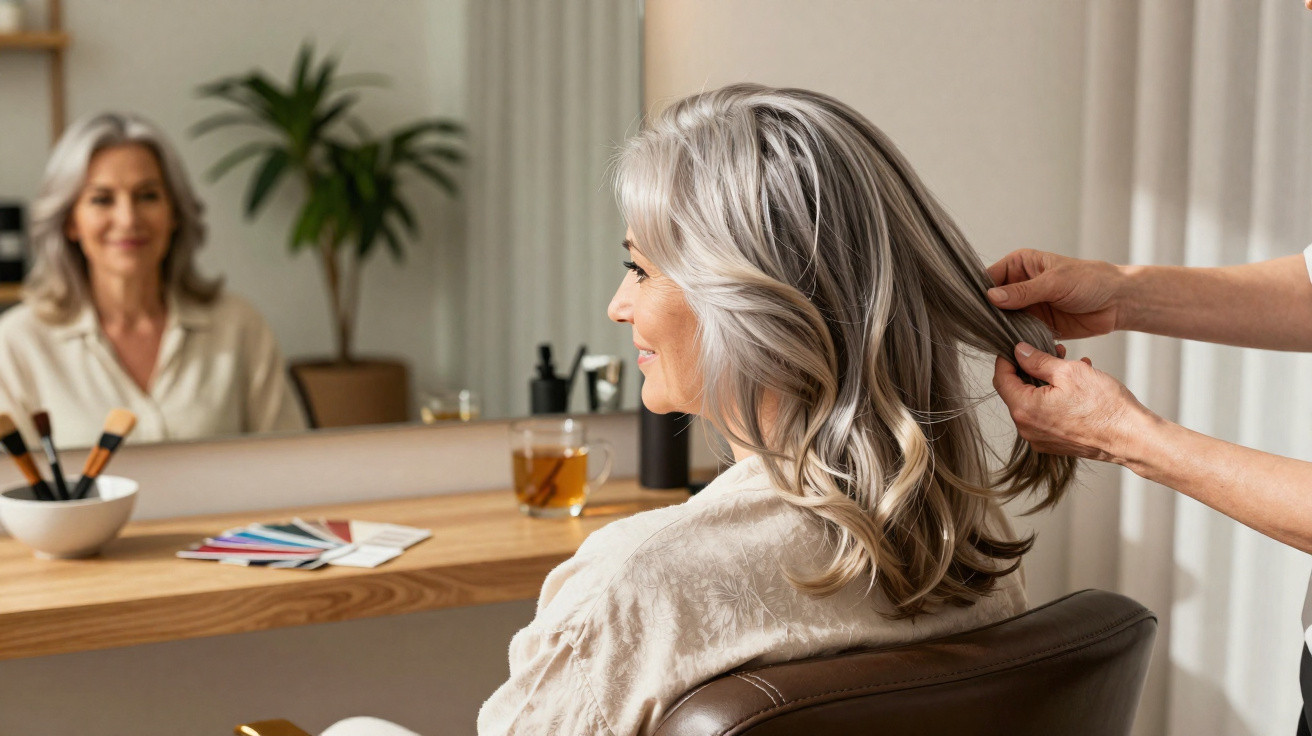
At 9:15 on a Tuesday morning, the salon is already alive with activity. A kettle hisses out back, foils rustle, and women chat quietly about holidays and hormone levels. In chair three, a woman in her early 50s turns a lock of hair around her fingers as she studies the mirror and lets out a sigh. Her roots are rapidly turning silver, the lengths remain an old chestnut brown, and the overall result is… patchy. “I don’t want to look 25,” she tells the hairdresser. “I just don’t want to look tired.” The stylist smiles, raises the salt-and-pepper roots with a comb and says softly: “You’re ready for lowlighting balayage.”
Something changes in the reflection.
Why lowlighting balayage makes sense after 50
If you are over 50 and feel as though your grey hair has arrived overnight, it is not your imagination. First, there are only two or three strands near your parting; then suddenly, your temples are silver and your familiar colour looks dull. Traditional all-over colour can begin to seem overly harsh, as if you are battling the person in the mirror. That is where lowlighting balayage can help. Rather than fighting the grey, it works with it to create an intentional look. Salt-and-pepper hair becomes a colour in its own right rather than a “problem” needing to be fixed. The result is gentler root regrowth, fewer lengthy salon sessions and a face that can look instantly more refreshed.
Hairdressers are noticing this change every week. One Paris colourist told me that, since 2020, many of her clients over 50 have stopped trying to cover 100% of their grey. Instead, they ask for something “between blonde and gray” or “not too fake, but not too old either.” She often shows before-and-after images of women with striped, grown-out box colour who leave with natural salt-and-pepper hair threaded with slightly deeper ribbons of colour. You do not necessarily think, “wow, nice balayage.” Instead, you simply think: “she looks rested.” That is the understated strength of this technique when grey begins to dominate the hairline.
There is a practical reason for the trend. As skin tone becomes softer with age and facial contrast decreases, the solid dark colour that worked at 35 can feel severe by 55. Bleaching everything towards white is not always the solution either, as it may leave you looking washed out. Lowlighting balayage creates considered depth in areas where grey appears too even or flat. The stylist hand-paints slightly deeper shades between and beneath the silver strands. Your natural greys become built-in “highlights”, while the lowlights bring movement and definition. Rather than shouting, your hair colour begins to whisper.
How lowlighting balayage works on salt-and-pepper hair
Picture lowlighting balayage on grey hair as adding shadows to a pencil sketch. The stylist does not cover salt-and-pepper hair with a solid blanket of colour. Instead, they identify where grey is concentrated - commonly around the front, crown and temples - and paint slightly deeper tones around those sections. The application is soft and diagonal rather than straight or striped. A skilled colourist blends cool and neutral shades close to your natural base so that the finish looks naturally grown-in from the first day. Its appeal lies in respecting the grey rather than removing it. You leave the salon looking recognisably like yourself, only… refined.
One London stylist described a client in her late 50s who had coloured her hair dark brown for years. White roots appeared every three weeks, leaving her feeling tied to salon appointments. Together, they chose to end the constant battle with regrowth. The stylist lightened some of the old dark colour before introducing soft lowlights around the client’s natural grey, particularly at the back where the shade looked too uniform. The front was kept lighter, with more silver used to frame her face. Following two appointments, friends asked her: “You look younger, did you sleep more?” No one could identify the hair colour as the reason. More importantly, she went from colouring every 3–4 weeks to topping up her balayage twice a year.
From a technical perspective, grey hair has a different texture and level of porosity, which is why all-over colour can take too darkly or fade in an uneven way. Because lowlights are applied only to selected strands, the hair retains more of its natural texture and character. A stylist can tailor the formula too: using a cooler lowlight when grey turns yellow, or a marginally warmer tone when the skin needs extra glow. The gray itself acts like free, built-in highlights, meaning there is less overall processing. This can be gentler on hair that is becoming drier or more delicate. It offers a sensible middle ground between “I give up” and “I’m pretending I never went gray.”
The hairdresser’s approach to lowlighting balayage
The work begins well before the colour is mixed. A good hairdresser will sit with you and map out your salt-and-pepper pattern. They divide the hair into sections to assess where it is mainly white, where it is blended and where the original natural colour remains strongest. Then comes an important question: how much grey are you emotionally comfortable seeing? Some women want 60% visible, while others begin at 30% and gradually become more confident. The stylist then selects two or three lowlight shades rather than relying on a single colour. These are painted in V-shapes and gentle sweeps, while much of the grey is left untouched. The aim is a soft, watercolour-like blur rather than defined lines.
A major mistake is attempting to “try out” lowlighting balayage at home with an unsuitable box dye. This is often how patchiness happens, particularly on previously coloured hair. Another frequent issue is requesting very warm caramel lowlights over cool, icy grey. That can make your hair feel unfamiliar. Rather than naming a celebrity, explain how you would like to feel: brighter, softer or less high-contrast. Your stylist can turn that into the appropriate shades and placement. If you are uncertain, ask for deeper tones at the back and a lighter touch around the face. The initial surprise in the mirror is likely to be much gentler.
A colorist I spoke to put it plainly: “Gray hair after 50 doesn’t need correcting, it needs curating. The lowlights are like punctuation marks; they guide the eye so people see your face, not just your roots.”
- Arrange a consultation before committing to colour: photographs, colour history and time to discuss everything are essential.
- Take daylight selfies of your hair from the front, side and back, allowing the stylist to see your real grey pattern.
- Begin with delicate lowlights and add more over 1–2 sessions; a dramatic change in one appointment can often feel “too much.”
- Select a cut that lets the colour move, as soft layers, a fringe or a bob all work brilliantly with salt-and-pepper hair.
- Consider maintenance in advance: for most women, a gloss every 6–8 weeks and lowlight top-ups twice a year work well.
Living with salt-and-pepper hair beyond the salon
The experience does not finish when you leave the salon with bouncy, toned salt-and-pepper hair. During the first week, many women describe an unusual mix of surprise and relief. You might glimpse yourself in a shop window and think, “Oh, that’s really me.” Then you notice how the lowlighting balayage looks in daylight, beneath office LEDs and in a friend’s bathroom mirror. The greys catch the light rather than gathering into blocks, while the lowlights add a small amount of root shadow. Suddenly, silver looks like a deliberate choice rather than an accident. This is often when compliments arrive from unexpected people: a teenage niece, a male colleague or a neighbour in the lift.
| Key point | Detail | Value for the reader |
|---|---|---|
| Respect your natural grey | Add depth and definition with lowlights rather than removing the salt-and-pepper colour | Hair appears authentic, contemporary and easier to maintain |
| Plan for long-term maintenance | Balayage every 4–6 months, with gloss appointments in between and no more panicked root touch-ups | Less time and money spent at the salon, with greater freedom from anxiety about regrowth |
| Find the right colourist | Seek experience with grey blending, photographic portfolios and a proper consultation | Lowers the chance of flat, ageing colour and encourages a smoother transition to grey |
FAQ:
Is lowlighting balayage only for women who are “fully gray”?
No. It can work beautifully from 30–40% grey onwards, even when the colour is concentrated mainly at the temples or along the parting. The technique is adjusted according to both the amount of grey and where it appears.Will lowlights damage my already dry, gray hair?
A careful colourist will use gentler formulas on targeted strands rather than colouring the entire head. Alongside a bond-builder and nourishing masks at home, most women find their hair feels better than it did after repeated full-colour applications.How often do I need to refresh lowlighting balayage on gray hair?
For most clients over 50, a refresh every 4–6 months is sufficient. Between salon visits, a toner or gloss every 6–8 weeks helps prevent yellow tones and enhances shine.Can I go from box dye to lowlighting balayage in one appointment?
It is possible in some cases, though it is often a two-step process. Old pigment may need to be softened or lifted first, with the lowlights and grey blending refined over a couple of appointments. This staged approach usually looks more natural and feels less shocking.What if I try it and decide I don’t like seeing my gray?
You still have choices. You could add further lowlights, move to a softer all-over colour or grow out into a lighter shade that meets your grey halfway. In truth, hardly anyone makes this choice every single day, but candid conversations with your stylist at every appointment will help you adjust the result as needed.





Comments
No comments yet. Be the first to comment!
Leave a Comment