
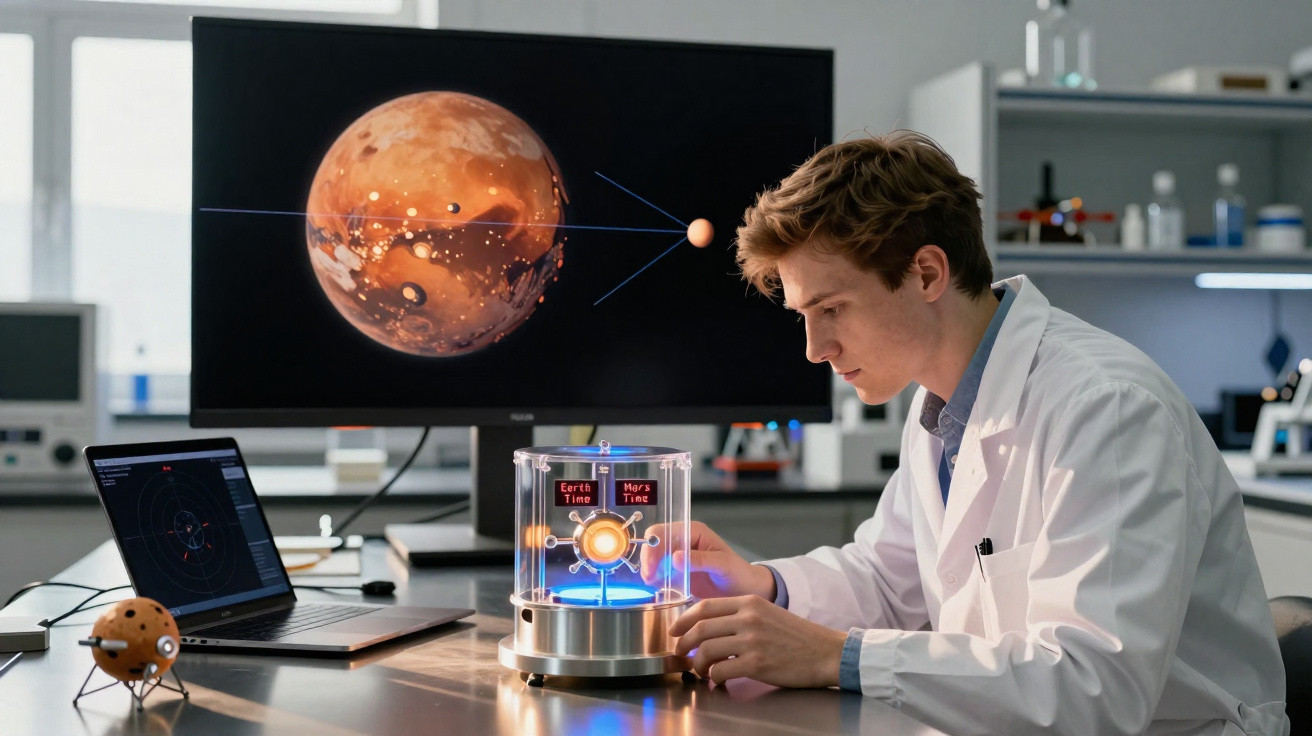
Clocks on Mars are now known to run marginally faster than those on Earth, with scientists determining precisely how much time they gain.
Without correction, this consistent difference would eventually disrupt navigation, scientific time records and everyday timetables for future crews.
Establishing Mars time
Using a fixed reference point on the surface, the latest analysis calculated that Mars gains an average of 477 millionths of a second each day.
Applying Einstein’s theory of relativity, the National Institute of Standards and Technology (NIST) linked this advantage to the gravity of Mars.
Over the course of the Martian year, NIST physicist Dr. Bijunath Patla determined that the daily gain varies by as much as 226 millionths per day.
Without a common time standard, mission clocks would gradually diverge, meaning every Mars signal would need to include a correction.
Gravity determines the rate
Mars’s weaker gravity at the surface causes seconds to pass very slightly faster, even where a clock itself maintains perfect time.
Under Einstein’s physics, time dilation makes clocks run at varying speeds in different gravitational fields, allowing clocks on worlds with weaker gravity to move fractionally ahead.
A clock placed on Mars would continue to tick as normal, as the instrument cannot detect its own difference. Only when that Mars clock is compared with an Earth clock does the discrepancy become visible, and NIST needed to measure it for mission planners.
Orbital motion and time
As Mars accelerates and decelerates along its elongated orbit, its changing speed alters the clock difference throughout the year.
The Sun’s gravity is stronger when Mars is nearer, while a recent article described the additional gravitational effects exerted by neighbouring bodies.
The new calculation had to consider four major bodies simultaneously: the Sun, Earth, the Moon and Mars.
Because these forces change, Mars time fluctuates, preventing planners from relying on one constant offset.
Why very small timing differences matter
A millionth of a second may appear insignificant, but light covers roughly 1,000 feet (300 metres) during that interval.
Navigation systems determine distance by measuring radio-signal travel times, so even minor clock inaccuracies translate directly into errors measured in miles or feet.
Earth’s Global Positioning System (GPS) relies on synchronised satellites and receivers, and its calculations break down if their clocks are not aligned.
Using the same approach on Mars without a correction table could cause a rover to miss its intended destination by a substantial distance.
Creating a Mars clock
Mars follows a different calendar: a day is around 40 minutes longer, while a year lasts 687 Earth days.
In addition to those clear distinctions, engineers require a single agreed second so that Mars clocks can be compared accurately with clocks on Earth.
Using the areoid as a reference surface - an imagined sea-level surface for Mars - ensures clocks remain consistent across the planet.
This common baseline enables mission teams to timestamp events, map positions and transmit instructions without uncertainty over the clock used for each time record.
Signals through deep space
Radio transmissions between Earth and Mars already experience delays, with one-way travel times of between four and 24 minutes.
Because signals arrive late, spacecraft, orbiters and ground teams must timestamp every packet so that receivers can reconstruct the correct sequence.
“If you get synchronization, it will be almost like real-time communication without any loss of information,” said Patla.
Even with shared timekeeping, crews would still have to wait for responses, although the network could remain internally coherent.
Maintaining synchronised clocks
On Earth, GPS maintains time by comparing numerous clocks simultaneously before transmitting updates that devices can use.
A collection of atomic clocks, which track time by counting the natural vibrations of atoms, could be installed on Mars orbiters and landers.
As spacecraft travel quickly and are affected by planetary gravity, the system would need to exchange timing checks regularly; otherwise, errors could accumulate unnoticed.
Setting that standard will influence how missions organise tasks, exchange maps and record every experiment to the second.
Testing Einstein once more
Mars offers more than navigation benefits: it provides scientists with a clear setting to examine whether Einstein’s rules remain accurate far beyond Earth.
Comparing clock rates on Earth, Mars and spacecraft allows scientists to check whether the gains and losses forecast by relativity occur as expected.
“It may be decades before the surface of Mars is covered by the tracks of wandering rovers, but it is useful now to study the issues involved in establishing navigation systems on other planets and moons,” said Dr. Neil Ashby, a physicist at NIST.
Findings such as these can also inform future clock designs, since any remaining discrepancy might indicate physics that has not yet been accounted for.
What engineers will address next
Converting the calculation into an operational Mars clock will require rules covering updates, backups and failures during extended missions.
Jupiter, spacecraft thrust and subtle solar effects will further refine the correction tables on which future GPS-style networks will rely.
Politics will also play a role, as agencies need to agree on a Martian time standard before contractors can produce compatible equipment.
Nevertheless, assigning a dependable figure to the drift changes Mars from a timekeeping puzzle into an engineering challenge that can be solved.
Preparing for crewed missions
Accurate Mars time now appears to be an achievable system rather than an estimate, because researchers have charted both the drift and its underlying causes.
As missions move towards crewed operations on the surface, engineers can incorporate these corrections into navigation and communications throughout the solar system.






Comments
No comments yet. Be the first to comment!
Leave a Comment