

If you happen to be walking through woodland or a meadow at the right point in the year, you could come upon something that looks like a piece of supernatural mischief.
Given the right conditions, an almost flawless circle of mushrooms may appear, arranged as if a ring dance had been frozen in place.
For hundreds of years, these so-called fairy rings have given rise to mythology. Some tales attribute them to the devil, while others credit fairies, witches or elves.
Yet, despite their prominent place in folklore, scientists still cannot say precisely why the fungus beneath the visible mushrooms grows into a ring rather than a solid disc, or why the ring spreads outwards in such remarkably tidy circles.
A team headed by Stockholm University mycologist Hanna Johannesson in Sweden has now looked beneath the turf for clues, combining DNA analysis with an unusual fungal transplantation experiment.
Their early findings do little to make fairy rings seem less mysterious. They indicate that the fungi responsible for fairy rings could be attempting to ‘escape’ something left behind them.
"The results were most consistent with a transient-escape hypothesis," the researchers write in Royal Society Open Science, "and suggest that the mycelium avoids inhibitory factors present at the back edge of the mycelial growth front."
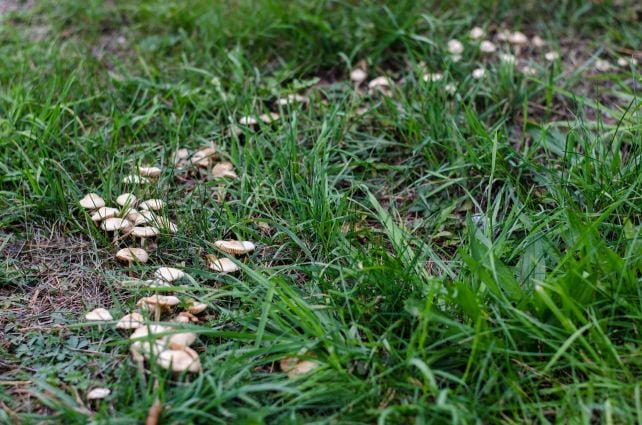
How mushroom fairy rings form
Fairy rings are made by far more than one mushroom species. Scientists have recorded over 100 different taxa that form them, although their underlying principle is much the same.
Put simply, the mushroom visible above ground represents only a small portion of a considerably larger organism. It is the fruiting body, whereas the fungus’s main body is the mycelium: a branched web of thread-like structures concealed in the dark below ground.
As a fungus extends outwards from its initial point, mushrooms can emerge along its leading edge, marking the underground expansion as a circle. This circle may go on widening over time.
That is the broad picture, at least. However, because the overwhelming majority of the fungus is concealed within the intricate ecosystem underfoot, mapping a fairy ring’s below-ground structure has proved unexpectedly challenging.
To investigate, the scientists studied Marasmius oreades, a species also called the fairy ring mushroom or Scotch bonnet, in two distinct fairy rings at a cemetery in Uppsala.
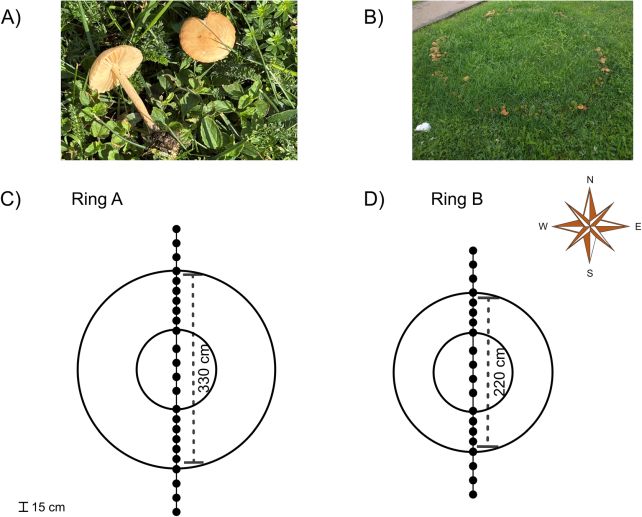
They collected soil along transects running across both rings. The samples included the mushroom-free centre, the mushroom-filled margins, and soil beyond each circle to provide a background control.
Next, they sequenced the DNA within those samples and looked for sequences corresponding to the M. oreades genome.
The soil at the ring margins contained large amounts of the mushroom’s DNA, especially at the outer edge.
In contrast, DNA in the circles’ centres fell to background concentrations comparable with those outside the rings. This suggests that the mycelium itself, not only its fruiting bodies, has a ring-shaped structure.
It is an intriguing finding, but it prompted a further question: why does this happen?
The team outlined several explanations. Once established, perhaps the fungus simply maintains the same direction and rate of movement. The ring’s expansion might be aligned like a compass. It is even possible that the fungus communicates with itself, directing every section to create a ring.
Or it might be moving away from something.
Testing the fairy ring escape hypothesis
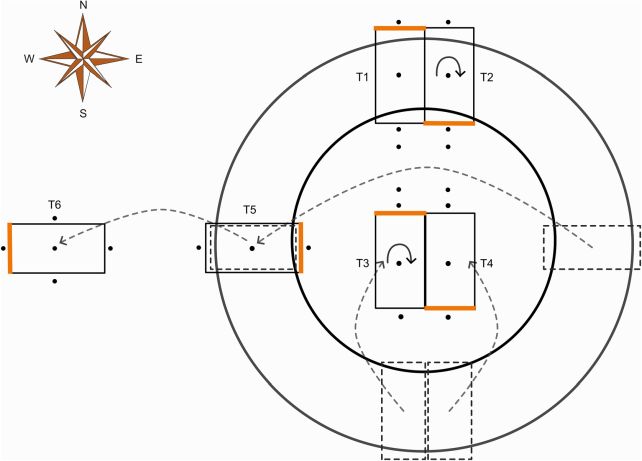
To test this, researchers excavated sections of each mushroom ring, then either turned them around or transplanted them to other locations. They subsequently left the fungus undisturbed and returned 14 months later to assess whether anything had altered.
Their observations most strongly supported what the researchers termed the transient-escape hypothesis.
In this model, the soil immediately behind the advancing front becomes temporarily unsuitable for growth. The fungus consequently continues into the soil in front of it, leaving the temporarily unfavourable conditions behind.
The findings did not reveal the reason for this pattern. One plausible account is that, as it travels through the soil, the fungus temporarily exhausts the available nutrients and keeps moving towards food.
A second possibility is that it releases toxins, briefly making the soil an unattractive place to grow.
Whatever the cause, however, the impact is not permanent. Fungi replanted in the centre of a circle were able to resume growing.

Meanwhile, a fungal segment transplanted entirely outside one ring kept growing in its original direction. The matching experiment with the other ring, however, resulted in growth in one additional direction.
Related: Hidden Web of Fungus Inside Earth Could Reach The Sun a Billion Times
More research will be required to establish whether any of these proposed explanations can be confirmed.
"Though additional studies with data from more rings, complemented with laboratory experiments, are needed to unveil the causal mechanism behind the observed patterns here, we show that it is possible to gain detailed information about fungal genomes directly from soil samples, which enables us to study vegetative growth of fungi in their natural environment," the researchers write.
"This will provide new insight and ignite new questions regarding the processes behind the fairy ring structure and growth pattern."
Still, it is worth noting that a solid disc would make a rather poor portal to fairyland.
The findings were published in Royal Society Open Science.
This article was fact-checked by Fiona MacDonald and edited by Peter Dockrill. While we take pride in our process, we are only human. If you spot an error, please let us know.


Comments
No comments yet. Be the first to comment!
Leave a Comment