
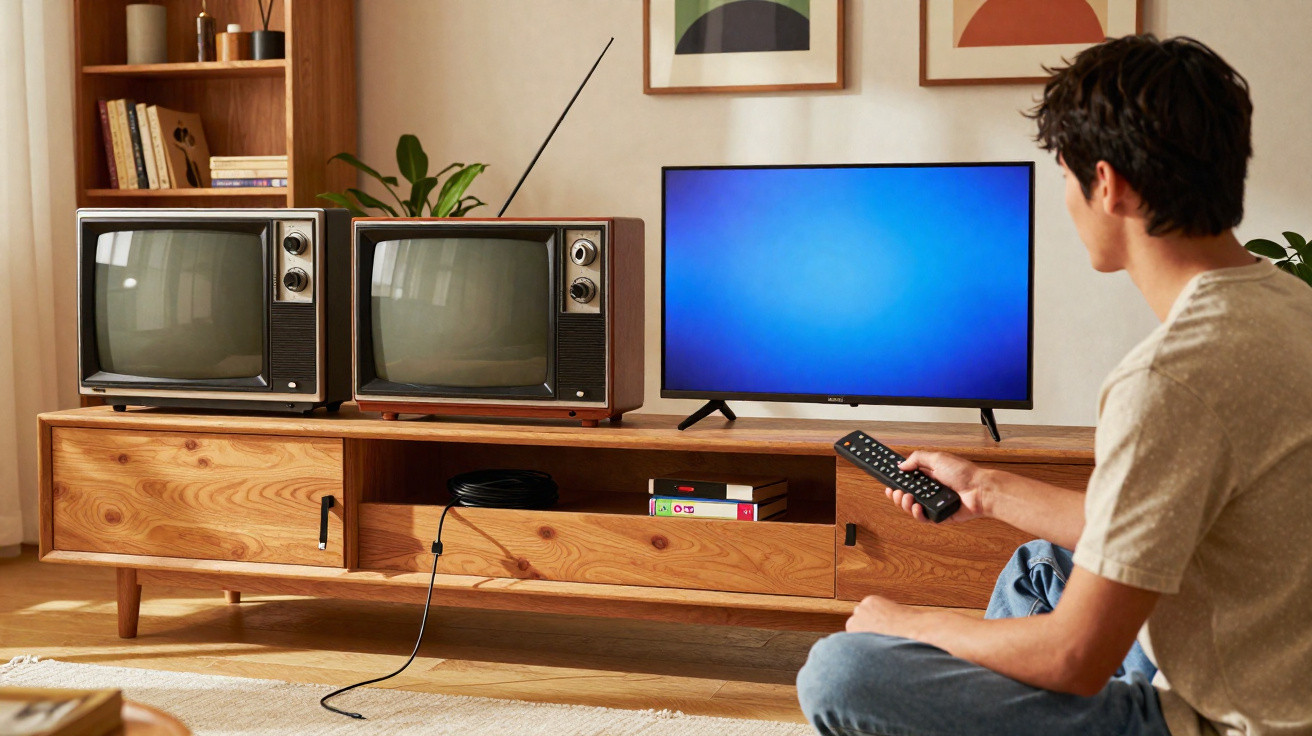
The compelling history of modern televisions spans decades of intense technological progress and ongoing challenges. The move from monochrome screens to colour displays revolutionised media consumption, turning a rudimentary mechanical experiment into the main entertainment hub for families around the world.
How did the first monochrome televisions work?
The earliest models, developed at the start of the last century, relied on mechanical discs and tiny viewing screens. These basic displays needed complex synchronisation with radio broadcasts to produce blurred pictures, requiring considerable engineering work to make any stable visual display possible for early viewers.
With the arrival of cathode-ray tubes, sets achieved sharper images while eliminating the irritating mechanical noise. This advance replaced the original mechanical scanning process with hundreds of electronic lines, establishing a higher quality standard in television that found its way into homes everywhere.
What do the letters HDMI mean on television cables?
This global standard carries high-definition digital audio and video signals, but the abbreviation conceals a technology that connects… Read more
What was the secret behind the introduction of colour?
The true colour revolution emerged through the mastery of light’s three primary colours. Engineers created systems that could produce specific red, green and blue beams, generating every visible shade and turning each analogue broadcast into a captivating, realistic visual experience.
The greatest difficulty was sending colour signals without making the millions of existing older receivers unusable. The industry had to establish compatible standards so audiences could continue watching regular programming, gradually encouraging the replacement of sets with models offering vivid colour images.
Below is a video from the Você Sabia? YouTube channel, which examines this technological transformation in detail:
How did television technology evolve after cathode-ray tubes?
Decades after colour broadcasting became established, bulky tubes gave way to ultra-slim screens. Plasma and liquid-crystal panels ushered in an era centred on resolution, replacing analogue lines with digital pixel matrices that delivered strong lighting performance in the home.
The introduction of LED technology and organic matrices improved contrast and the reproduction of absolute blacks. Each pixel began producing its own light independently, ensuring faithful illumination without the distortions found in the previous generation of electronic displays.
Milestones in Screen Evolution
Notable innovations
Technological developments that enabled television sets to be modernised:
- Replacement of mechanical discs with cathode-ray tubes;
- Adoption of the three-beam light system using red, green and blue;
- Transition to ultra-slim digital panels with advanced lighting control.
Which factors ensure greater image fidelity?
Current innovations focus on refined light control to achieve vivid, natural colours. Quantum dots and targeted illumination make it possible to adjust dark areas precisely, preventing gloomy scenes from appearing grey and preserving the original intention of cinematic creators.
Alongside dynamic contrast, colour consistency at different viewing angles has become essential in homes. Advanced screens prevent saturation distortions when viewed from the side, ensuring every viewer enjoys the same visual sharpness during shared events and games.
Several modern components work together to provide users with maximum colour accuracy:
- Local dimming control to produce deep black levels without light leakage;
- Quantum-dot filters that expand colour volume and vibrancy;
- Wide viewing angles that preserve visual fidelity from any position in the room.
Why does the evolution of television screens continue to surprise us?
The century-long journey of television sets demonstrates an ongoing pursuit of realism and visual perfection. From rudimentary discs to modern quantum matrices, each technological stage has refined human interaction with the screen, placing constant innovation at the heart of contemporary habits.
Understanding what lies behind this evolution makes it possible to appreciate the hidden complexity behind every scene shown each day. Televisions have moved beyond being simple signal receivers to become advanced centres for visual playback, connecting the viewer with the world of global culture.






Comments
No comments yet. Be the first to comment!
Leave a Comment