
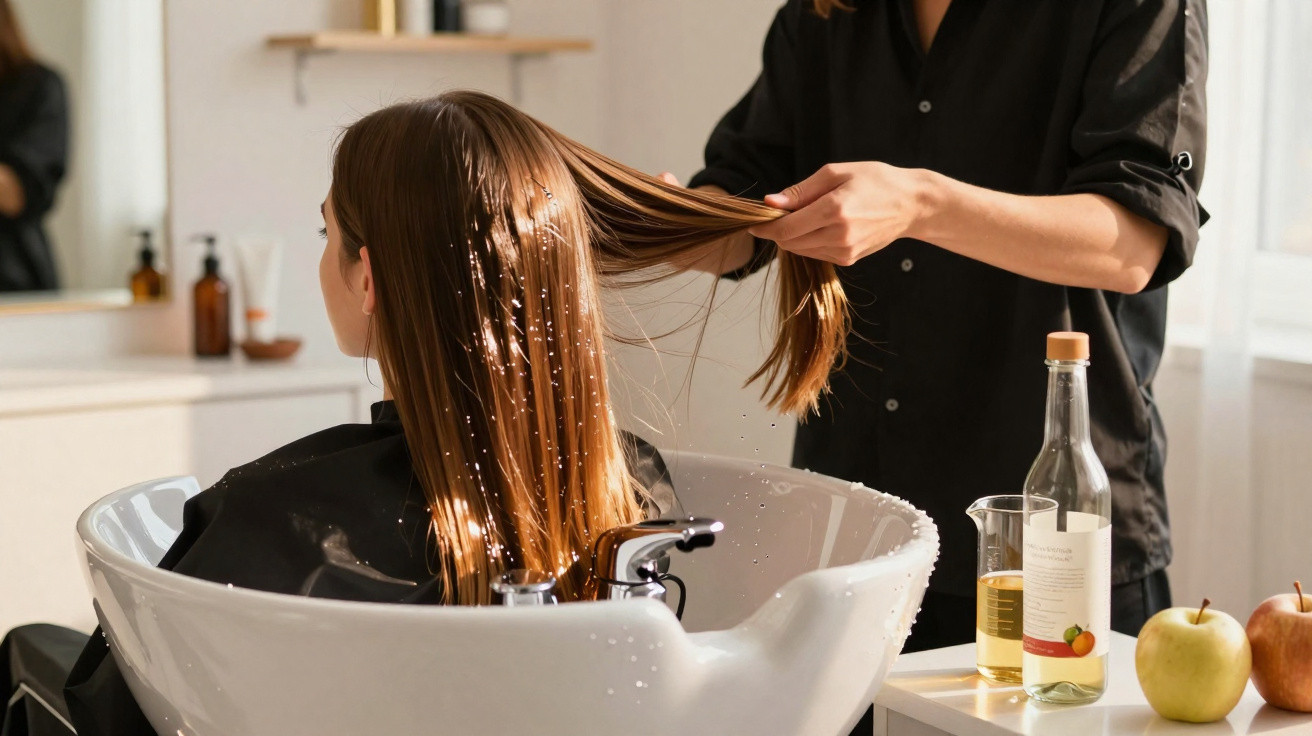
What my hairdresser took for an expensive professional treatment did not come from a luxury salon, but from my kitchen. A straightforward ingredient from the cupboard has now replaced both conditioner and hair mask in my routine, yet still leaves my hair feeling soft, light and glossy.
When the hairdresser suddenly asks about the luxury brand
Anyone who has regular trims knows the moment: you sit at the basin, already expecting the verdict of “dry ends, a little dull”, and mentally prepare yourself for another round of product recommendations. This time, however, things went very differently.
My hairdresser ran his hands through the lengths, paused for a moment and looked genuinely puzzled. To him, my hair felt as though it had just had an expensive salon treatment: smooth, virtually tangle-free and highly reflective in the light. His question was: “What do you use? Which brand is it?”
The twist was that there were no new high-end bottles in my bathroom. The real game-changer had come from the kitchen cupboard. It highlights a widespread misconception in the beauty world: we tend to associate effectiveness almost automatically with a high price.
“Hair responds to ingredients – not to marketing and bottle design.”
Many people spend money on increasingly complicated care routines because they want to recreate a “salon effect” at home. Often, though, one carefully selected and very simple component is enough to visibly improve the hair’s condition.
Why conventional conditioners can weigh down the lengths
Before trying the kitchen-based solution, I knew the familiar issue well: straight after washing, hair feels reasonably good, but two days later it hangs flat, looks dull and somehow feels “coated”.
One reason lies in the ingredients of many standard conditioners and masks. They often contain:
- silicones, which coat the hair like a film
- synthetic polymers that provide temporary manageability and shine
- heavy oils that make hair feel soft but can often weigh it down
Rather than addressing damage and roughness, these substances conceal them. With every use, tiny residues build up. Professionals call this “build-up”: an invisible layer that effectively encases the hair.
The everyday consequences include:
- The hair fibre absorbs genuine care and moisture less effectively.
- Over time, the lengths look duller, even when freshly washed.
- The scalp becomes oily more quickly because shampoo is used more often.
- The ends continue to dry out because they are constantly being “over-conditioned”.
This exact cycle pushes many people towards buying ever more products. A better approach can be to simplify the routine radically and introduce one minimalist but intelligent ingredient.
Apple cider vinegar: the unassuming home remedy from the past
The hero of my hairdresser experience is anything but exotic: apple cider vinegar. It is a classic cupboard staple that earlier generations had long used for skin and hair before cosmetic shelves became so crowded.
Apple cider vinegar is made from fermented apples. This process creates acetic acid, alongside minerals and trace elements. That combination makes it interesting for hair care:
- Its mild acidity loosens residue from limescale and styling products.
- The hair cuticle becomes visibly smoother.
- The lengths feel supple without becoming heavy.
- Natural shine looks clear and reflective rather than artificially “sprayed on”.
“Apple cider vinegar works like a gentle reset for hair overwhelmed by products and limescale.”
While strong clarifying shampoos can dry hair out quickly, diluted apple cider vinegar works more gently. The correct water-to-vinegar mix is crucial: it should never be applied neat to the skin or scalp.
How limescale and pH determine shine and tangles
Two factors can undermine hair condition without many people noticing: hard water and an unbalanced pH level.
Hard water: an invisible film on hair
In many areas, tap water contains plenty of limescale. With every wash, tiny crystals settle on the hair surface. As a result, the lengths feel rough, are more difficult to comb and can take on a greyish, dull appearance.
Apple cider vinegar is naturally acidic. That acidity helps dissolve and rinse away limescale deposits. Once the surface is clearer, light can reflect directly again – and the shine returns.
pH level: the cuticle switch
Healthy hair and a healthy scalp sit in a slightly acidic range, roughly between 4.5 and 5 on the pH scale. Many shampoos, and especially tap water, are above this level and therefore more alkaline.
This causes the hair cuticle to open. Open cuticles mean:
- more frizz because the surface feels rough
- more tangles because hairs catch on one another more easily
- less shine because light is not reflected cleanly
Diluted apple cider vinegar returns the pH level to the mildly acidic range. The cuticle closes, hair feels smoother and is less likely to break during brushing.
The easy “1-to-4” method: how to use apple cider vinegar correctly
For the treatment to work without irritating the scalp, two things matter: correct dilution and appropriate application. Many people are put off by the smell of apple cider vinegar, but find that no scent remains once the hair has dried.
The basic rinse recipe
This ratio is tried and tested:
- 1 part apple cider vinegar, ideally unfiltered and organic
- 4 parts cold or cool water
Pour the mixture into a bottle or measuring jug, then give it a quick shake.
Step-by-step application after shampooing
- Wash your hair with shampoo as usual and rinse thoroughly.
- Slowly pour the diluted apple cider vinegar over the scalp and lengths.
- Gently massage it into the scalp with your fingertips, then run it through the lengths.
- Leave it on for two minutes so that the acid and minerals can work.
- Finally, rinse thoroughly with cool water.
If you are willing to try it, finish with a brief blast of very cool water. The temperature change provides extra support in closing the cuticle. Afterwards, hair feels unusually “squeaky clean”, is easy to comb once dry and falls more lightly.
A noticeable difference to waste, spending and bathroom shelves
The hair transformation is only one aspect. Anyone using apple cider vinegar regularly will usually remove several products from their routine at once: conditioner, intensive masks, gloss sprays and sometimes even scalp tonics.
This has tangible effects:
- Less plastic: rather than using several bottles each year, one glass bottle of apple cider vinegar diluted with water is often enough.
- Lower costs: the price per litre of specialist treatments is often considerably higher than that of a good bottle of vinegar.
- More clarity: the bathroom becomes easier to manage when every hair concern does not require a separate product.
“Anyone who makes apple cider vinegar a permanent part of their routine saves several plastic bottles of conditioner or hair mask each year.”
Many users report that using it once a week is enough to keep the lengths consistently glossy. Those who wash their hair daily can also schedule the treatment every two or three washes.
Who is the method suited to – and where are the limits?
The vinegar rinse is particularly suitable for people with:
- fine hair that quickly feels weighed down
- a slightly oily scalp and dry ends
- hard tap water with high limescale content
- frizz caused by open cuticles
The method is less suitable if the scalp is acutely inflamed, has open areas or reacts with extreme sensitivity. In such cases, medical advice should be sought first.
Those with heavily coloured or extensively chemically treated hair should also proceed cautiously: begin with a weaker dilution, leave it on for less time and observe how the lengths respond.
Practical extra tips for everyday use
If the scent is bothersome, the mixture can be given a subtle fragrance without compromising its effect. One or two drops of essential oil, such as lavender or rosemary, in the bottle are enough. It is important not to overdo it, so the scalp and hair are not unnecessarily weighed down.
For especially dry ends, a combination can work well: use an apple cider vinegar rinse for shine and pH balance, then apply a tiny drop of lightweight plant oil to towel-dried lengths. This keeps the hair flexible while giving it added protection.
If you use excessive styling products, hairspray or dry shampoo once a month, pair the vinegar rinse with a gentle clarifying shampoo. Use the shampoo first, followed by the diluted vinegar treatment – this removes product build-up without placing unnecessary strain on the hair structure.
There is no miracle product at work here, but a logically explainable result: fewer layers on the hair, a cleanly closed cuticle and neutralised limescale residue. The hairdresser sees only the shine – what lies behind it is something everyone can quietly decide for themselves at the kitchen shelf.





Comments
No comments yet. Be the first to comment!
Leave a Comment