
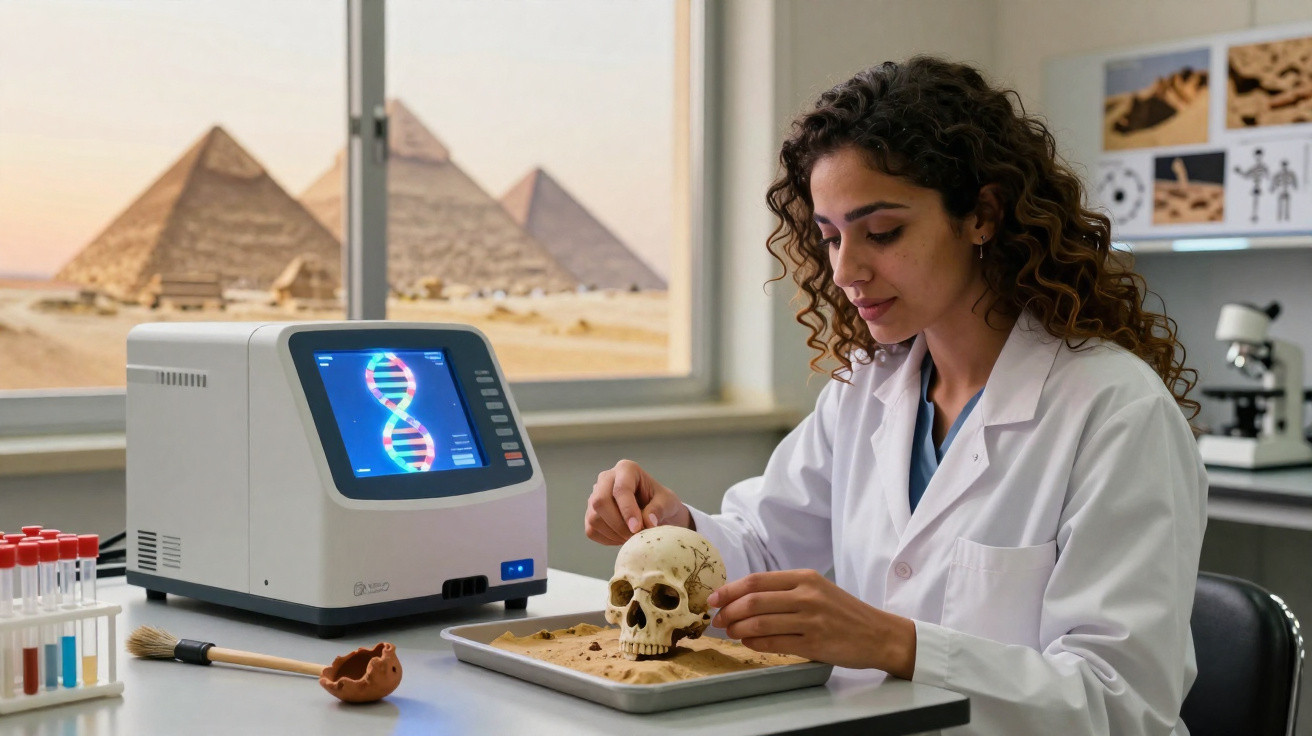
For the first time, researchers have sequenced DNA from the complete genome of a person who lived in ancient Egypt as long as 4,800 years ago, during the era when the earliest pyramids were under construction.
The ancient genome came from an older man who was likely a member of the social elite. His ancestry indicates that he probably had brown hair, brown eyes and dark skin.
Roughly 80 percent of his genome is associated with North African lineages, with the other 20 percent connected to lineages from West Asia.
Ancient Egypt and genetic links to Mesopotamia
The results indicate that early Egypt may have been a cultural melting pot, as migrants and merchants arrived from elsewhere in Africa and from Mesopotamia - the ancient area now spanning parts of Iraq, Türkiye and Iran.
Earlier archaeological findings had already pointed to commercial and cultural ties between Egypt and other regions of the Fertile Crescent. These links were chiefly reflected in the transfer of domesticated plants and animals, writing systems, and technologies including the pottery wheel.
However, human DNA is far harder to preserve in this hot, arid region. This latest find is the oldest DNA yet retrieved from ancient Egypt, and the researchers say the remains offer "direct evidence of genetic ancestry" from Mesopotamia.
"Ancient Egypt is a place of extraordinary written history and archaeology, but challenging DNA preservation has meant that no genomic record of ancestry in early Egypt has been available for comparison," says geneticist Pontus Skoglund, who founded the first high-throughput ancient DNA laboratory in the United Kingdom at the Francis Crick Institute.
"Building on this past research, new and powerful genetic techniques have allowed us to cross these technical boundaries and rule out contaminating DNA, providing the first genetic evidence for potential movements of people in Egypt at this time."
The ancient Egyptian man's burial and life
The man's remains were found in a necropolis at Nuwayrat, an ancient city 265 kilometres south of Cairo. He had been placed in a large pottery vessel within a rock-cut tomb, and died at some point between 2855 and 2570 BCE.
During his lifetime, he stood about 160 centimetres tall. His severely worn teeth and pronounced arthritis suggest he was probably aged between 44 and 64 - a notably advanced age for that period.
Although the style of his burial points to high social standing, his body unexpectedly shows indications of regular physical work.
"His seat bones are expanded in size, his arms showed evidence of extensive movement back and forth, and there's substantial arthritis in just the right foot. Though circumstantial, these clues point towards pottery, including use of a pottery wheel," suggests bioarchaeologist Joel Irish from Liverpool John Moores University.
"That said, his higher-class burial is not expected for a potter, who would not normally receive such treatment. Perhaps he was exceptionally skilled or successful to advance his social status."
Diet, survival and future ancient Egypt research
By examining the isotope mixture in the man's second molar, scientists found signs that he had grown up in the hot, dry Nile Valley. His diet included animal protein and plants such as wheat and barley, which was typical of early Egyptians.
"This individual has been on an extraordinary journey. He lived and died during a critical period of change in ancient Egypt, and his skeleton was excavated in 1902 and donated to World Museum Liverpool, where it then survived bombings during the Blitz that destroyed most of the human remains in their collection," says archaeogeneticist Linus Girdland Flink from the University of Aberdeen.
"We've now been able to tell part of the individual's story."
The story of one person cannot reveal everything researchers want to understand about ancient Egypt, but these results provide an intriguing beginning.
The team hopes its method will make possible a "more detailed and nuanced understanding of ancient Egyptian civilization and its inhabitants" in future.
The study was published in Nature.






Comments
No comments yet. Be the first to comment!
Leave a Comment