
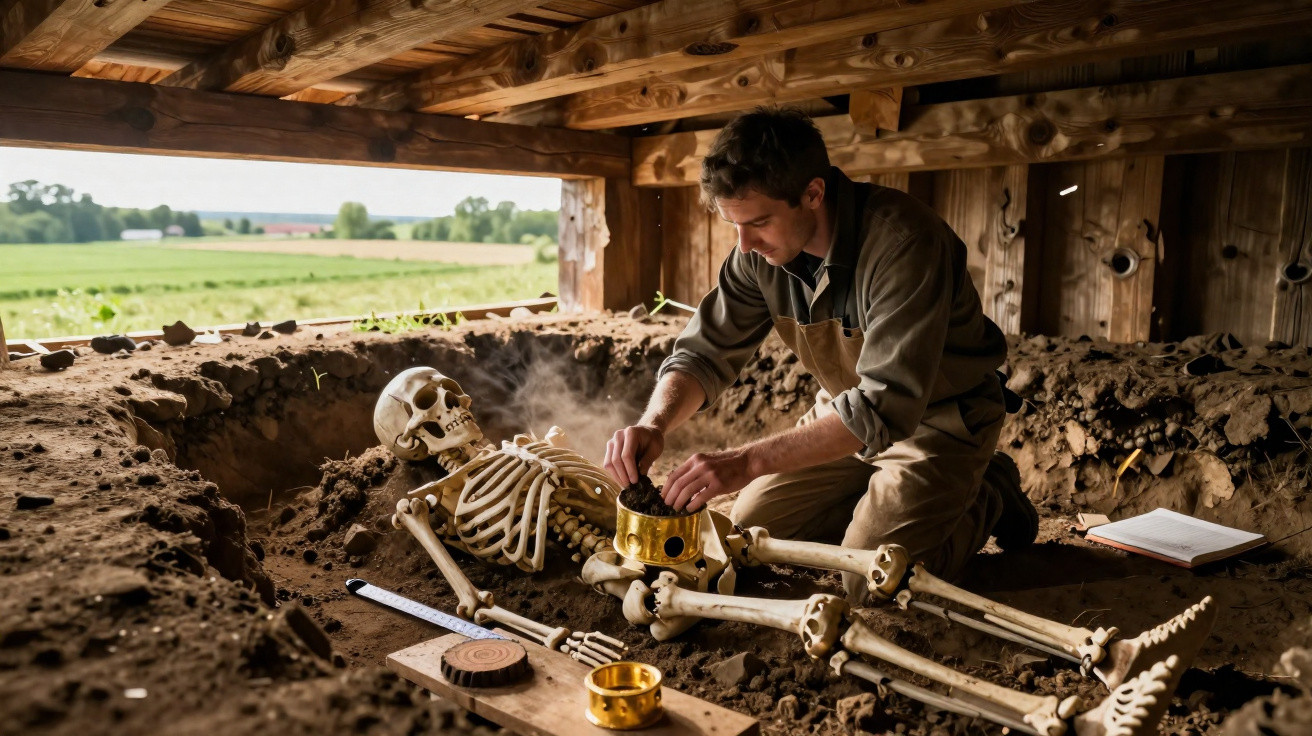
Archaeologists in southern Germany have discovered an exceptionally preserved Celtic burial chamber, believed to be “princely” and approximately 2,600 years old. Although it was plundered in antiquity, the wooden tomb survives in such remarkable condition that experts believe it may reshape understanding of early Celtic elites.
A monumental mound on the Danube plain
The chamber was found close to Riedlingen in Baden-Württemberg, on the broad upper Danube plain. Baden-Württemberg’s Ministry for Regional Development and Housing announced the discovery on 18 October 2024, following scheduled archaeological investigations carried out before construction work.
Archaeologists initially located a burial mound, or tumulus, standing roughly two metres above the surrounding ground and measuring about 65 metres in diameter. Its form and internal structure indicate that the mound may originally have been around six metres high.
The size and form of the mound suggest the grave belonged to a high-ranking individual, possibly part of an early Celtic ruling elite.
From about 620 to 450 BC, societies in present-day south-west Germany created these vast earthen mounds for important people. Archaeologists commonly call them “princely graves”, not because their occupants were necessarily royalty, but because they signal exceptional status and accumulated wealth.
A looted grave, but a wooden chamber almost intact
At the centre of the Riedlingen mound, only 70 centimetres beneath the modern ground surface, the excavation team made an unusual discovery: a substantial oak chamber that has survived almost completely intact.
Built from heavy oak beams, the wooden room measures around 3.4 metres across and 4.05 metres in length. For a structure that has been underground for more than two and a half thousand years, its condition is extraordinary.
Anyone expecting glittering grave treasures will be disappointed, however. Grave robbers entered the mound at least twice in antiquity, tunnelling through it and breaking into the chamber. They appear to have taken most of the objects originally placed around the dead person.
Even with most valuables long gone, archaeologists insist the true treasure may be the wood itself and the information it holds.
The chamber remained sealed and waterlogged for centuries, allowing the oak to retain sufficient structural integrity for close examination. Dirk Krausse, Baden-Württemberg’s state archaeologist, has described the tomb as “a stroke of luck for archaeology”, emphasising that wooden structures of this date rarely survive so well in central Europe.
Pinpointing a date ring by ring
Researchers intend to date the chamber using dendrochronology, which examines annual growth rings in timber. Every ring represents one year, and patterns of broader and narrower rings can be compared with established chronologies, frequently identifying an exact calendar year.
Although the complete findings are not yet available, preliminary examination of a wooden artefact has provided an early indication. A club-shaped object recovered from the tomb has provisionally been dated to around 585 BC, placing the burial at the beginning of the Celtic Iron Age in this area.
The quality of the oak beams should allow researchers to determine not just when the tree was felled, but possibly the season of construction.
Anthropologists also recovered human bones alongside the wooden object. Initial examination suggests that they belonged to a male aged between 15 and 20, with an estimated height of 1.60 to 1.68 metres.
That assessment immediately prompts further questions. Was he a young leader, a prince who died before assuming power, or a member of an influential family whose position alone justified a monumental burial? Continued analysis of the remains could identify evidence of disease, trauma or diet, offering clues to his life and death.
A rare window on early Celtic elites
Regional officials regard the chamber as more than a dramatic discovery: it is an uncommon source of evidence for a period that remains poorly understood. At a press conference, Andrea Lindlohr, state secretary at Baden-Württemberg’s development ministry, called the burial an “exceptional testimony” to regional heritage and noted that it is still fully preserved 2,600 years after being built.
Early Celtic communities in central Europe produced almost no surviving written evidence. In contrast to the later Greeks and Romans of the classical world, they left no enduring written accounts of their history, laws or myths. What is known today depends largely on archaeology, later Greek and Roman writers, and considerable academic debate.
Some historians have argued that the “Celts” as a single, coherent people might be more of a convenient label than a clearly defined historical reality.
For instance, the British magazine The New Statesman once called the Celts a “historical mirage” used to bridge a chronological gap. Discoveries such as the Riedlingen tomb, which offers securely dated and well-preserved material, can anchor that discussion in physical evidence rather than conjecture.
What the Riedlingen tomb could reveal
Even without impressive gold or bronze finds, the wooden chamber may yield extensive evidence. Researchers hope it will help answer questions including:
- What building methods were used for elite burials?
- Where were the oak trees grown, and how were they managed?
- Which rituals accompanied burial in chambers of this type?
- How does this mound relate to other early Celtic “princely” graves in Germany and France?
Microscopic examination of soil and wood remains could reveal evidence of fabrics, food deposits or organic ornamentation either overlooked by looters or no longer recognisable as objects.
Looters, timelines and the science behind the wood
The ancient robber tunnels also provide evidence in their own right. Their dimensions and location may indicate how far the mound had eroded when it was plundered, helping archaeologists establish a relative sequence of construction, burial, reopening and later natural alteration.
Scientifically, the oak beams are exceptionally valuable. Dendrochronology compares overlapping tree-ring sequences from living trees, historic buildings and archaeological timber.
| Method | What it reveals |
|---|---|
| Dendrochronology | Exact year (and sometimes season) the tree was felled |
| Isotope analysis | Climate conditions and possible origin of the wood |
| Microscopic study | Tool marks, construction techniques and timber quality |
Together, these approaches may establish whether the timbers came from one woodland, whether they were felled simultaneously and how deliberately builders chose and prepared them. This can, in turn, reveal the organisation of labour, access to resources and capacity for planning within early Celtic communities.
Why a teenage “prince” in a wooden room matters
A high-status burial for someone so young calls into question some ideas about authority in early Iron Age societies. If the preliminary assessment is confirmed, it may indicate that descent and family connections outweighed age or experience. The mound could therefore represent the standing of an entire clan, rather than only the life of one person.
The lack of lavish grave goods also requires restraint in interpretation. Those seeking treasure probably removed metalwork and jewellery, while leaving behind less conspicuous items made of wood, textiles or leather. With modern analytical methods, such neglected fragments may prove more informative to archaeologists than gold.
For students and visitors seeking to understand this era, the Riedlingen discovery provides a tangible example. Rather than considering an indistinct “Celtic prince”, they can trace a particular individual buried at an identified location, at a known date, in a precisely measured chamber made from trees that can be identified.
From a quiet field to a new reference site
Excavation teams will continue their work around the mound in the months ahead. They will search for signs of a nearby settlement, smaller burials or ritual buildings that may have been associated with the central grave. Should such features be found, the Riedlingen site may become a reference location for research into early Celtic Europe.
What started as a routine excavation at a German development site has, for the moment, become an unusual opportunity to see archaeology at its most methodical and exact: interpreting a 2,600-year-old account, ring by ring and beam by beam, from a wooden chamber made for a young man whose name will probably never be known.






Comments
No comments yet. Be the first to comment!
Leave a Comment