
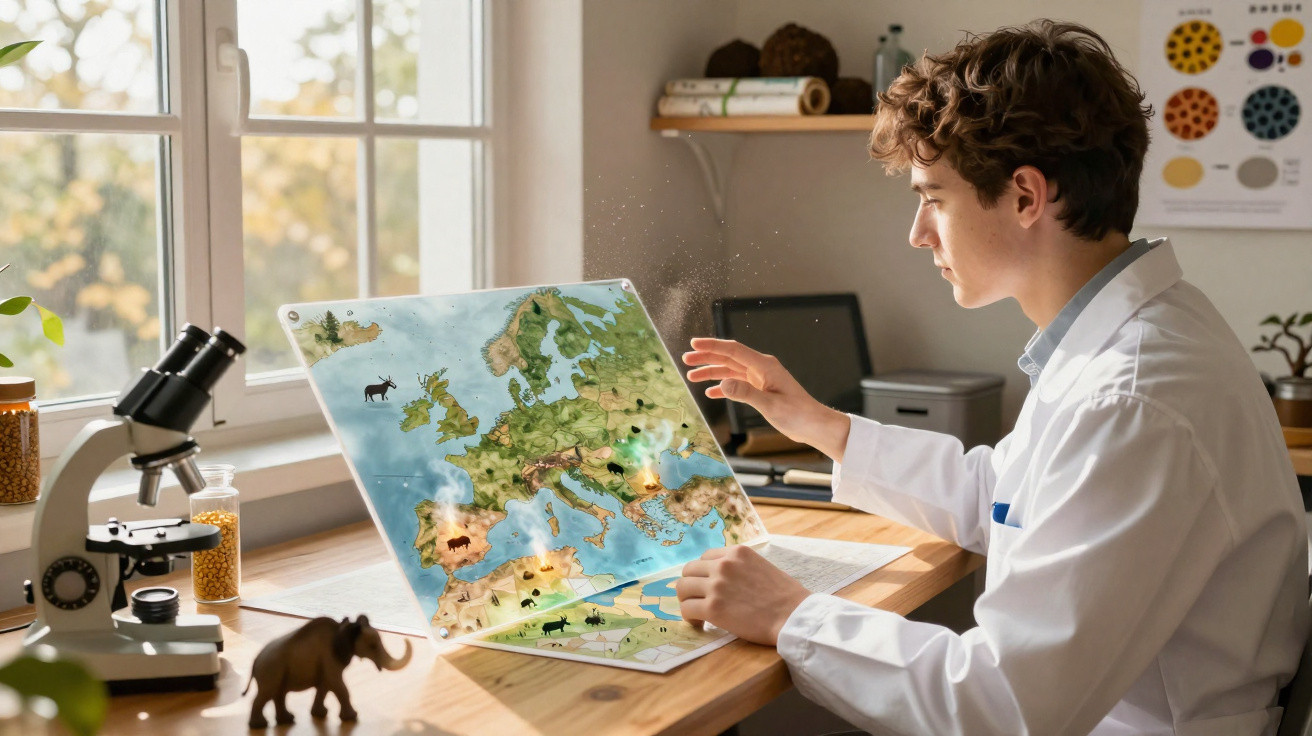
New findings indicate that prehistoric humans did more than pass through unspoilt forests: they actively changed them using fire and spears, producing detectable effects tens of thousands of years before agriculture emerged.
Ancient Europe was not an untouched wilderness
For many years, Ice Age and early post-Ice Age Europe was portrayed as an almost entirely natural setting, with dense woodland, wandering megafauna and small human communities making little impact on the land. A new study in the journal PLOS One disputes that reassuring image.
An international research team applied sophisticated computer modelling to recreate changes in European vegetation during two warmer periods in the past:
- Last interglacial (around 125,000–116,000 years ago), when Neanderthals were Europe’s only human inhabitants
- Early Holocene (about 12,000–8,000 years ago), when Mesolithic hunter-gatherers of our own species, Homo sapiens, lived throughout the continent
The researchers tested their simulations against detailed pollen evidence recovered from lake sediments and peat deposits. These grains of pollen work like minute time capsules, showing which plants were dominant at different points in the distant past.
When researchers added human hunting and fire to their simulations, the virtual landscapes suddenly matched the real pollen data far more closely.
The result leads to a clear conclusion: humans were modifying ecosystems well before the arrival of ploughs, settled villages and cultivated crops.
Neanderthals hunted giants, not only deer
The models indicate that Neanderthals influenced vegetation, although their effects were less extensive than those of later people. Their main ecological influence came through hunting large herbivores.
Europe in the last interglacial supported a remarkable variety of large animals. Forest elephants and rhinoceroses lived alongside bison, wild cattle known as aurochs, horses and several deer species. By grazing and browsing, these enormous animals maintained open spaces, damaged young trees and influenced plant communities.
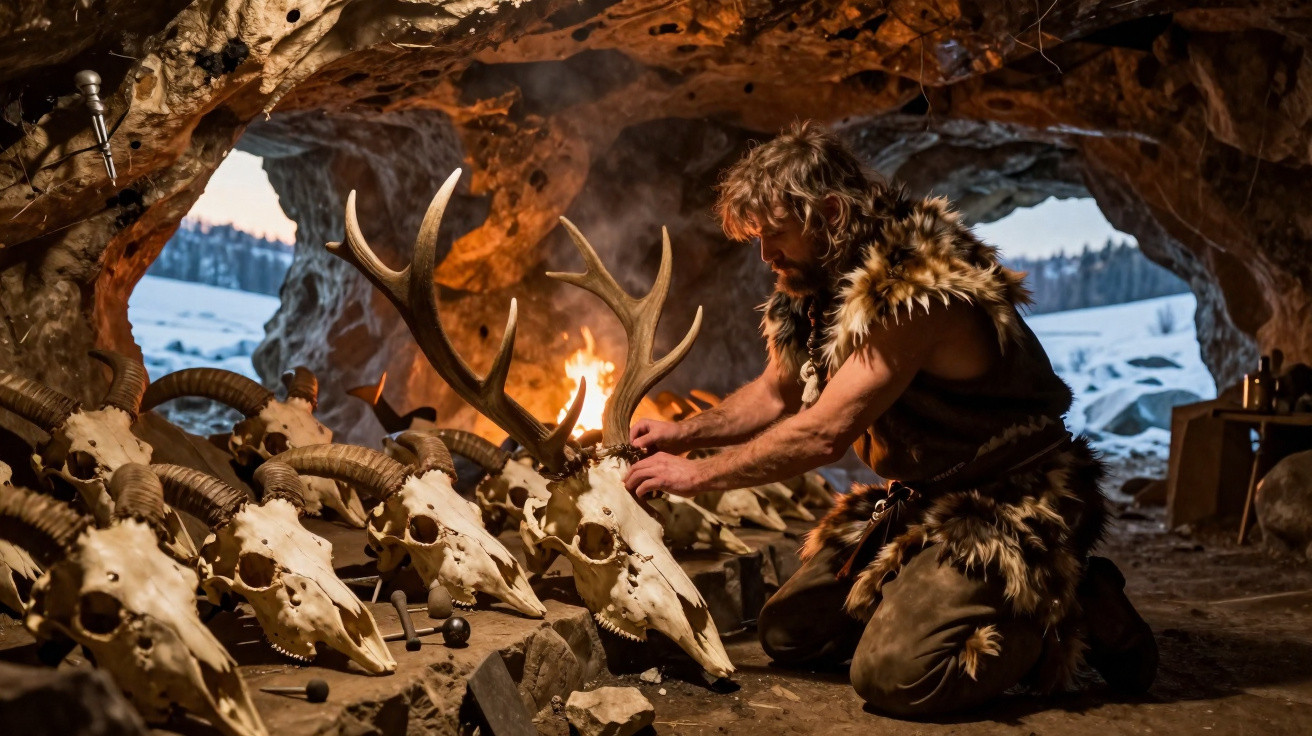
Current evidence suggests that Neanderthals did not leave the largest animals alone. At times, they hunted prehistoric elephants weighing as much as 13 tonnes, employing co-ordinated group strategies and weapons used at close range.
Fewer elephants and other mega-grazers meant less pressure on young trees, allowing bushier, denser vegetation to spread.
According to the modelling, Neanderthals influenced approximately 6% of plant-type distribution and around 14% of total vegetation openness. Although this may appear limited, it represents a significant ecological contribution given their very low population densities.
Neanderthals were not numerous enough to eliminate large mammals wholesale. Nevertheless, their selective hunting, use of fire and patterns of movement subtly changed the balance between open ground and dense woodland.
Mesolithic hunter-gatherers reshaped nearly half the landscape
By the Early Holocene, conditions had shifted greatly. The most recent ice age was over, glaciers had retreated and Homo sapiens had spread across Europe. Many of the biggest animals had disappeared or undergone major population declines, as part of a wider worldwide wave of megafauna losses following the expansion of our species.
The study concludes that Mesolithic hunter-gatherers exerted a much greater effect on vegetation than Neanderthals had.
According to the simulations, Mesolithic communities may have altered up to 47% of the distribution of plant types across Europe.
The data identifies two principal processes:
- Fire use: Deliberate or partly controlled burning of trees and scrub opened forests, favoured particular plants and assisted with the management of game.
- Intensive hunting: Hunting large herbivores reduced their grazing pressure, pushing some regions towards more closed-canopy woodland and creating patchier landscape mosaics elsewhere.
This pattern supports ethnographic observations of more recent hunter-gatherer societies, in which hunting and fire are important means of managing land, encouraging useful plants and drawing in animals.
Mesolithic hunter-gatherers challenge the myth of pristine pre-farming Europe
The research team says the findings run counter to the widespread notion that Europe remained an unspoilt wilderness until farming populations arrived from the Near East around 8,000 years ago.
The evidence points to Neanderthals and Mesolithic people as “co-creators” of European ecosystems, not passive occupants of a natural stage.
Human choices over where to hunt, where to burn and which animals to pursue had already shaped forests, grasslands and mixed mosaics. Agriculture intensified and formalised this connection, but it did not create it.
How AI and pollen records transformed ancient ecology
The headline result rests on a technical advance. The team brought together knowledge from ecology, archaeology, geology and palynology, the study of pollen.
They produced continent-scale simulations of earlier European ecosystems and then used an AI-based optimisation algorithm to test huge numbers of scenarios. In each scenario, they adjusted the strength of climatic influences, natural fires, animal populations and human activities.
| Factor tested | Role in the models |
|---|---|
| Climate | Baseline control over temperature, rainfall and ice cover |
| Large herbivores | Grazing and browsing pressure on plants |
| Natural wildfires | Background disturbance shaping forests and open areas |
| Human fire use | Additional, targeted burning beyond natural lightning fires |
| Human hunting | Direct reduction of large animal populations |
By matching the simulation results with genuine pollen records from lakes and peatlands, the researchers identified the combinations that most closely reproduced ancient plant patterns. Models excluding humans simply did not match the evidence.
Why the findings matter to today’s rewilding debates
The research appears as Europe commits heavily to rewilding initiatives, ranging from bison reintroductions to permitting forest recovery on abandoned agricultural land. Many such schemes are based on the idea of restoring a “natural” condition that existed before intensive human land use.
However, the new research indicates that even a baseline extending tens of thousands of years into the past already contains a human contribution. Prehistoric communities indirectly shifted animal populations through hunting, while directing plant communities through burning and other disturbances.
Restoration projects may need to think less about going back to a human-free past, and more about recovering dynamic, human-influenced mosaics.
This does not undermine the case for conservation. Rather, it makes it more precise: landscapes may remain diverse and resilient when people behave as careful partners within ecosystems instead of acting solely as extractive forces.
What “megafauna” and “pollen data” actually mean
The research centres on two specialist terms: “megafauna” and “pollen records”. Both merit explanation because they determine how researchers interpret the deep past.
Megafauna generally refers to land animals weighing more than about 45–50 kilograms, approximately the size of a large sheep or larger. In this study, the category covers:
- Elephants and rhinoceroses
- Bison and aurochs, the wild ancestors of cattle
- Large deer and wild horses
Such species shape habitats simply through feeding, trampling and travelling. Removing them from an ecosystem changes how trees spread, causes grasslands to contract or expand, and alters fire regimes.
Pollen data is obtained from cores drilled far down into lake beds or peat bogs. Every core layer represents a period of time and contains pollen grains carried in by wind or water from nearby vegetation. By identifying pollen types and establishing the ages of the layers, scientists can reconstruct which plants were most common at specific times. This extended record provides the benchmark against which climate and ecosystem models are assessed.
Future simulations and their potential discoveries
The team now intends to apply its methods to other areas, particularly the Americas and Australia. Neither continent was home to Neanderthals or other earlier human relatives; both were settled solely by Homo sapiens during the past 60,000 years or so.
This contrast creates a natural experiment. Comparing late Ice Age ecosystems before and after human arrival could allow scientists to follow the pace of megafauna disappearances and the ways plant communities responded.
Using the simulations across several time slices may establish whether Europe’s pattern also occurred elsewhere: relatively modest initial human effects, followed by more substantial change as populations increased and toolkits became more advanced.
For anyone following present-day climate and biodiversity trends, the study offers a sobering message. Small populations with basic technology can redirect ecosystems when they persist over long periods and occupy wide areas. Fossil fuels and global trade allow modern societies to magnify that capacity many times over.
At the same time, the work suggests a more optimistic possibility. If stone-tool-using hunters who employed fire could live alongside rich megafauna populations and varied landscapes for tens of thousands of years, careful, humble, data-led environmental management today may still make space for flourishing nature and human communities alike.




Comments
No comments yet. Be the first to comment!
Leave a Comment