
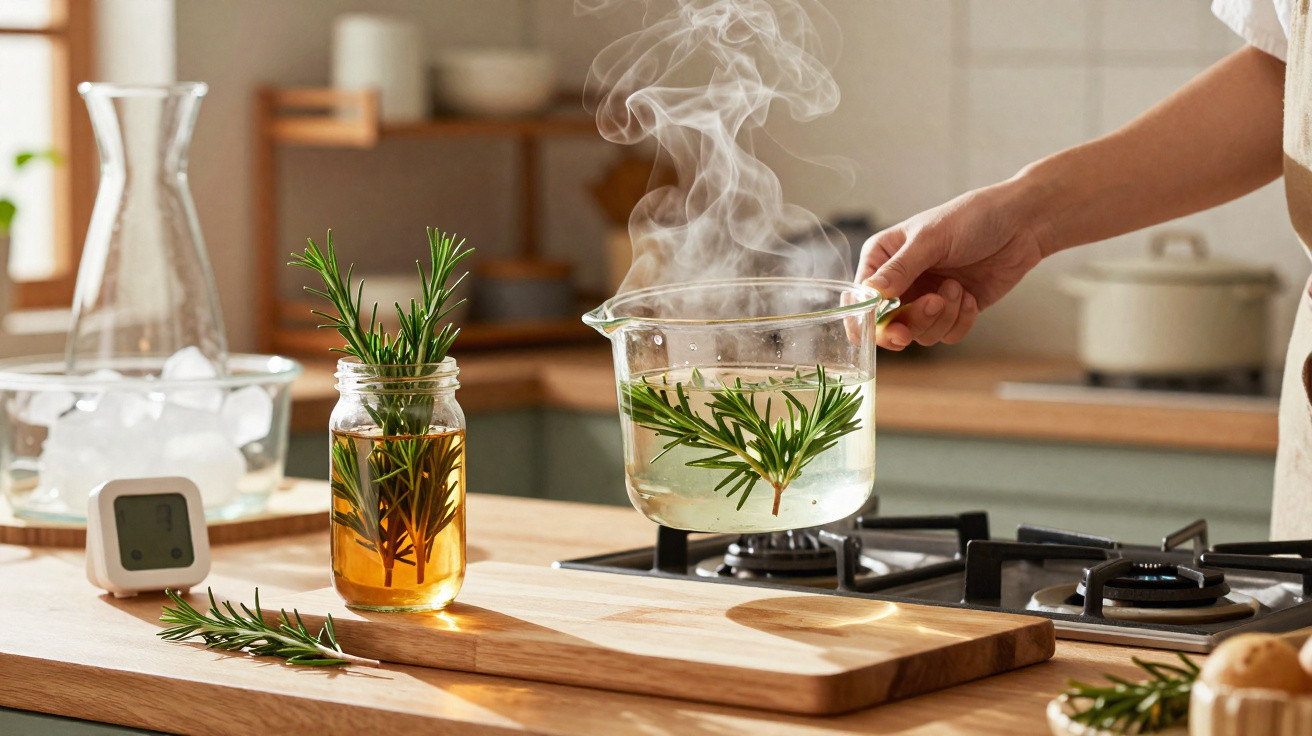
A compact kitchen, an exhausting weekday evening, and a few rosemary sprigs slipped into water just below boiling point. The aroma arrives quickly - resinous, pine-like and slightly untamed - and, for a moment, the room feels less like a rented flat and more like a small ceremonial corner you had forgotten was yours.
Your phone vibrates on the worktop. It is another short clip of somebody doing precisely this: boiling rosemary, leaving it to bubble for several minutes, then straining it into a glass jar. The comments race by - hair growth, improved sleep, fresher air, “this changed my life.” You look at your own saucepan: the same herb, the same vapour, the same expectation.
The water becomes amber, the heat is turned down, and the fragrance stirs something older than the app that introduced it to you. It leaves you asking: what, exactly, are we boiling?
Why rosemary water suddenly seems magical
Open TikTok or Instagram today and you will probably come across a person boiling rosemary in their kitchen. In some videos it is for hair, in others for skin, and sometimes it is simply intended to “cleanse the space”. The visuals are nearly always the same, although the implied benefit changes: less hair shedding, greater shine, fewer blemishes or more peaceful evenings.
Its appeal lies in how uncomplicated it is. There are no hard-to-find ingredients or trips to the chemist, only an ordinary herb that may already be wilting in a balcony pot. A saucepan, several sprigs and some tap water are all you need. At a time when routines are increasingly elaborate, this small ritual can seem like a quick route to feeling better.
The comments reveal just how readily a trend becomes a surge. One creator posts a before-and-after image of her hairline; another insists her kitchen smells “like a Mediterranean spa”; a third says she does not know whether it works but “it makes me feel like I’m doing something for myself.” On social media, that is more than enough to attract millions of views.
Beneath the excitement is a more subdued narrative. People are weary of lengthy ingredient labels and products that promise the world before seeming to offer slightly less every month. Boiled rosemary feels unlike that. It is inexpensive, tangible and unexpectedly personal - you can watch the plant transform before your eyes. Rather than purchasing a product, you are creating one. That resonates in an age when so much of life comes in packaging.
Science provides just enough support to keep the interest alive. Rosemary has antioxidant and anti-inflammatory compounds, including rosmarinic acid and carnosic acid, which frequently appear in hair and skincare products. A number of small studies suggest rosemary oil may help support scalp health or circulation. No one is describing it as a miracle treatment, but the underlying premise is not implausible.
The trend therefore occupies an ideal internet middle ground: it is neither complete fantasy nor conclusively proven, yet it has enough basis to appear credible. It is attractive on screen, pleasant in person and fits neatly into the story we want to believe - that the answer was in the kitchen all along.
How people boil rosemary water at home
The approach copied by most users is remarkably consistent. Take a handful of fresh rosemary - many videos use three to six sprigs - wash it under cold water, then place it in a small pan of simmering water. Avoid a fierce, rolling boil; aim instead for a gentle simmer, with ripples across the surface rather than vigorous bubbling.
After around 10 to 15 minutes, the liquid becomes slightly darker, taking on the pale colour of tea, while the fragrance spreads through the room. Some people allow it to cool in the pan, whereas others strain it straight away into a glass jar and leave it on the counter until it reaches room temperature. When cool, it is commonly stored in the fridge in a Mason jar, where it resembles a mysterious homemade tonic.
After that, people use it in different ways. Some decant it into a spray bottle and mist damp hair after washing. Others apply it as a scalp rinse, massaging it in before a final rinse with plain water. A smaller number keep it as a basic room spray or pour a little into bathwater. One ingredient becomes several small, almost private, rituals.
Listen to people describe the practice and it becomes clear that they are not merely talking about herbs; they are talking about control. A student in London records herself boiling rosemary on a Sunday evening and says she feels “like my grandmother is in the kitchen with me.” A new mum in Texas makes it into a peaceful project during nap time, quietly saying it is the only part of her day that feels “just mine.” In the comments, an overworked nurse admits she has not really noticed hair growth yet, but says the scent helps her relax after a night shift.
Those scenes are recognisable. Practically speaking, rosemary water is almost absurdly easy. Emotionally, though, it connects with something broader: the wish to slow down, to stir a pan rather than scroll a screen, and to do one small thing that has not been optimised or monetised. On a platform driven by speed and distraction, watching a pan steam gently can feel almost defiant.
That also explains why the trend travels so quickly. It is simple to replicate, film and adapt. Users alter the steeping time, add a lemon slice, include several sage leaves, or say they prefer a stronger or milder brew. It turns into a discussion rather than merely an instruction video. When a ritual offers that much flexibility, it can fit smoothly into millions of different lives.
Naturally, expectations rise just as fast. Some users begin comparing photographs of their hairlines week by week, while others are disappointed after three days because nothing “dramatic” has occurred. Let us be honest: nobody maintains every wellness habit they began after seeing it in a 15-second video.
Boiling rosemary safely without the hype hangover
For anyone keen to try it, the safest method is also the most straightforward. Use fresh rosemary where possible, preferably from a trusted supplier, and wash it thoroughly. Heat water until it is close to boiling, add the sprigs, then reduce the heat until the surface barely trembles. Simmer for 10 to 15 minutes; there is no reason to continue until the leaves appear limp and grey.
Allow the liquid to cool fully before applying it to your skin or scalp. Remove the leaves, transfer the rosemary water to a clean glass bottle and store it in the fridge. Creators who have used it over time generally recommend using it within a week, and throwing away any remaining liquid if it turns cloudy or develops an unpleasant smell. A simple smell check is more reliable than any viral advice.
If you intend to apply it to hair or skin, introduce it gradually. Begin with a patch test on the inside of your elbow or behind your ear, particularly if your skin is sensitive. Initially use it once or twice weekly, then observe how your scalp or face reacts. No trend justifies a week of itching.
Problems often arise when people mistake “natural” for “risk-free”. Rosemary is a plant rather than a miracle, and some individuals are sensitive to it. Boiling can concentrate certain compounds, which may increase potential benefits but can also be harsher on delicate skin. If you are susceptible to allergies, asthma or eczema, being careful matters more than getting clicks.
Using too much is another frequent error. Simmering for longer does not automatically make the mixture “more powerful”; it may simply create a more irritating brew. The same applies to how often it is used. Soaking your scalp daily with any herbal water can disrupt its balance, especially if you already use active ingredients such as retinoids or exfoliating acids.
Pregnant or breastfeeding? Speak with a healthcare professional before applying concentrated herbal brews to your scalp or skin. If you take medicines, particularly for blood pressure or blood clotting, do not regard rosemary as harmless kitchen decoration. Plants can interact with the body in complex ways, even when their scent feels familiar.
A trichologist interviewed about the trend put it plainly:
“Rosemary water can be a nice add‑on, but it won’t replace solid habits like gentle washing, balanced nutrition, and managing stress. Think of it as a supporting act, not the star of the show.”
To maintain realistic expectations, it is useful to place boiling rosemary within a broader routine:
- What rosemary water can realistically do: support a calming ritual, provide a gentle herbal rinse and give your space a comforting fragrance.
- What it is unlikely to do
- How to get the most from it: pair it with good sleep, less harsh styling and products genuinely suited to your hair or skin type.
The true value of these small kitchen experiments often comes less from the liquid itself than from the time you set aside to prepare it. When life feels loud and hurried, standing over a steaming pan and taking a deep breath can feel like taking back a little space in your own life.
Why the rosemary water trend reveals more about us than rosemary
The growth of boiling rosemary at home moves through social media like any other micro-trend, yet it touches something far older than an algorithm. When life has felt slightly beyond our control, people have always turned to herbs. Grandmothers suspended them above stoves, parents infused them into teas and neighbours exchanged cuttings across garden fences. The format has changed, but the instinct has not.
There is also a quiet weariness with glossy, costly wellness culture. When somebody stands in a marble bathroom holding a £70 serum, we watch. When somebody is in a cramped rented kitchen, stirring herbs that cost less than a coffee, we identify with them. That distinction matters: it determines whether we scroll on or save the post.
This moment for rosemary will not continue indefinitely. A different ingredient will emerge and another ritual will replace it. What will remain, however, is the wish beneath it: to feel slightly more grounded in our bodies, more at ease in our homes and more connected to something that does not arrive with a tracking number. That is what is worth retaining once the trend cools.
| Key point | Detail | Why it matters to the reader |
|---|---|---|
| Simple kitchen ritual | Boiling a handful of rosemary in water makes a versatile herbal rinse or room fragrance. | It provides an easy, low-cost way to try the trend without purchasing new products. |
| Some scientific support | Rosemary contains antioxidant and anti-inflammatory compounds used in hair and skincare formulas. | It helps distinguish realistic possible benefits from social-media hype alone. |
| Safety and expectations | Patch testing, a short simmering period and moderate use help lower the chance of irritation. | Readers can experiment with confidence while avoiding common mistakes and disappointment. |
FAQ:
- Does boiling rosemary really help hair growth? Current research largely examines rosemary oil rather than plain rosemary water, and evidence remains limited. Think of it as possible support for scalp health, not a guaranteed hair-growth solution.
- How often can I use rosemary water on my hair? Most people who tolerate it well use it one to three times weekly, while monitoring for dryness, itching or irritation.
- Can I drink the rosemary water I boil? When made with culinary rosemary and clean water, a mild rosemary tea is generally considered safe for many adults. However, anyone who is pregnant, breastfeeding or taking medication should speak to a healthcare professional first.
- How long does homemade rosemary water last in the fridge? Most people using it at home store it for no more than five to seven days, discarding it earlier if its smell, colour or texture changes.
- Is dried rosemary okay, or do I need fresh sprigs? Dried rosemary will work if necessary, but fresh sprigs release their aroma and essential compounds more evenly, which is why they are the preferred option in most viral videos.






Comments
No comments yet. Be the first to comment!
Leave a Comment