
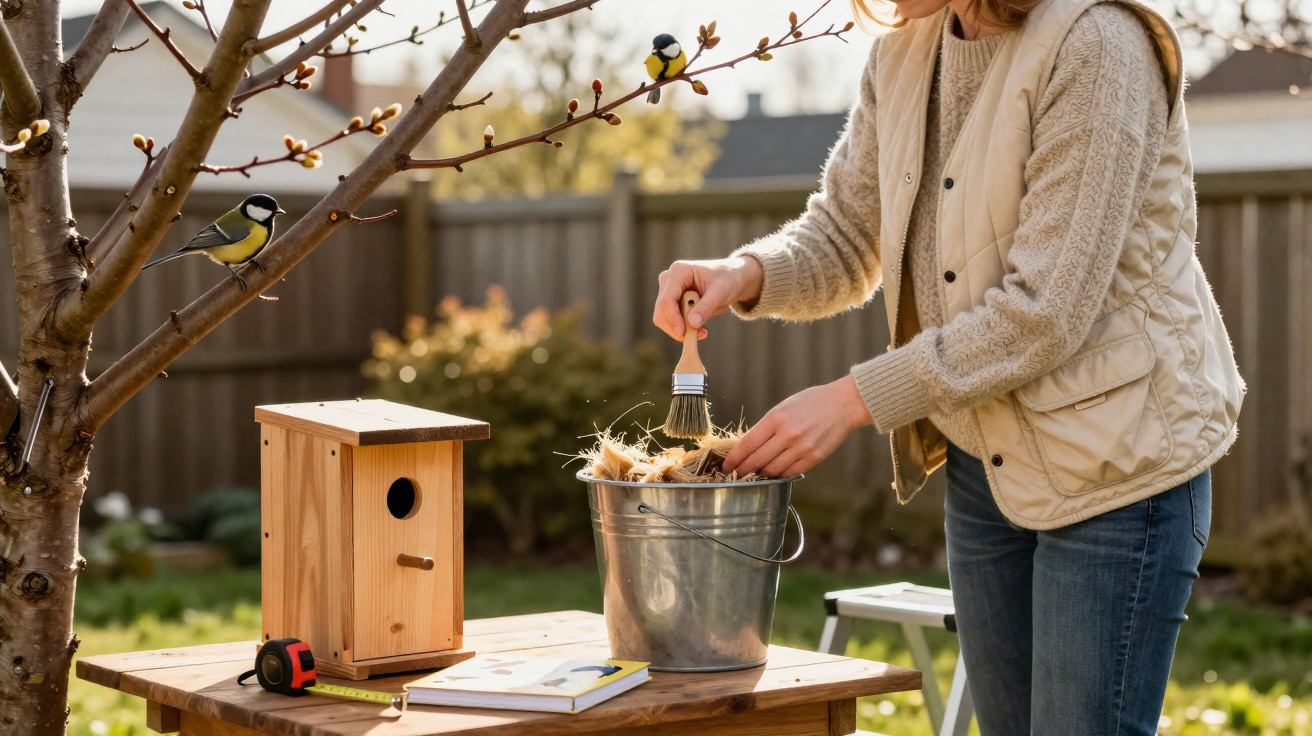
Many people still regard February as a quiet, lifeless time in the garden, yet birds are already preparing for the nesting season. One straightforward job involving your nest boxes can make the difference between healthy chicks and a whole brood lost to parasites or cold.
February is nesting house-hunting season
While people are still wearing scarves, February is effectively moving time for many garden birds. Pairs begin to form, territories are disputed and possible nesting places receive intense scrutiny.
Cavity-nesting species, including blue tits, great tits and redstarts, are among the earliest to search. They cannot wait until April, when the best holes in old trees and buildings have often been claimed and competition is intense.
By mid-February, cavity-nesting birds are already visiting and testing potential nest boxes, long before they lay their first egg.
In urban and suburban areas, where mature trees with hollows are scarce, a garden nest box may be the difference between breeding successfully and producing no chicks at all. For many species, putting one up in spring is already too late. They may nest somewhere else or end up using unsafe locations exposed to cats, crows and poor weather.
The crucial job: cleaning last year’s nest
If you already have a nest box attached to a tree, fence or wall, February is the time to clean it thoroughly. This is not merely a cosmetic task: it is an essential health precaution for birds returning to use your garden each year.
Nests left in the box provide parasites with a winter refuge. Fleas, mites and other tiny insects shelter among moss, feathers and droppings until new chicks bring warmth. When the brood hatches, they feed continuously on the nestlings, leaving them weakened and, in some cases, killing an entire clutch.
Skipping the annual clean can turn a safe-looking nest box into a parasite trap for newly hatched chicks.
How to clean a nest box safely
- Wearing gloves, open the box and take out all the old nest material.
- Scrub every internal surface with a stiff brush, including the corners and roof.
- Wash it through with very hot or boiling water to destroy lingering parasites and bacteria.
- Allow the box to dry fully outdoors before shutting it again.
- Reinstall it promptly so birds continue to regard it as a possible nesting site.
Do not use chemical cleaning products or disinfectants. Even tiny traces may harm adult birds and chicks, particularly in the enclosed air of a wooden nest box.
Choosing a new nest box: size really matters
If your garden does not yet offer nesting places, February is an ideal time to fit some nest boxes. However, not every “cute” box available in garden centres is genuinely suitable for birds. Its form, entrance dimensions and construction materials all influence which species will feel secure enough to occupy it.
The diameter of the entrance hole acts like a security filter, deciding who gets in and who stays out.
Recommended entrance sizes for common garden birds
| Entrance type | Typical diameter | Species attracted |
|---|---|---|
| Small round hole | 26–28 mm | Blue tit, coal tit, marsh tit and similar tiny species |
| Medium round hole | 32–34 mm | Great tit, house sparrow, nuthatch |
| Semi-open front | Wide opening | Robin, spotted flycatcher and birds preferring more open cavities |
The most suitable boxes use untreated, reasonably thick timber, such as larch, oak or cedar. Wood measuring about 1.5 cm or thicker helps insulate birds from chilly nights and abrupt spring heat. Decorative, thin-walled boxes can look appealing, but they often rot rapidly or become too hot.
Metal nest boxes create another common issue. In sunlight, they can become oven-like and overheat chicks within hours. Extremely bright colours are also unhelpful: subdued shades merge more effectively with the setting and draw less predator attention.
Placement: orientation can mean life or death
A well-made nest box can still fail when positioned badly. As birds inspect a nest box, they consider exposure to rain and wind, predator danger, proximity to food and daytime heat.
A nest box facing the wrong way can turn from shelter into hazard after just one storm or hot spell.
Where and how to fix a nest box
Most ornithologists recommend directing the entrance east or south-east. In many areas, where strong prevailing winds and driving rain arrive from the west, this reduces exposure. It also provides mild morning sunshine without the intense heat of the afternoon.
Height matters just as much. A position between 2 and 3 metres high is appropriate for most familiar garden birds. This keeps the nest beyond the reach of wandering cats and inquisitive children, while still allowing annual cleaning from a ladder.
Secure the box firmly to a solid wall or tree trunk with screws, sturdy wire or a hook. Tilting it slightly forwards allows rainwater to drain away rather than enter through the hole. Cut back branches immediately in front of the entrance, as these can give predators such as cats, squirrels and magpies a useful perch.
Why acting now boosts both birds and your garden
Timing has an understated but important effect. Nest boxes installed or cleaned in February can shed strong human smells and become visually integrated with foliage, bricks or bark. This makes them seem safer to wary birds that examine every detail.
The benefit is not limited to the pleasure of seeing young birds fledge in spring. To feed one hungry brood, a single family of tits may consume thousands of caterpillars, grubs and insects in just a few weeks. This form of natural pest control supports fruit trees, vegetable beds and ornamental borders without chemicals.
Well-placed, clean nest boxes turn garden birds into working allies against common pests.
Common mistakes people make with nest boxes
Even gardeners with good intentions can undermine their own work. Ornithologists’ field notes repeatedly identify several mistakes:
- Putting a box in uninterrupted, all-day sunlight, which can cause heat stress in chicks.
- Mounting it too low, so cats can reach it with an easy jump.
- Checking inside the box again and again while birds are nesting, which may disturb them enough to abandon it.
- Choosing smooth, glossy finishes around the entrance that birds struggle to grip.
- Fitting boxes close to intense lighting or busy pedestrian activity at night.
One simple test is useful: picture yourself raising a baby there through a rainy week followed by a heatwave. If the location seems too exposed, noisy or hot for a human baby, it will probably be unsuitable for chicks too.
Key terms and real-life scenarios
Gardeners often encounter the term “cavity nester” without fully understanding it. It describes birds that naturally breed in holes in walls, rock faces or trees, rather than making free-hanging nests in hedges and bushes. Installing nest boxes therefore replaces old hollow trees removed for construction projects or safety reasons.
“Predation pressure” is another helpful expression. Where cats, squirrels or corvids are common, apparently small factors - including the box angle, the absence of nearby perches, or a metal predator guard around the tree trunk - can significantly alter the chances of success.
Consider two adjoining gardens. In one, last year’s nest remains in the box, which faces west and receives full afternoon sun. In the other, the box is cleaned, turned eastwards and has nearby branches cut back. A nesting pair uses each garden. Following a week of heavy rain and then a warm spell, the first brood faces damp conditions and parasites, with only one or two chicks surviving. In the second garden, every chick fledges successfully. The outcome rests on that one carefully timed task in February.
Planting bird-friendly vegetation near your nest boxes increases these advantages. Native trees, berry-bearing shrubs and lawns free from pesticides support more insect life, shortening the parents’ food-gathering journeys. Spending less time away from the nest gives predators fewer opportunities to attack and enables more food to reach growing chicks each hour.





Comments
No comments yet. Be the first to comment!
Leave a Comment