
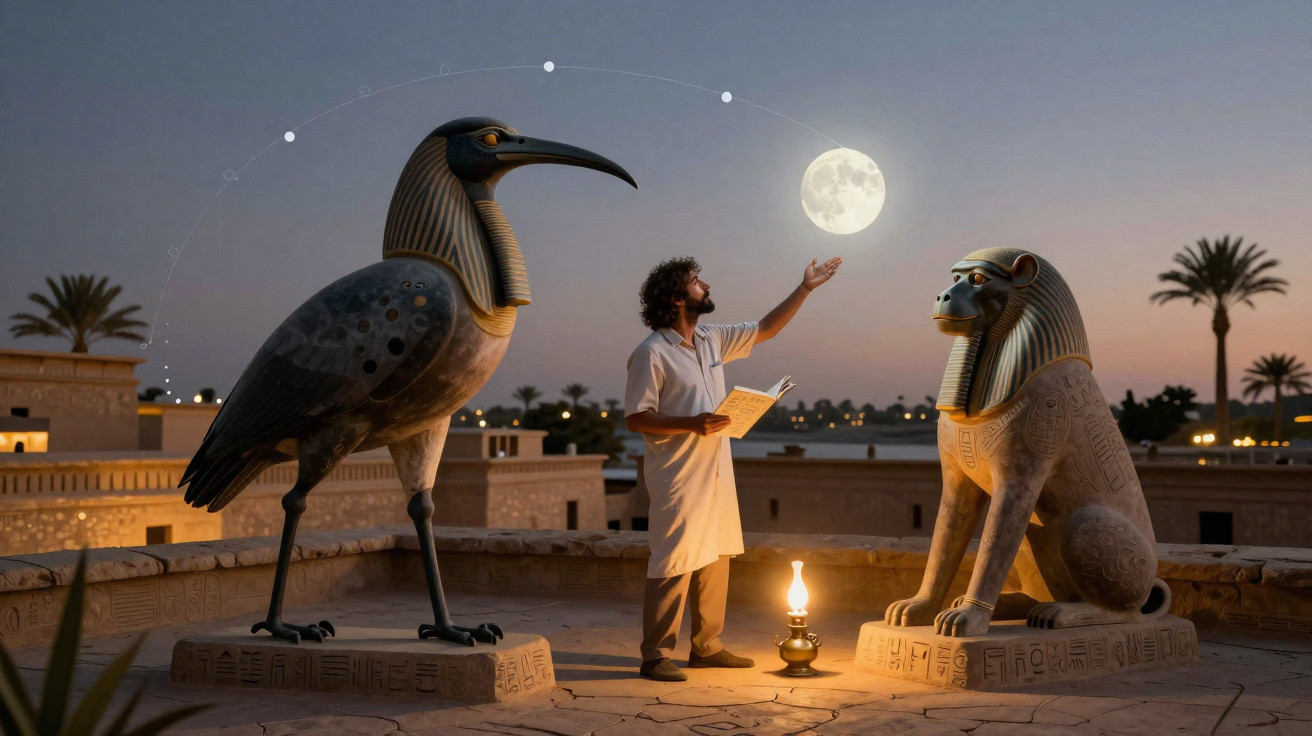
For millennia, the ancient Egyptians portrayed Thoth in two apparently mismatched forms: a white-feathered ibis and a silver-haired baboon. Research published in 2026 has proposed a surprising possible reason for this choice. Both animals reflect light in a way that resembles the glow of the Moon, a celestial body closely linked with the deity.
Who was Thoth to the ancient Egyptians?
Thoth held a distinctive role in Egyptian religion. He was associated with wisdom, writing, magic, knowledge and the Moon. His best-known depictions featured the sacred ibis, Threskiornis aethiopicus, and the hamadryas baboon, Papio hamadryas-two animals with very different appearances.
This contrast puzzled scholars, as many Egyptian deities were linked more consistently with a particular animal. With Thoth, however, a long-billed bird and a primate foreign to Egypt shared the same sacred function. The question was what the ancient Egyptians might have recognised as common to them.
What did moonlight reveal to researchers?
Catherine Hobaiter of the University of St Andrews and Nathaniel Dominy of Dartmouth College chose to examine the theory without relying solely on how humans perceive colour. Instead, they used spectroscopy, a method that measures the way surfaces reflect different wavelengths of light.
- Twelve specimens from the American Museum of Natural History were examined using a spectrometer.
- Hamadryas baboon fur showed spectral features very close to those of lunar light.
- The white feathers of the sacred ibis also created a profile comparable with the glow of the Moon.
- Male baboons were particularly notable for their pale cheeks and long, silvery shoulder fur.
The findings support the idea that lunar colouring may have helped determine why both creatures became manifestations of Thoth. Rather than being a visual coincidence noticed today, the likeness could be assessed through the physical properties of light reflected by feathers and fur.
Why were these two animals chosen for Thoth?
The ancient Egyptians knew of other species that might have filled the same role. At least three kinds of ibis lived in the region, yet the white-feathered ibis became especially connected with Thoth. Likewise, among the primates known to Egyptians, it was the silver-toned hamadryas baboon that acquired this status.
The ibis also possessed another suggestive feature: its long curved beak had previously been compared with the crescent shape of the Moon. The researchers argue that the combination of its form, shining plumage and visual appearance may have strengthened this link, while the baboon's light fur could explain why it too entered this symbolic world.
Watch the video shared by the Ancient Egypt YouTube channel explaining why Thoth takes the form of two animals.
What was so unusual about baboons in Egypt?
Unlike ibises, baboons did not naturally live in Egypt. Nevertheless, hundreds of baboon mummies and skeletons have been discovered in religious settings. Evidence suggests that they arrived through ancient trade routes from other parts of Africa, demonstrating the effort required to incorporate these primates into Egyptian cults.
More than one baboon species was mummified, including the olive baboon. The analysis, however, identified an important difference: its fur produces a greener hue, whereas hamadryas fur has a silvery appearance similar to moonlight. This offers a possible explanation for the religious preference for one particular species.
Has science finally explained Thoth's two forms?
The discovery cannot establish with certainty what people living thousands of years ago believed, but it provides a measurable hypothesis for an ancient mystery. Egyptologist Salima Ikram, who was not involved in the research, considered the study to offer a plausible explanation for the particular association between Thoth and the hamadryas baboon.
Perhaps that is precisely what makes the finding so compelling. The look of a feather or the sheen of fur may have carried meanings across millennia. When looking again at images of Thoth, it is worth noticing these pale tones: the Moon may have been the invisible link between two completely different animals and one of the most important gods of ancient Egypt.






Comments
No comments yet. Be the first to comment!
Leave a Comment