
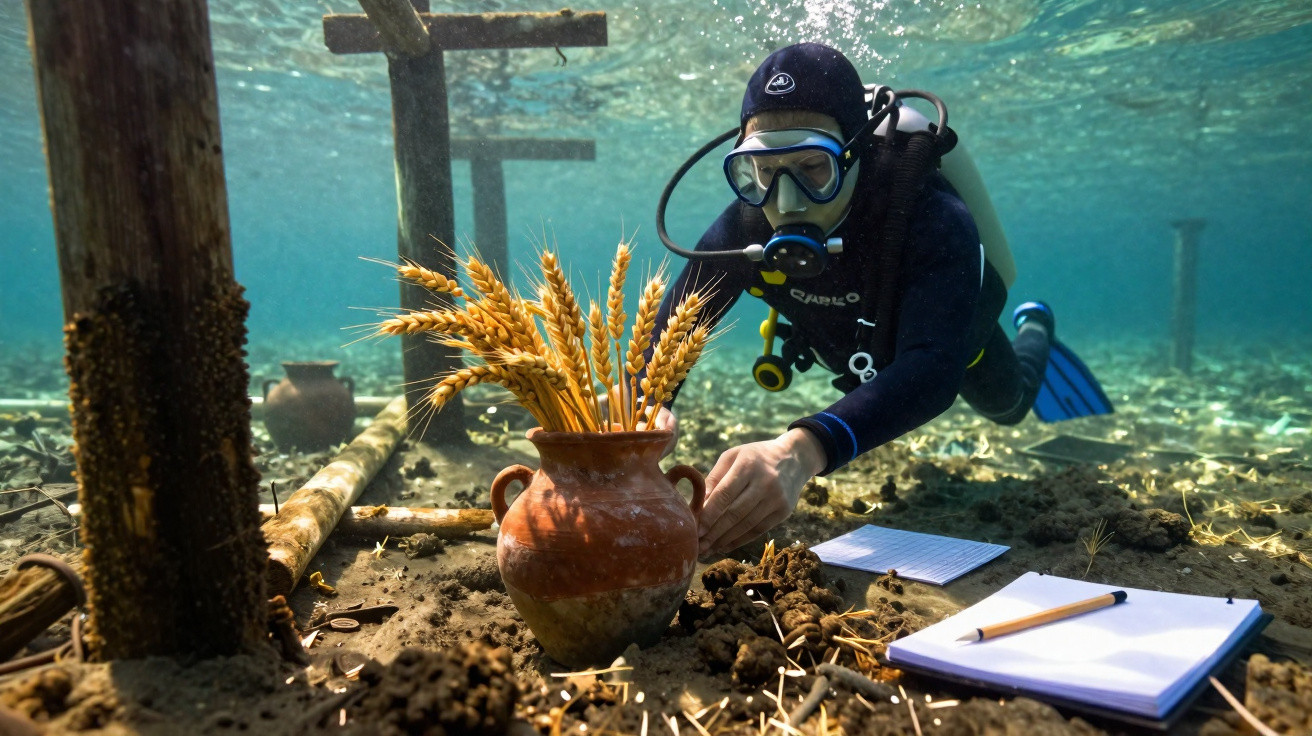
Beneath the waters of an Italian volcanic lake, archaeologists have uncovered items that would ordinarily vanish within a few years: 3,000-year-old spelt ears, timber, textiles and prehistoric pottery. The discoveries made in 2026 at the submerged settlement of Gran Carro di Bolsena are offering rare insights into life between the end of the Bronze Age and the beginning of the Iron Age.
What was found beneath Lake Bolsena?
The 2026 archaeological campaign retrieved pottery vessels dating to the Late Bronze Age, substantial wooden components and organic materials conserved by the underwater setting. Among the most remarkable finds were intact ears of spelt, discovered inside ceramic containers in the area known as Aiola.
The discoveries were made at Gran Carro di Bolsena, in central Italy, by teams associated with the Superintendency of Archaeology, Fine Arts and Landscape for the Province of Viterbo and Southern Etruria. Although the site has been investigated for more than six decades, it continues to yield material that can substantially expand its known history.
Why did the pottery change the history of the settlement?
The newly recovered vessels matter because they display features linked to the Proto-Villanovan phase, which developed during the final stages of the Bronze Age. This culture came before the Villanovan culture of the Early Iron Age, often connected with developments that would later contribute to the emergence of Etruscan civilisation in central Italy.
Researchers therefore now have evidence that Gran Carro experienced several phases of occupation rather than belonging to one prehistoric period alone. Materials helping to reconstruct this extended history include:
- Pottery vessels associated with the Late Bronze Age.
- Ears of spelt preserved inside ancient containers.
- Large wooden pieces whose purpose has not yet been identified.
- Woven materials, including a possible fragment of rope or mooring line.
- A rare textile fragment attributed to the beginning of the Iron Age.
How did spelt ears survive for three millennia?
Plant remains are usually destroyed by decomposition long before archaeologists can recover them. At Gran Carro, however, conditions created by the waterlogged environment promoted the preservation of organic material. This accounts for the exceptional survival of the spelt, as well as timber and textiles that would be unlikely to endure for so long at a land-based site.
Their context makes the ears of spelt even more intriguing. They were found near objects with parallels among the grave goods of the Villanovan culture. Researchers hope to establish whether the plant was connected solely with food and farming, or whether it also held a ritual, funerary or symbolic role for the settlement’s inhabitants.
What do the mysterious wooden structures conceal?
Large wooden elements were found beneath stones at the base of a structure described as a sacred mound in the Aiola area. It is not yet known whether they formed part of a building, platform or installation with a ritual purpose, and further analyses will be needed before archaeologists can interpret their function.
The preserved timber may provide exceptionally rare evidence of prehistoric construction methods. Together with the plant remains and textiles, it makes it possible to investigate aspects of daily life that normally disappear from the archaeological record, leaving only durable objects such as stone, metal and pottery fragments.
Why could Gran Carro transform the study of prehistoric Italy?
The campaign forms part of a three-year programme overseen by Italy’s Ministry of Culture, involving specialists in underwater archaeology and conservation. The pottery, textiles, timber and botanical remains must now undergo conservation and analysis before they can be compared with materials recovered in earlier decades.
Gran Carro is moving beyond being simply a settlement hidden on a lake bed to become a rare archive of everyday life around 3,000 years ago. Farming, construction, textile production and possible ritual practices have survived where almost nothing ought to have endured. If the recent campaigns are any indication, there are still strong reasons to watch closely what remains beneath the waters of Lake Bolsena.






Comments
No comments yet. Be the first to comment!
Leave a Comment