
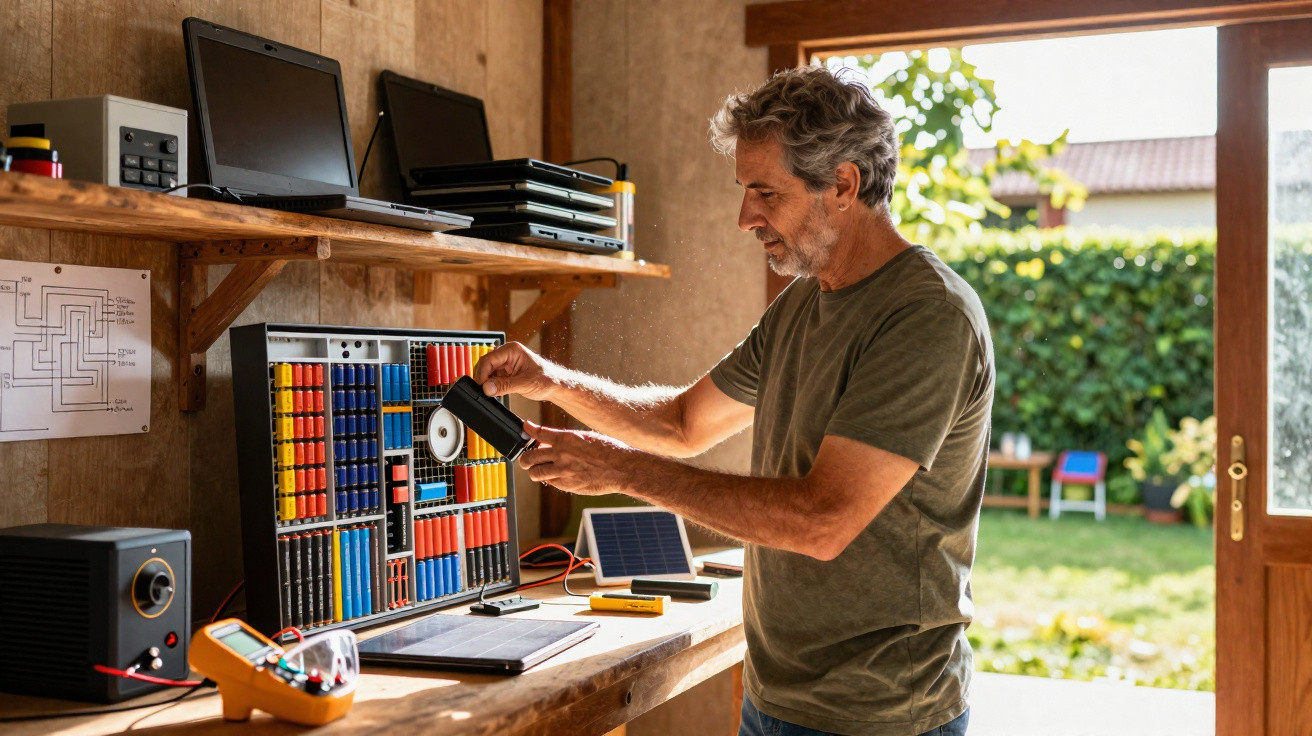
One man is building his own energy source from discarded technology that would otherwise have ended up in the bin.
What many people regard as obsolete electronics has become the lifeblood of one energy-minded DIY enthusiast’s home. Using hundreds of old laptop batteries and plenty of determination, he has gradually moved away from conventional electricity supplies and has powered his home largely by himself for years.
From electronic waste to the heart of a home energy system
The project began in November 2016. By then, the tinkerer had already gained some initial experience with solar power: a few solar panels, an ageing forklift battery, plus a charge controller and an inverter. It was conventional off-grid equipment, but still a long way from a carefully planned complete system.
Then he had an idea: put used laptop batteries back into service. Notebook battery packs often end up at recycling centres even though some of their individual cells remain surprisingly capable. He wanted to tap into precisely that unused reserve. So he started collecting, testing and sorting faulty or discarded laptop batteries.
“Broken notebook batteries gradually became an independent energy system that has supplied his home with electricity for almost a decade.”
At first, he had around 650 laptop batteries available. The collection later grew to more than 1,000 units - a vast store of reusable energy that would otherwise simply have been thrown away.
The power station in the shed behind the house
To keep the installation safe, he set up his small private power station not inside the home but in a shed around 50 metres away. This is where everything comes together: rooftop solar panels, copper cables, self-configured battery packs and the electronics needed to manage the whole system efficiently.
The laptop cells are connected together to form larger units. Numerous small batteries become battery packs with a capacity of around 100 ampere-hours. Several of these packs then make up the central energy-storage bank. In this way, the system expands modularly, one cell at a time.
He deliberately chose copper cables for the connections. Their relatively low electrical resistance reduces losses and lowers the risk of heat build-up. For a DIY project, this is a crucial safety consideration.
Electricity for the home - year after year without major incidents
Despite its unconventional construction, the system has operated for almost ten years without any significant problems. Its owner reports neither swollen cells nor fires, showing that careful planning and regular inspections can offset a great deal.
Naturally, it requires a substantial amount of work: cells must be tested, weak batteries removed, connections tightened and the electronics monitored. The concept is not completely maintenance-free, but it cuts electricity costs and makes him less dependent on sharp price rises in the energy market.
How old laptop batteries are given a new lease of life
At its core, the project is based on a simple principle: not all lithium-ion cells in a laptop battery fail at the same time. Often, one defective cell is enough for an entire pack to be considered “scrap”, even when the remaining cells can still be used.
The DIY enthusiast dismantles the battery packs and tests every cell individually. Only cells with stable voltage and an acceptable remaining capacity are used in the new home energy-storage bank. Weak cells are consistently sent for disposal.
- Dismantle: Carefully open the notebook battery pack and remove the cells.
- Test: Measure the voltage and check capacity using a charge/discharge device.
- Sort: Only install cells of similar capacity and voltage together.
- Connect: Wire the cells into larger blocks and protect them with fuses.
- Integrate: Connect the battery blocks to the solar panels and inverter via charge controllers.
This exacting, repetitive work is what makes the project feasible - but also unattractive to many ordinary users. Anyone building such a system needs patience, basic electrical knowledge and a sound awareness of safety.
Why the effort is worthwhile for him
The greatest benefit is independence. The house is no longer fully reliant on the conventional electricity grid and can run on its own energy for much of the year. Price increases from the electricity supplier affect him far less.
There is also an environmental benefit: every notebook cell that continues serving as home storage for a few more years does not have to be recycled or incinerated straight away. This significantly extends the battery’s life cycle and conserves resources.
“From the owner’s perspective, every revived laptop battery is a small victory against throwaway culture and rising electricity prices.”
At the same time, the project functions as a real-world technology trial: how long do used cells actually last in a system like this? What weaknesses emerge after several years? The answers are of interest not only to DIY enthusiasts, but also to professional storage providers.
Risks, limitations and what is best avoided
As inspiring as the story may sound, it is not something to copy without critical thought. Lithium-ion batteries can become a serious fire hazard if handled incorrectly, damaged or wired improperly. Short circuits, overcharging and mechanical damage can all cause fires.
Anyone wishing to work with battery cells themselves needs at least the following basics:
- Knowledge of the correct end-of-charge voltages and discharge depths
- Protective circuits against overcharging, deep discharge and short circuits
- Clean, secure and corrosion-protected connections
- Adequate ventilation and fire-protection measures at the installation site
Anyone who cannot manage this safely is far better off with a certified home battery system, even if it costs more. Professional systems have tested battery-management systems, integrated sensors and clear warranty cover.
What this story reveals about our use of energy
The project demonstrates how much potential lies in discarded technology. As mountains of electronic waste continue to grow, one individual experimenter shows that part of it can be turned into a useful resource. Not merely in theory, but in everyday real-world conditions - for a decade.
Experiments like this prompt debate: would greater repair and reuse also be worthwhile on a larger scale? Could local authority projects use old laptop cells in buffer storage, for example for solar installations at schools or public buildings? Pilot projects could emerge precisely in these niches.
For private households without a screwdriver workshop in the shed, a more modest approach is more suitable: first reduce their own electricity consumption, then consider buying a small certified storage system. Anyone who still wants to work with individual cells should consult specialists or attend courses - and be aware of the responsibility involved.
The DIY enthusiast in this story shows what can be achieved when technical knowledge, persistence and a desire for self-sufficiency come together. He has built his own mini power station from more than 650 old laptop batteries, finding a highly unusual answer to rising electricity prices and wasted resources.





Comments
No comments yet. Be the first to comment!
Leave a Comment