
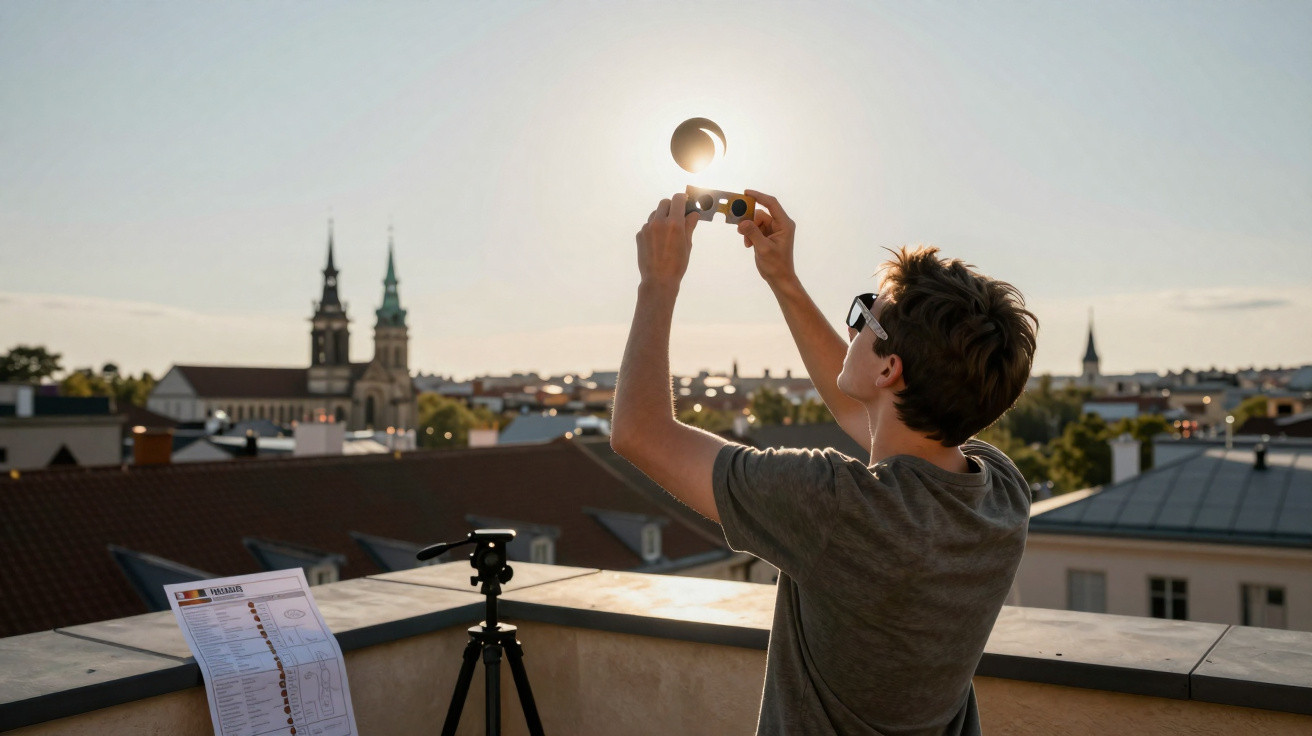
The astronomical event of 2026 is almost here. On 12 August, France will witness an almost total solar eclipse. Here is how to capture the occasion with your phone without damaging it.
Looking directly at the Sun without protection is exceptionally harmful to your eyes, and your phone faces a similar risk. Smartphone camera sensors are not designed to handle such an intense burst of light.
If you want to photograph the Sun, you must therefore protect them. This is especially important for anyone planning to watch the solar eclipse on 12 August. With coverage expected to exceed 95% across most of the country, taking photos or video could create a wonderful keepsake - provided you take a few precautions.
How to film or photograph a solar eclipse with your phone
To record this historic occasion - it will be the only total solar eclipse visible from France before 2081 - several requirements must be met. During an eclipse, sunlight is even more powerful than usual, so your phone needs protection to prevent internal damage.
Protect your phone camera sensor
The easiest option is to buy a solar filter. These are specifically made to shield cameras from high light intensity. Numerous brands offer solar filters for smartphone sensors, but make sure that the filter complies with the recommended protection standard.
Be wary of ND filters, too. A standard filter is not suitable for an eclipse: although it reduces visible light, it still allows Infrared (IR) and Ultraviolet (UV) rays through. If you choose an ND filter, you will need to spend a considerable amount on a specialised model rated ND100000 (16.6 stops) or ND1000000 (20 stops).
Alternatively, a DIY method can work just as well. You can use eclipse viewing glasses. When ISO-certified, they offer the best possible protection for both your eyes and your phone’s sensor. Simply cut the protective material from a pair of glasses to match the size of the sensor, then place it over the lens.
A total solar eclipse in Europe
The solar eclipse of 12 August 2026 will be historic. It will be total in Spain and Iceland, while France will see a partial eclipse with exceptional obscuration, ranging from 90% in the north-east to 99.8% in the south-west.
Eclipse timing and viewing conditions
The event will begin at around 19:20, reach its peak at approximately 20:20, and end at about 21:15, at twilight. As the Sun will be very low over the western horizon, choose an elevated location with a completely unobstructed view. The good news is that the heatwave weather is bringing perfectly clear skies.
Certified ISO 12312-2 glasses must be worn throughout the observation, from beginning to end.




Comments
No comments yet. Be the first to comment!
Leave a Comment