
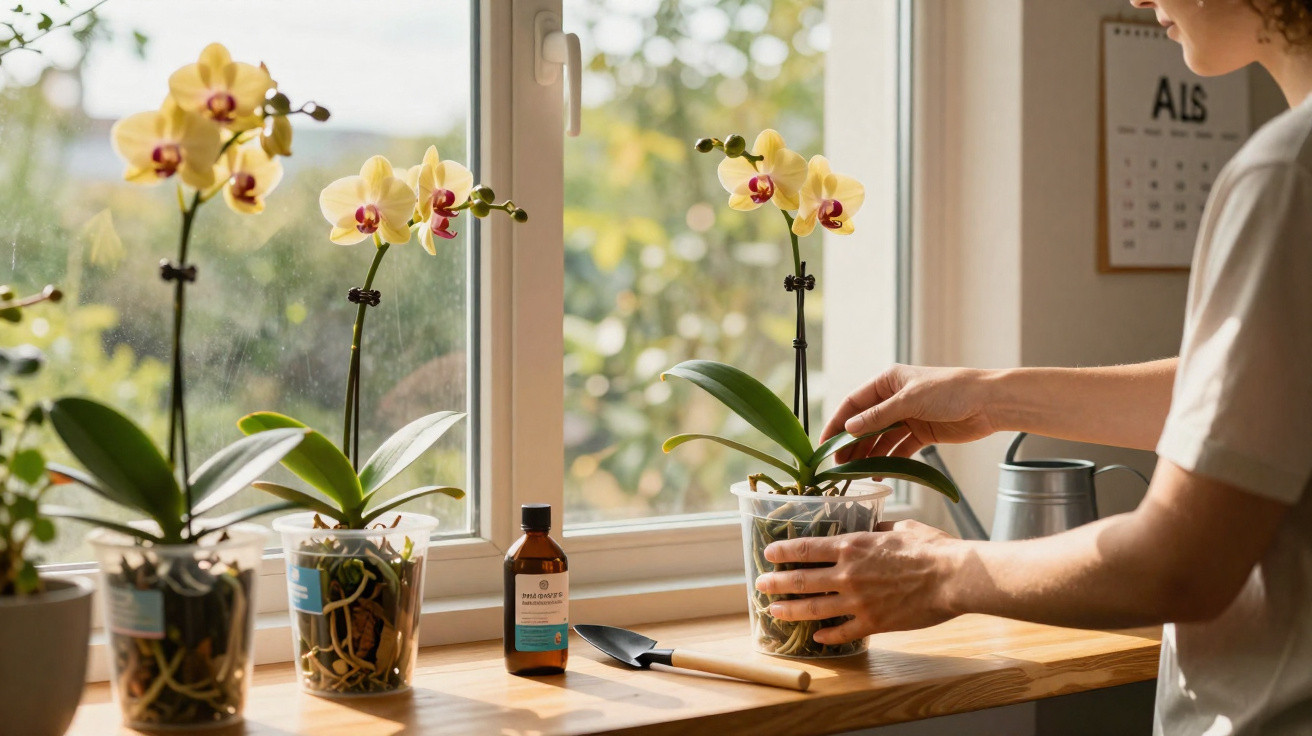
For growers in regions where August marks the approach of spring, it can be an important month for getting many orchids ready for their next growth phase. As daylight lengthens and temperatures begin to rise, certain varieties restart root, leaf and flower-spike development after winter’s slower pace. This is a good time to assess light, watering, feeding and, above all, the condition of the growing medium, without presuming that every orchid follows the same timetable.
Why can August alter an orchid care routine?
Not all orchids have an identical dormant period, although many species commonly grown indoors react to changes in temperature and day length. Phalaenopsis, for instance, may begin producing flower spikes after experiencing cooler nights, whereas other types move into vegetative growth as cold weather eases.
For that reason, August is better treated as a time for observation than as a fixed date for changing care. Green root tips, emerging leaves and small new growths at the base of the plant are signs that it is becoming active again.
- Look for new roots appearing;
- Check for young leaves emerging from the centre of the plant;
- See whether a new flower spike has started to develop;
- Monitor changes in night-time temperatures;
- Avoid changing several aspects of care at once for plants that are still inactive.
When should orchid fertilising resume after winter?
Orchid fertilising can be increased gradually once there are clear signs of fresh growth. Rather than applying a strong dose in the hope of speeding up flowering, it is safer to use an orchid-specific fertiliser at the dilution recommended by the manufacturer. Plants without active roots make less use of nutrients and may be harmed by salt build-up in the growing medium.
How can you tell whether the growing medium needs replacing before spring?
Pine bark, coconut fibre and other organic components break down over time. As they deteriorate, the gaps that allow air to reach the roots become smaller, and the material stays wet for longer. For an epiphytic plant, this can pose a greater risk than simply not receiving enough fertiliser.
For many orchids, the most suitable time to repot is when new roots are just beginning to emerge, as they can establish themselves in the refreshed growing medium. The following signs suggest that the pot needs checking:
- Growing medium that is dark, crumbly and soil-like;
- Material that remains damp for several days;
- A decomposing smell inside the pot;
- Internal roots that are brown, hollow or soft;
- An unstable plant because the material has lost its structure.
Does more water in August help an orchid produce flowers?
Not always. Watering should reflect how quickly the roots and growing medium are drying out. With warmer conditions and active growth, an orchid may begin using water more quickly, but keeping the pot continually saturated raises the risk of root loss. It is also unwise to leave water sitting in the crown of a Phalaenopsis for extended periods.
- Check the moisture level before watering again;
- Allow all excess water to drain through the holes in the pot;
- Do not leave a saucer full of water beneath the roots;
- Increase watering frequency only if the growing medium is drying more quickly;
- Ensure good air circulation around the plant.
Light may matter more for flowering than extra fertiliser
An orchid prepared for spring needs enough light to support both growth and flowering. In some species, very dark leaves combined with a prolonged lack of flowers may point to insufficient light, while scorched or yellowing leaves in directly sunny positions indicate too much. Any adjustment should be made gradually, particularly after months spent in a more sheltered spot during winter.
In August, then, the best approach is not to seek a formula that will force every orchid to flower. Instead, identify the species, watch for new roots, replace a growing medium that has lost its aeration, restart fertilising in line with growth, and provide suitable light. When the plant reaches spring in good health, it is more likely to direct energy towards new roots, leaves and, at the appropriate time for its variety, flower spikes carrying blooms.






Comments
No comments yet. Be the first to comment!
Leave a Comment