
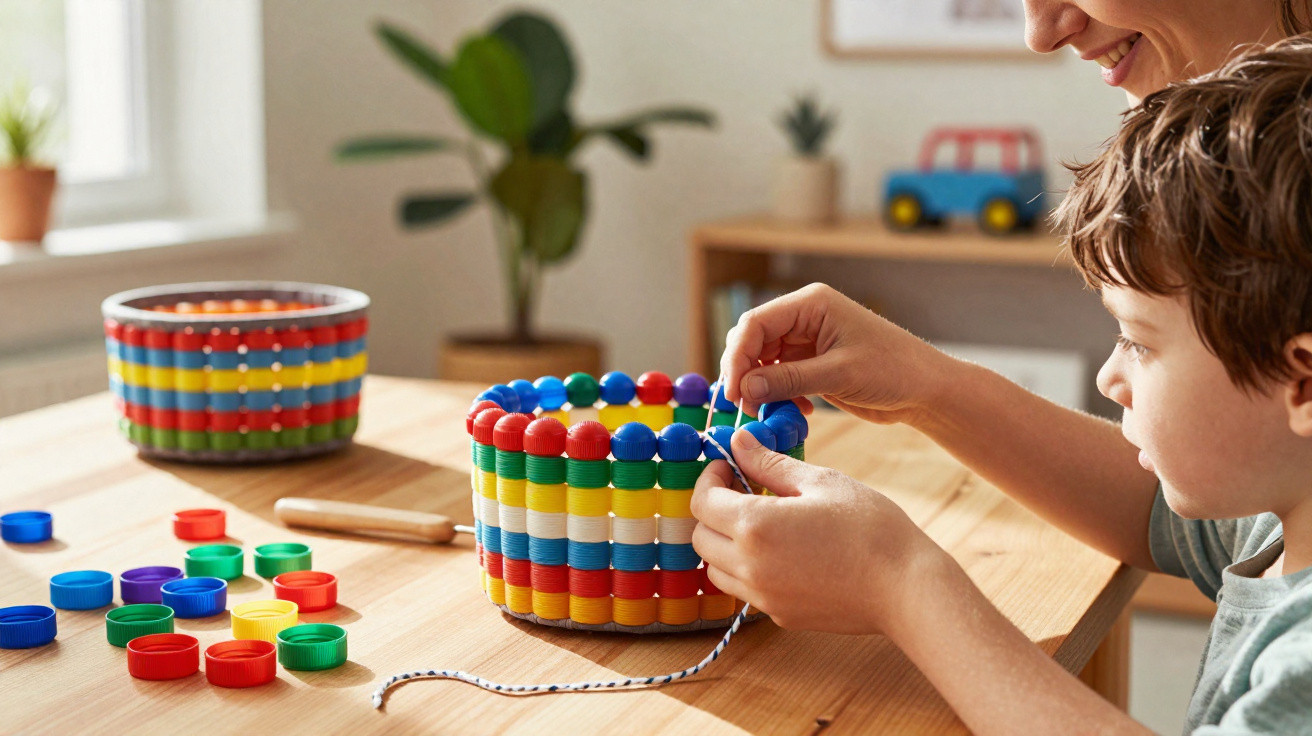
Bottle caps can be diverted from general waste and turned into useful, colourful, low-cost items for organising the home. With evenly positioned holes, string and patience, they can be made into a sturdy basket, simple storage containers and educational toys.
Why reuse plastic bottle caps?
Caps are small, lightweight and widely found in Brazilian homes, making it easy to collect enough material for craft projects. Once washed and sorted by colour, they gain visual appeal and make recycling more creative.
Plastic recycling gives objects made from resins new functions or turns them into new products. In home crafts, this principle begins before formal collection: items that still have shape, strength and decorative potential are reused.
Bottle caps can have five main uses:
- Basket: interwoven caps create lightweight sides for storing small items.
- Storage container: a rigid base helps to organise a desk, craft area or utility room.
- Games: colours and numbers can be used for children’s memory, counting and matching activities.
- Colours: alternating patterns make the finished piece more decorative.
- Reuse: the material remains in circulation for longer before being thrown away.
How can bottle caps be turned into a useful basket?
Start the basket by selecting caps of the same size, as this makes it easier to keep the rows aligned. After washing and drying them, mark two opposing holes in every cap to create routes for the string or nylon thread.
The weaving process works like circular stitching. Join the caps side by side to create strips, then connect these strips in layers to build firm walls. A flat base made from caps prevents the basket from becoming crooked.
What is the step-by-step weaving method?
First, arrange the bottle caps by colour and lay out a test row on the table. Thread the cord through the side holes, secure the pieces with discreet knots and keep an even tension to avoid large gaps between the caps and rows.
Bottle-cap basket
Strength comes from repeating the rows
The more consistently the holes are placed, the straighter the structure will be. Use the finished item for light objects such as clothes pegs, thread, sachets or craft supplies.
Once you have enough strips, connect one row to the next with vertical stitches, checking throughout that the structure rises evenly. To finish, strengthen the upper edge with a double loop of thread for finishing and stability.
The assembly can follow this sequence:
- Wash, dry and sort the caps by size and colour.
- Make two opposing holes in each cap, using a firm support.
- Thread string or nylon through the caps to make horizontal rows.
- Join the rows in layers until the desired height is reached.
- Reinforce the base, rim and handles before using the basket.
What other uses can bottle caps have?
As well as a basket, bottle caps can be used to make pencil holders, small storage pots, coasters and decorative trays. The principle remains the same: connect matching pieces, create a solid base and use colour to produce a functional object.
For children’s activities, caps can become pieces for memory games, counting, colour sequences and word-building. They should be thoroughly cleaned, broken pieces should not be used, and the activity must suit the child’s age, always with supervision and organisation.
Three easy ideas to try at home:
- A shallow storage container for paper clips, buttons, thread or keys.
- A memory game with matching colour pairs or identical stickers.
- A small basket for clothes pegs, sachets or sewing materials.
- A decorative base for light plant pots or craft-room items.
Why does this form of reuse reduce waste?
Craft projects using bottle caps follow the same principle as DIY ideas made with recycled materials: extending the use of something that would otherwise be discarded. Although simple, the practice encourages more conscious consumption and everyday creativity.
The impact increases when households keep clean caps separate, avoid mixing waste and send leftover material to suitable collection points. The basket then becomes more than a craft project; it is a practical reminder of reducing plastic waste.
Comments
No comments yet. Be the first to comment!
Leave a Comment