
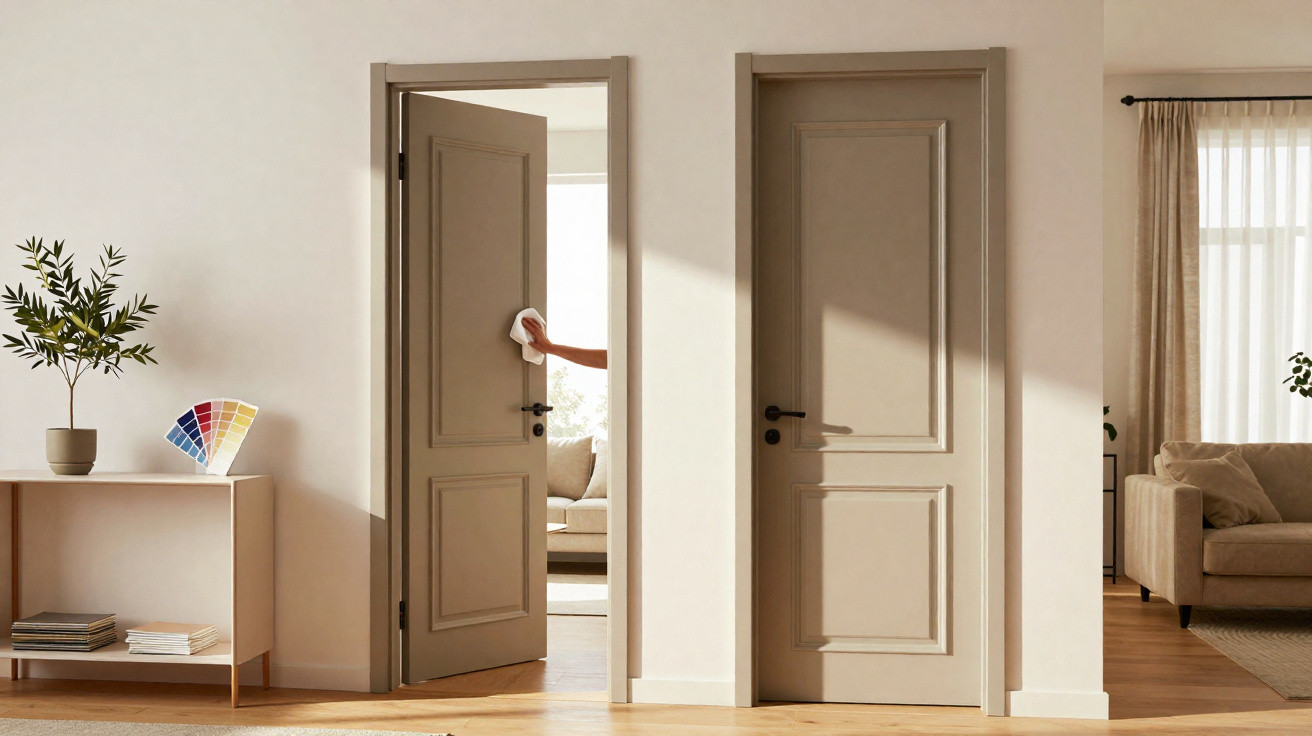
In many homes, the choice of colour for internal doors still centres on traditional white, linked with cleanliness, neutrality and a safe decorative choice. In recent years, however, greige – a balanced blend of grey and beige – has emerged as a contemporary alternative for creating welcoming rooms, a greater sense of space and a flexible foundation for a range of decorating styles.
What is greige for internal doors, and why is it so versatile?
Greige sits between warm beige and soft grey. It is often characterised as a mineral or earthy shade because it recalls natural stone, pale sand and other organic materials. Used on internal doors, it delivers much the same neutrality as white, but with a warmer and less stark visual effect.
Its balance allows greige to work with white walls, off-white finishes, pastel shades and bold accent colours. It also pairs effectively with timber, natural fibres and dark metals. In open-plan spaces, it can establish a visual link between the living room, hallway and bedrooms, making doors a subtle feature that supports a cohesive look.
Watch a video on the Let’s Evandro YouTube channel discussing the leading colour trends for interiors, contemporary joinery and elegant palettes currently shaping architectural design:
https://www.youtube.com/watch?v=X2mB_7V9_kI
Do greige internal doors create a greater sense of space?
Painting doors in a greige that is slightly deeper than pale walls creates a soft frame around each opening. This can make doorways appear taller and hallways feel longer. In compact flats or homes with low ceilings, it avoids overly strong contrasts that can visually “break up” the room.
The effect becomes stronger when the architraves and skirting boards are finished in the same shade, softening transitions and making better use of natural light. To get the most from this approach, consider the following practical combinations:
- Off-white or warm white walls with greige internal doors one shade darker;
- The same colour on doors, architraves and skirting boards, creating a continuous “outline” throughout the rooms;
- Understated black metal, brushed stainless-steel or brass hardware, adding fine lines to the surface;
- Pale flooring or mid-tone timber floors, which enhance the feeling of an orderly, spacious interior.
How can greige internal doors be used in everyday décor?
Greige can be introduced as part of a full renovation or through smaller updates, without requiring the replacement of furniture or wall finishes. In already decorated homes, it suits Scandinavian, contemporary, rustic-chic and soft industrial styles, retaining a balance between warmth and modernity.
Alongside light walls and timber flooring, greige heightens the sense of comfort without making rooms darker. It works well with linen textiles, neutral rugs, handmade ceramics and accessories in terracotta, olive green or grey-blue. Before painting, assess the natural light, test small paint samples on the doors, and choose a satin or semi-gloss finish to make everyday cleaning easier.
How do you keep greige internal doors looking good for longer?
A long-lasting finish relies on careful surface preparation and straightforward upkeep, as doors are frequently handled and exposed to knocks and scratches. Properly sanding the timber and applying a compatible primer or sealer improves the adhesion of greige paint and lowers the likelihood of early peeling or staining.
For routine cleaning, use a soft cloth lightly dampened with water and mild washing-up liquid. Avoid abrasive products, particularly in homes with children or pets. With this basic care, greige internal doors can remain elegant for years, offering an affordable way to refresh the home while maintaining a neutral base that makes future décor changes easier.



Comments
No comments yet. Be the first to comment!
Leave a Comment