
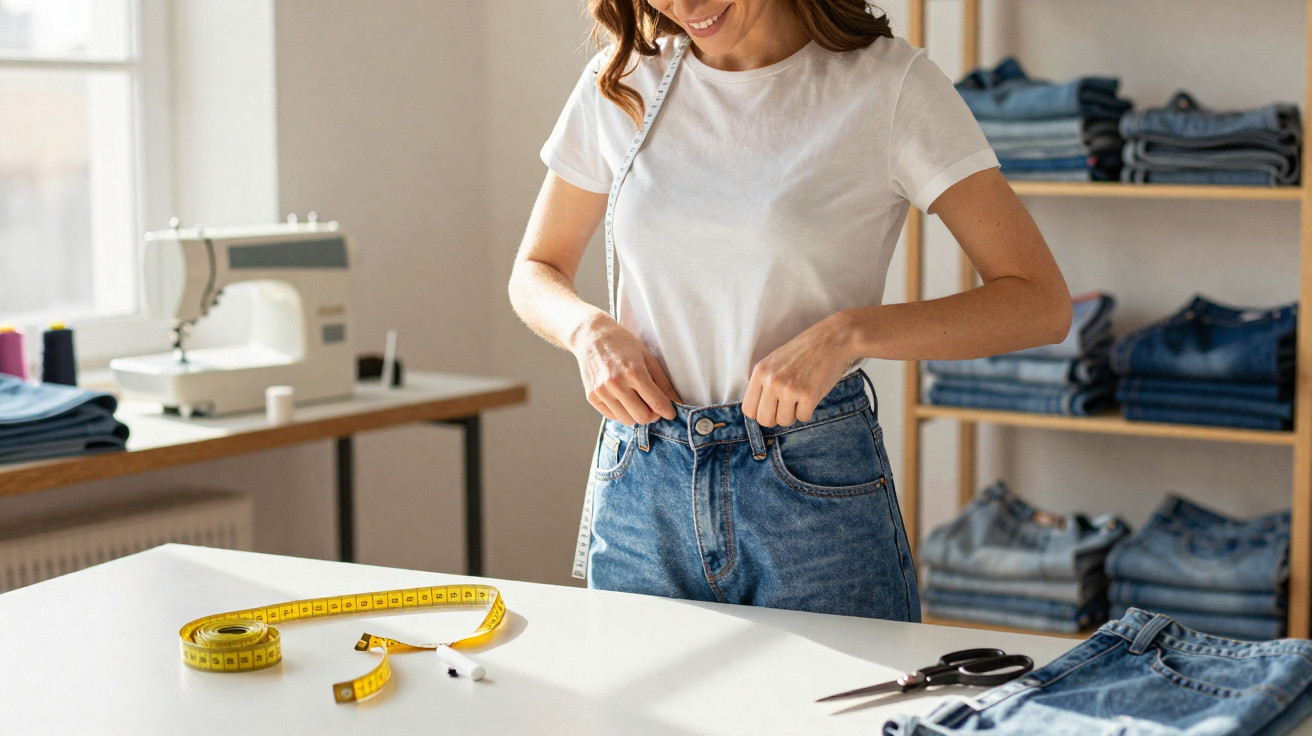
There is a surprisingly simple way out.
Many people know the situation: the button is straining, the zip gapes, and the once-perfect jeans suddenly join the pile labelled “perhaps I’ll fit into these again one day”. Rather than frustratingly buying new trousers, a quick, targeted sewing technique can save a remarkable amount – without your wardrobe bursting at the seams.
Why so many pairs of trousers suddenly feel too tight
A few holidays, a desk job involving lots of sitting, hormonal changes or simply a wash that was too hot: before long, the waistband feels tighter than it did a few months ago. The body has often changed only slightly, but every centimetre is noticeable around the stomach.
“The waistband is the weak point: this is where the tension builds up – and it is precisely where the trick comes in.”
Jeans and traditional tailored trousers in particular usually have a firm waistband with very little stretch. While the rest of the fabric may adapt slightly, the waistband remains rigid. This can lead to:
- constant strain on the button and buttonhole
- the zip popping open easily or forming creases
- the stomach being uncomfortably constricted
- many pairs of trousers sitting unworn in the wardrobe
Instead of accepting this or spending heavily on replacements, it is worth considering a simple alteration exactly where it is needed: at the waistband.
How to gain up to 5 cm of extra waistband width from no spare room
Tailoring professionals use a straightforward principle: they introduce flexibility where everything was previously rigid. This is done with a small, discreet insert placed directly in the waistband area.
The concept is simple: a narrow panel of elastic material or bias-cut fabric creates a flexible section. This distributes the tension more evenly without making the lines around the hips and legs look distorted.
“In many cases, an elastic insert can add up to five centimetres to the waistband circumference – often with half an hour of work.”
The alteration remains invisible in everyday wear, provided the waistband is not left on display. Anyone who generally wears a T-shirt, blouse or jumper over it will simply see that the trousers are comfortable again and the stomach has room to breathe.
Step by step: adding an elastic insert to the waistband
Anyone with basic needle-and-thread skills can often carry out this alteration themselves. Otherwise, simply explain the desired technique to an alterations tailor – many professionals already know it.
1. Choose the right position
For most trousers, there are two suitable options:
- Side seam – discreet, easy to access and ideal for many jeans and chinos
- Centre back seam – especially subtle and often preferred for tailored trousers
Depending on the cut, choose a position where there is already a seam and where the alteration will barely be visible from the outside.
2. Open the seam and separate the waistband
Turn the trousers inside out. Using a seam ripper, unpick the selected seam for around four to five centimetres downwards. Next, open the waistband precisely along the original seam line. Work neatly to ensure nothing becomes distorted later.
3. Prepare the insert
Now comes the key component: the insert, often called a “gusset”. You will need either:
- firm, flat elastic at least 3 cm wide, or
- a slightly thicker piece of stretchy fabric, such as one taken from an old pair of trousers
Cut two small triangles from the material. The wider edge will form the new waistband edge, while the point faces towards the hip or seat. This creates a wedge-shaped expansion that gives the waistband additional room.
4. Pin it in place, try the trousers on and sew
Place the triangles into the opened seam, secure them with pins and tack them loosely. Then briefly try on the trousers. This makes it possible to check whether the new width is right or whether the insert needs to be narrower or wider.
Once everything fits properly, sew it in place. A zigzag stitch on a sewing machine is ideal because it retains the material’s elasticity. If sewing by hand only, use close, strong stitches so the insert will not tear out later.
“The clever part is that the shape of the trousers stays the same; only the waistband gives slightly when you breathe and sit down.”
An alternative without elastic: extra width using fabric alone
Some people do not like synthetic materials against their skin or are sensitive to elastic. There is also a solution that uses fabric alone.
Rather than using elastic, use a piece of fabric cut on the bias – tailors call this “on the bias” or a “bias cut”. This cutting direction provides natural give, even when the fabric contains no elastane.
- choose an old garment in a similar colour
- unpick a section from the hem or leg area
- cut the triangles on the bias
- insert them as for the elastic insert and secure them with a zigzag stitch
The result feels slightly firmer than an elastic version, but it still provides noticeable relief at the waistband, particularly while sitting.
Common cases: favourite jeans, weight fluctuations and hormonal changes
A recurring issue in many wardrobes is the once-perfect pair of jeans that suddenly no longer fastens properly. This often happens during stages of life in which waist measurement changes: after pregnancy, during the menopause or in stressful periods with little movement.
“Two small side inserts are often enough to make old favourite jeans suitable for everyday wear again – without a shopping trip.”
This technique can prevent a great deal of frustration, particularly in midlife when the figure gradually changes. Rather than responding to every physical change by replacing an entire wardrobe, it allows favourite pieces to be consciously adapted to the new reality.
Why this repair is more than simply a cost-saving measure
Alongside the obvious benefit of avoiding a new purchase, this method has a tangible environmental effect. Every pair of trousers kept out of the bin saves resources such as the water, energy and raw materials involved in manufacturing new clothing.
Authorities and environmental agencies have pointed out for years that extending the life of clothing is one of the most effective ways to tackle ever-growing textile waste. Altering trousers instead of discarding them fully supports repair and longer product life.
- economical: fewer impulse purchases and more use of existing clothes
- ecological: lower resource consumption
- emotional: favourite pieces remain part of everyday life
Who is the waistband trick suitable for, and what are its limits?
The technique is suitable for many styles of trousers: jeans, chinos, tailored trousers and, in some cases, even suit trousers. The key requirement is an existing waistband seam and a construction that can technically accommodate the insert.
There are limits where the fabric is already heavily worn or stretched out. The small insert also reaches its limit if more than five centimetres are needed. In that case, only a more extensive alteration or a new style with a fundamentally different fit will help.
If you are unsure, ask an alterations tailor for an assessment. A quick look at the waistband and seams is often enough to establish whether the work is worthwhile. For high-quality trousers or beloved jeans, the small investment usually pays off – financially and emotionally.
Anyone who likes this approach can use the technique as an introduction to other small alterations, such as letting out waistband pleats, shortening overly long legs or fitting a new zip. Step by step, this creates a wardrobe that genuinely fits your body, rather than the other way round.



Comments
No comments yet. Be the first to comment!
Leave a Comment