
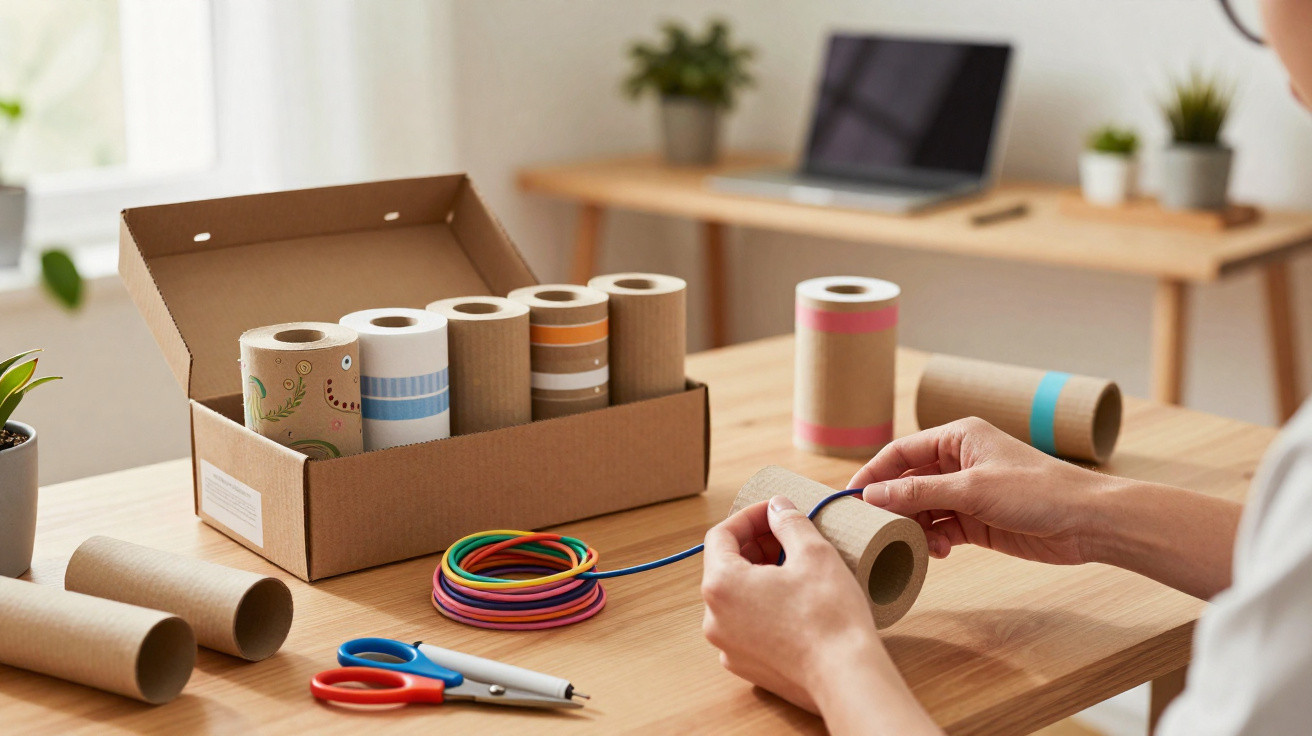
Reusing cardboard tubes as organisers for wires and cables is becoming increasingly common in many homes, especially among people looking for straightforward ways to keep their living space tidy without spending money. Drawing on Japanese organisation, these ideas bring together practicality, a clean appearance and the reuse of materials that would otherwise be discarded, making it possible to create modular systems that readily suit different spaces.
Why does a cardboard tube wire organiser work so well?
A cardboard tube wire organiser is particularly effective because it is inexpensive, quick to assemble and adaptable. In homes with numerous electronic devices, cables often become tangled together; placing each one in its own “tube” helps prevent knots, makes it easier to find and can even extend the lifespan of the wires.
Inspired by Japanese tidying methods, this approach places usefulness and simplicity first. Each tube becomes a small “home” for one cable. It can be strengthened with adhesive tape or sturdier paper, then labelled, creating a setup that looks orderly and is easy to maintain.
How to make an individual cable organiser from recycled material
An individual version is an ideal way to try using cardboard tubes as a cable organiser made from recycled material. No specialised tools are needed, and it can be adjusted for many types of wire, from mobile phone chargers to computer cables.
Once the tubes have been prepared, store them side by side in drawers, boxes or baskets. Follow this straightforward step-by-step guide to make the process easier and ensure a consistent result:
- Set aside clean cardboard tubes that are free from dents.
- Strengthen their edges with adhesive tape so they do not fray during use.
- Wind the wire or cable into a circle or “figure of eight” shape to reduce its bulk.
- Place the coiled cable inside the tube, leaving its ends slightly visible.
- Attach a label naming the device, such as “mobile phone charger” or “external hard drive”.
How to create a cardboard tube box to organise several wires
Anyone who has built up a large collection of cables, such as in a home office, can arrange several tubes inside one sturdy box. This creates internal compartments similar to ready-made modular organisers, but uses only repurposed cardboard.
The complete box can be moved during house moves, reorganising or cleaning. Keeping every tube upright and in view means you can quickly identify what you need, while preventing cables from becoming mixed up in the drawer again.
- Choose a robust box that fits the intended drawer or shelf.
- Stand the tubes upright, covering the entire base like small tubes positioned side by side.
- If required, trim the tubes to the same height as the box to keep the top even.
- Put one coiled cable into each tube, following a consistent layout.
- Label the front of every tube with discreet labels or markers.
Best practices for staying organised with cardboard tubes
To ensure the system remains useful, adopt a few small maintenance habits inspired by the Japanese organising routine. Returning each cable to its tube immediately after use, replacing damaged tubes and updating labels when a device is changed all help stop clutter from returning.
It is also worthwhile separating cables used every day from those needed only occasionally, keeping the most frequently used ones in easier-to-reach places. In this way, tubes that would have gone in the bin become a simple, sustainable and unusual resource for keeping wires, cables and small items under control every day.





Comments
No comments yet. Be the first to comment!
Leave a Comment