
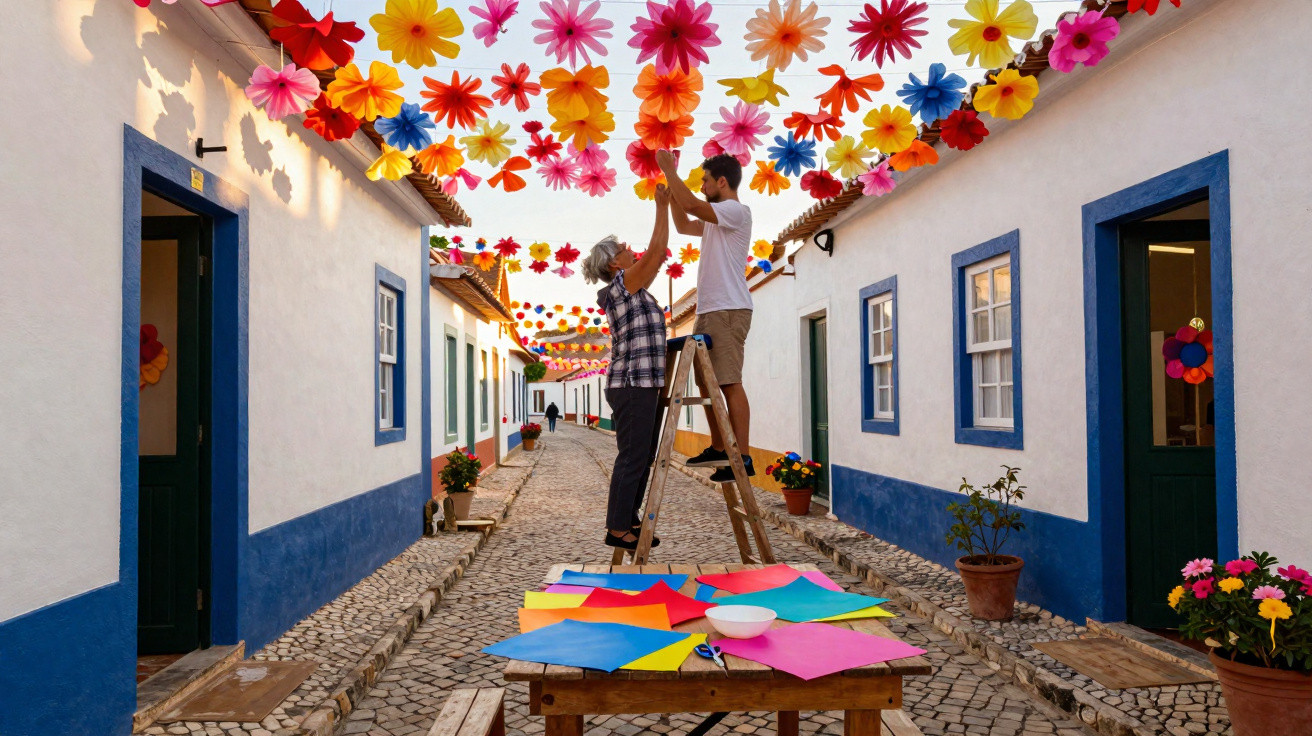
Evenings in Campo Maior are being devoted to making paper flowers, crafted by the skilled hands of dozens of women in homes across the town. Production has even taken over a former bakery belonging to the late businessman Rui Nabeiro.
This flower-making operation, involving more than four thousand volunteer residents, is preparing for the Campo Maior People’s Festivals in the Portalegre district. The event returns this year, running from 08 to 16 August.
The celebrations are renowned for transforming dozens of streets in the Alentejo town with thousands of handmade paper flowers. Created by local people, the decorations fill this community near the Spanish border with colour.
Held through the will of the people, the festivities were last staged in 2015. In 2021, they were recognised by the United Nations Educational, Scientific and Cultural Organization (UNESCO) as Intangible Cultural Heritage of Humanity.
Campo Maior People’s Festivals preparations begin
For the 2026 edition, a former bakery once owned by Rui Nabeiro (1931-2023), a native of Campo Maior, has welcomed women from two streets every evening since the start of the year. They gather there to make flowers.
The groups do not mix, however. The building has been split into two so that neither street reveals the theme it is preparing to the other, because “secrecy is the soul of business”, Lusa observed at the site.
Speaking to Lusa while cutting paper and snipping card, with no time to waste in the race against the clock, 68-year-old Filomena Correia regrets the current shortage of helpers. Above all, she is concerned by younger generations’ lack of interest in learning the craft.
“There are lots of people in the street who could be here making [paper flowers], but there have been very few. It is a shame, because the festival belongs to everyone, doesn’t it? There should be more people here, but there aren’t,” she argues.
Maria José Silveira, a local street leader - effectively a team captain - tells Lusa that she has been making flowers for 60 years. She too highlights the shortage of volunteers, despite support for the initiative from the municipal council and the Campo Maior People’s Festivals Association, which organises the event.
“I don’t know whether, in a few years’ time”, the festivals will still continue, she says, leaving the question open. “To my great regret, because I have always loved it, but I do not know whether this is tending to come to an end, because it is a huge responsibility.”
Her daughter, Ana Silveira, is certain that the tradition must continue, although she regrets the lack of “capacity for sacrifice” among some residents, including young people.
Ana Silveira points to the difficulty of persuading younger people to take part, especially those who “have never lived on a street that was decorated” and are unwilling to give up their private lives for volunteer work.
Volunteers preserve Campo Maior’s paper-flower tradition
In the adjoining room of the old bakery, Fátima Vitorino, also a street leader, underlines the responsibility that comes with UNESCO recognition. She believes the designation reflects what is “the essence” of Campo Maior: “the voluntary work of an entire people”.
“We spend whole days and nights here, and this year it is a great responsibility to show what the essence of Campo Maior is, what the strength of the people of Campo Maior is, and that yes, we can put up 100 streets” decorated with flowers, she stresses.
Evenings are just as busy in the historic part of the town, where the festivities began. There is no shortage of entertainment either, as volunteers sing Campo Maior’s “saias”, the region’s traditional music, accompanied by a tambourine.
“We sing from time to time - those of us who know how to sing, of course. We have our little snack at around 23:00, our lemonades, liqueurs, cakes and rice pudding. We have had lots of little treats during the evening,” says 76-year-old Ana Juromento.
The Campo Maior People’s Festivals are not built by women alone. Men play an important role in producing heavier materials and props, and on the night of the enramação, when decorations and flowers are installed in the streets on the eve of the festivities.
José Manuel is one of the many volunteers. Yet, as he acknowledges to Lusa, even with men’s assistance, it is the women who have the final say on how the streets are finished.
“Our [role] is the structure of the street itself, the entrances, but the final beauty comes from the women. The women are the ones who give the street its finishing touch,” he says.
Until the festivities begin, the work is demanding and takes place every day, with no time to spare. Space is already running short in every home. Thousands of paper flowers and props are stored everywhere, ready once again to “make more than 100 streets of Campo Maior bloom” in August.

Comments
No comments yet. Be the first to comment!
Leave a Comment