
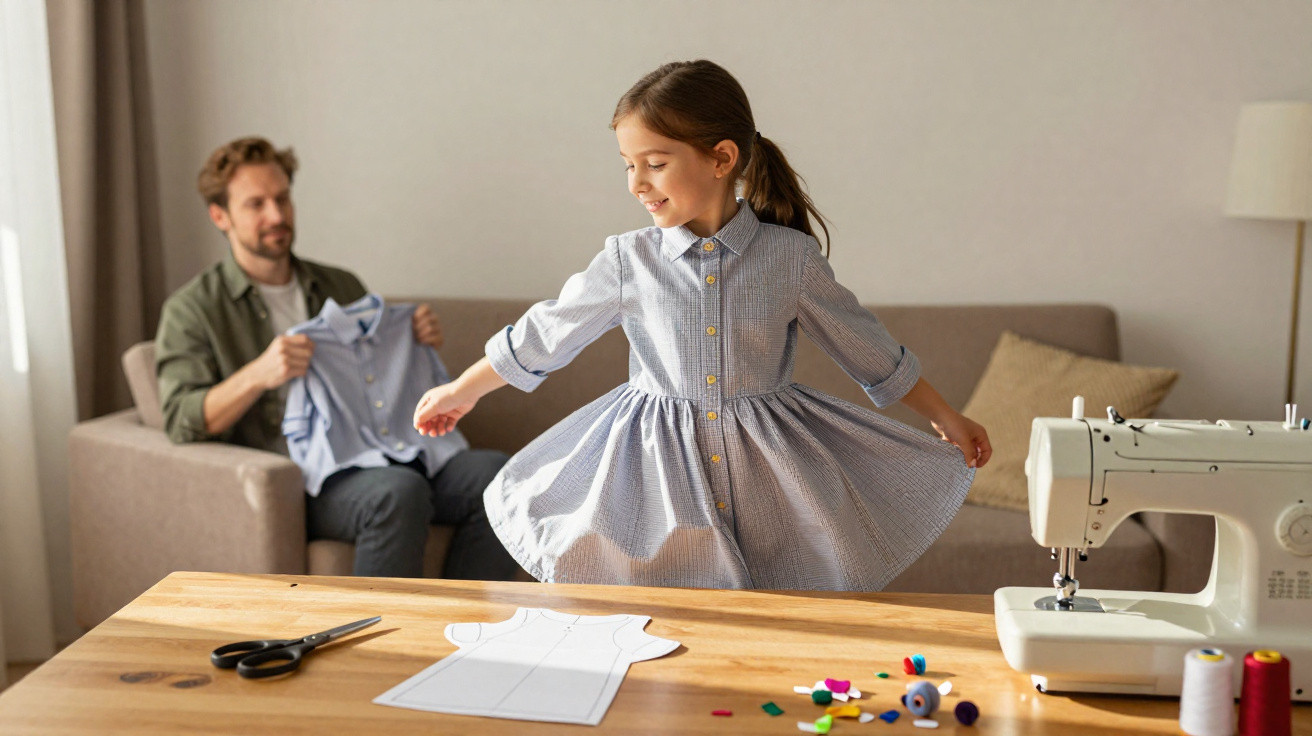
Many parents will recognise the situation: the wardrobe is overflowing, while old shirts linger forlornly at the very back of the rail. Rather than throwing them away, a few smart steps can turn them into a child-friendly dress – without spending a penny on new fabric. The result is less waste, a truly personal garment and a small sustainability revelation for the whole family.
Why a men’s shirt is ideal for making a children’s dress
A classic men’s shirt in size L or XL contains a surprisingly generous amount of fabric. Dressmakers estimate roughly 1.5 to 2 square metres – easily as much as you might buy from a fabric shop for a children’s dress.
An old shirt usually provides fabric worth €20 to €40 – entirely free because you already own it.
Popular shirt fabrics such as poplin, Oxford and chambray are tightly woven, pleasantly smooth and still hard-wearing. That is exactly what children need: kind to the skin, yet sturdy enough for climbing frames, sandpits and the washing machine.
- Poplin: fine, smooth cotton, ideal for summer dresses
- Oxford: slightly heavier with a subtle texture, perfect for everyday wear and nursery
- Chambray: a denim look but much lighter – relaxed and contemporary
There is another benefit: the shirt has already been washed countless times. This stabilises the fabric, so it is unlikely to shrink further or release dye. That means fewer unwelcome surprises when the new dress is washed for the first time.
Upcycling with sentimental value: Dad’s shirt becomes a children’s dress
The emotional aspect matters too. When the finished dress is made from a father’s or grandfather’s shirt, fashion becomes a story parents can share with their children.
“This used to be Dad’s favourite shirt – now it’s your favourite dress.” Words like these give a garment character.
This project is particularly useful for families where sustainability is already a subject, as it offers children a playful way to understand the value of clothing. Instead of ending up in the bin, the fabric is given a new life, and the child can see the before-and-after transformation first-hand.
Step by step: turning a men’s shirt into a children’s dress
1. Prepare the shirt
Start by washing and ironing the shirt thoroughly. A crease-free shirt makes it far easier to position the pattern accurately. Then quickly inspect it for worn areas: these are usually found inside the collar and on the cuffs, occasionally along the button placket and only rarely on the back panel.
- Ignore the collar and worn cuffs, or cut them away later
- Plan to use the back panel, front panels and sleeves as fabric sources
- Keep the button placket wherever possible – it saves a great deal of work
2. Unpick only the seams that need to be opened
There is no need to take the entire shirt apart piece by piece. Simply undo the seams that get in the way of cutting: open the side seams, remove the sleeves and, if necessary, unpick the pocket. Leave the button placket attached to one front panel. It will become a practical fastening later and gives a professional finish without requiring complicated sewing.
3. Create a pattern without buying one
The easiest option is to use a dress that currently fits the child well. It becomes the template for the new garment. A simple design is enough, ideally one with a loose-fitting bodice and a gently flared or gathered skirt.
- Lay the existing children’s dress flat on the shirt.
- Trace around it with tailor’s chalk, including seam allowance.
- Take care to position the pieces around stains or thin patches in the shirt.
For children aged around two to six, the fabric from an L or XL shirt is usually more than sufficient. The shirt’s back panel is generally ideal for the skirt, while the sleeves provide fabric for the bodice or narrow straps.
4. Join the bodice and skirt
Once the pieces have been cut out, attach the bodice to the skirt. For a softly pleated effect, ease the upper edge of the skirt and gather it onto the bodice. This creates a playful look and is forgiving of minor measuring inaccuracies.
The shirt’s lower hem can simply be retained – saving sewing time and creating a neat, shop-bought finish.
The existing shirt hem is especially useful: it is neatly topstitched, subtly curved and visually ideal as the finishing edge of a children’s dress. Many home dressmakers say this alone saves them a good 20 minutes of work.
Details that make the dress especially distinctive
Reuse the button placket, hem and curves cleverly
The button placket can be placed either at the front or the back. At the front it looks casual and practical for everyday wear; at the back it makes dressing easier because the neckline opens wider. The characteristically slightly rounded side sections on many shirts also create an attractive curved hemline – much like a designer piece, only second-hand.
More experienced sewers can turn cuffs into small flutter sleeves or shoulder tabs. Breast pockets can also be unpicked and reused as patch pockets on the skirt, perfect for hair bands, little stones or other childhood treasures.
Decorations made from leftover fabric
The remaining shirt fabric can quickly become small extras:
- A hair band in the same pattern as the dress
- A miniature skirt or dress for a doll
- Bows, frills or a small ruffle at the hem
This creates a coordinated look without buying extra materials. Children see directly how something lovely can be made from “leftovers”. If you like, let the child help choose the buttons or decide where a pocket should go – it strengthens their connection to the garment.
Practical questions many parents ask
Which shirts work best?
Shirts made from pure cotton or linen are best, provided they are not too thick or stiff. Fine stripes, small checks and understated patterns look especially charming at a smaller scale. Even a shirt that initially appears “old-fashioned” gains character when transformed into children’s clothing.
| Material | Suitable? | Special feature |
|---|---|---|
| Cotton poplin | Yes | Smooth, comfortable, easy to care for |
| Oxford | Yes | Durable, ideal for everyday nursery wear |
| Chambray | Yes | Lightweight denim look |
| Thick flannel | Limited | Better suited to autumn/winter dresses |
| Viscose/silk | Only for experienced sewers | Slippery and more difficult to sew |
Small stains or a worn collar are no problem. Simply avoid those areas while cutting out the pieces. Those feeling especially bold can even use a deliberately “quirky” shirt with a bold pattern – in children’s sizing, it soon becomes a witty one-of-a-kind item.
Can it be done without a sewing machine?
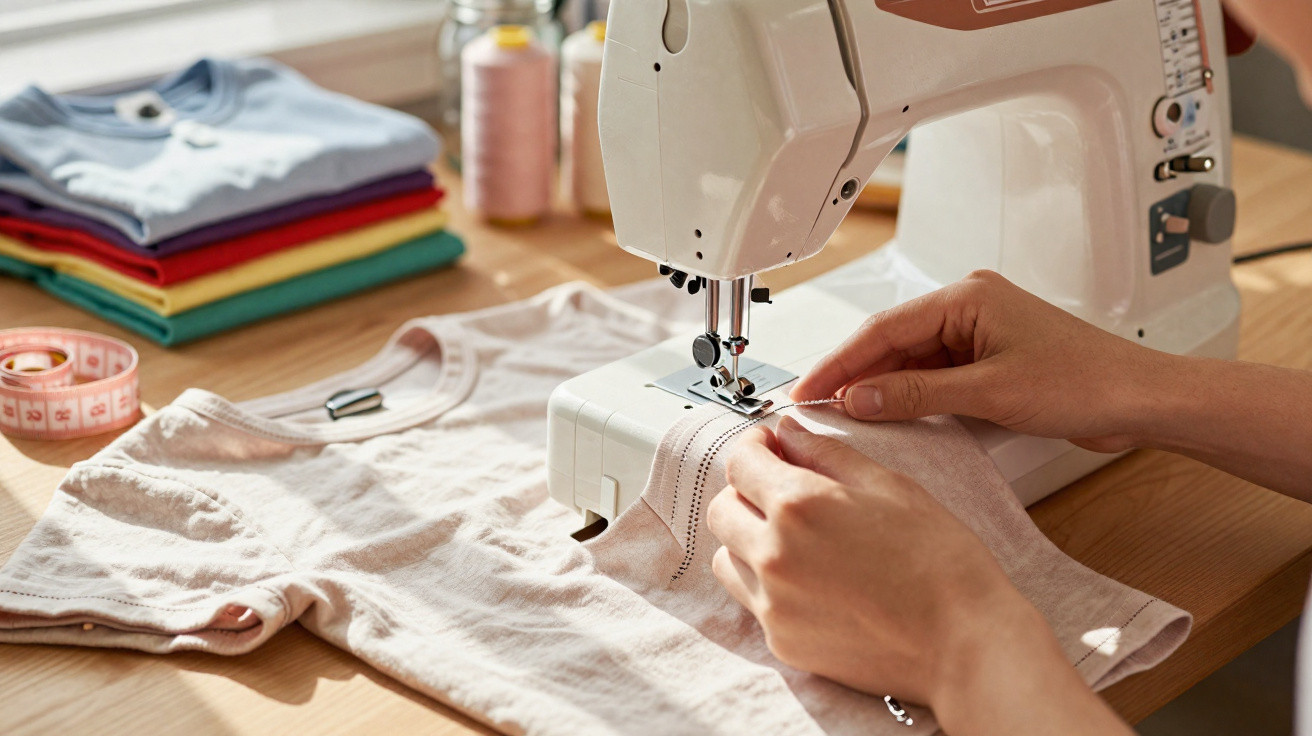
In theory, yes. Close, even hand stitches are surprisingly durable. However, for anyone who sews only occasionally, a machine is far more comfortable, especially for the side seams and attaching the skirt. Many adult education centres or community workshops offer sewing stations by the hour – a good opportunity to complete the project in one afternoon.
Benefits beyond the dress: sustainability, learning and creativity
A project like this brings together several advantages: it saves money, conserves resources and casually teaches children practical crafting skills. Inviting young children to the cutting table makes it possible to explain sizes, patterns, colours and function, while showing that clothing is not simply a consumer product.
At a time when the textile industry is considered particularly damaging to the environment and climate, an upcycling project like this sends a strong message: not every dress needs to be bought new, and good fabric deserves a second life. A single shirt can produce several small projects – a dress, an accessory and doll’s clothing – rather than being thrown into the bin.
Anyone who develops a taste for it can extend the idea further: old jeans can become sturdy pinafore dresses, while bedding can be transformed into colourful summer dresses. The men’s shirt is only the start of a whole series of straightforward, practical sewing ideas that ease the pressure on both the family budget and the environment – and may ultimately produce a new favourite garment for a child.


Comments
No comments yet. Be the first to comment!
Leave a Comment