
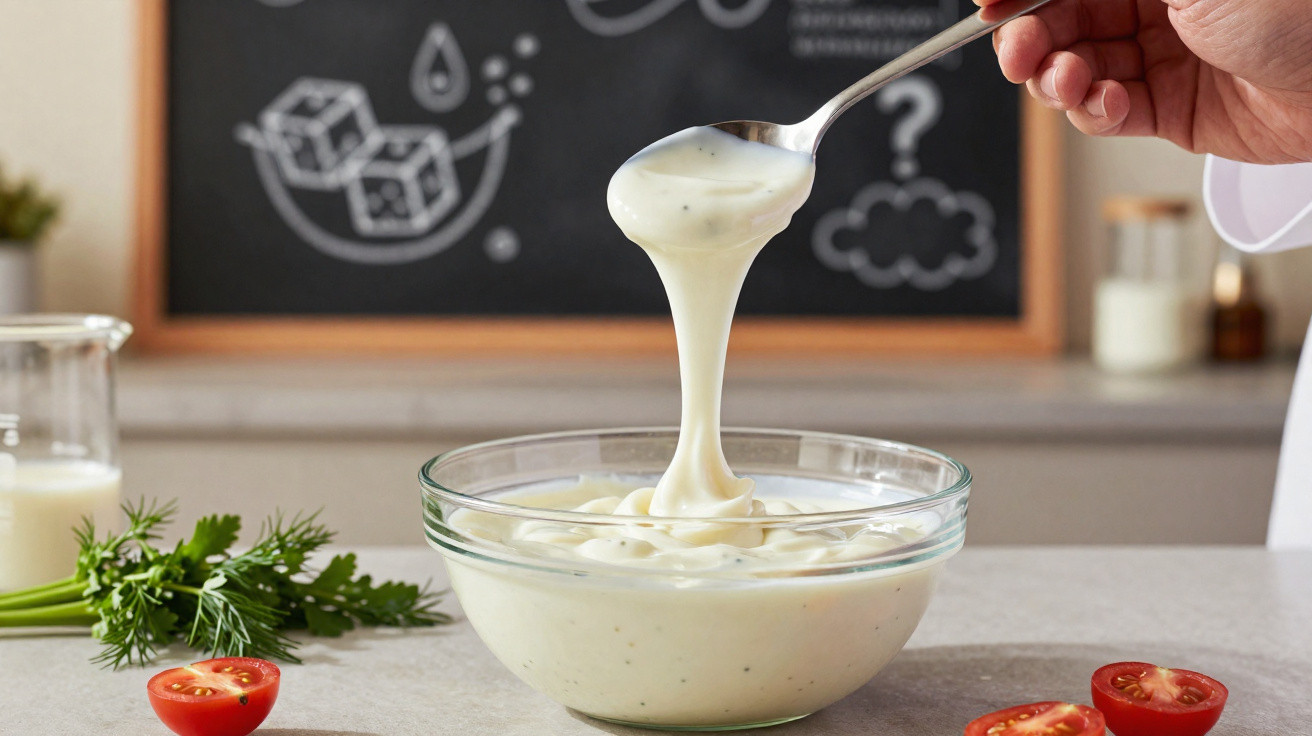
Picture yourself having dinner. You want to add ranch dressing to your plate for dipping vegetables. You turn the bottle upside down, yet nothing emerges. It appears to be a solid.
Then you shake the bottle, and a large dollop of dressing drops onto the plate. That makes it seem like a liquid.
Yet the dressing does not flow across the entire plate as milk, or another spilled liquid, would. Instead, it retains a degree of shape, much like the vegetables on your plate. Again, it appears solid.
Whenever you push a solid carrot or celery stick into the dollop, however, the dressing changes shape slightly. You can smear and spread it too, whereas the celery's form and firmness remain unchanged by this experiment. It seems liquid.
So is ranch dressing both a liquid and a solid, or neither one?
I am a professor of physics and biophysics whose research examines squishy materials that display the characteristics of both liquids and solids. Physicists refer to these materials as soft matter.
In my laboratory, we study why biological substances, including skin and snot, are squishy, as well as how to make bio-inspired materials with these same intriguing traits.
I also run a social media channel called Physics Mama, where my two sons and I explore and answer questions about the physics behind daily life.
The fundamental states of matter
To understand what happens with ranch dressing, it helps first to know the different states of matter and the features that distinguish them. “Matter” is simply the scientific term for “stuff”: anything made from microscopic building blocks called atoms that has mass.
You probably learnt at school that matter has three states: solid, liquid and gas. Think of an ice cube, a pool of water and steam. You may also have been taught about a fourth state, plasma.
These states differ according to the ways the extraordinarily small molecules within matter interact. Molecules are too tiny to see with the naked eye, but their unseen interactions determine the qualities of the materials you can observe.
In a solid, molecules are physically joined in a way that prevents them moving relative to one another. This gives solids their rigidity and enables them to retain a fixed form.
By contrast, molecules in a liquid are not joined together. They can move, slip past one another and mix. This mobility lets a liquid adopt the shape of whichever container holds it.
Gas molecules can move entirely freely, without colliding very much with the other molecules in the gas. Like liquids, gases take the shape of their container and have no fixed form. Unlike solids and liquids, though, gases can also alter their size, or volume.
Plasma resembles a gas but contains far more energy. That energy separates the electrically charged components of molecules, known as protons and electrons. The Sun and other stars are plasma, as is the material responsible for the glow of neon signs.
Elasticity and viscosity
Although solids retain their form, they are not wholly inflexible. The bonds between their molecules act like minute springs, giving solids elasticity.
When you press on a solid, it changes shape, then returns to its original condition once the pressure stops, rather like a mattress after you bounce on a bed. Naturally, this takes place at the molecular scale, so it is not visible.
Liquids also resist changes in shape, despite changing shape readily. The resistance comes from friction as liquid molecules attempt to pass one another, and this friction is called viscosity.
Honey and syrup, for example, are far more viscous than milk or water, which makes them more difficult to stir. Try imagining a swim in a pool of honey: tasty, but challenging.
Soft matter: a fifth state
Ranch dressing is in fact a fifth state of matter, called soft matter. Because soft matter may have the properties of both solids and liquids, materials scientists describe it as viscoelastic: a blend of viscous and elastic.
Everyday examples of soft matter also include yoghurt, biscuit dough, shampoo, toothpaste, silly putty, snot, slime and icing.
These materials are neither fully solid nor fully liquid, but partly both. Shampoo can be poured from its bottle, but if you place some between your fingers and pull them apart, it stretches between them.
Biscuit dough can keep its shape, yet pressing it causes it to deform without springing back.
Many viscoelastic substances show shear thinning, meaning their viscosity falls as they are agitated more.
That is why shaking a bottle of ranch dressing or ketchup makes it pourable, even when it previously seemed too solid-like to come out. It also explains why yoghurt that seems firm enough to hold its shape becomes more liquid-like when stirred rapidly.
Squishy substances may also display shear thickening: the more forcefully you try to deform them, the stiffer they become. Oobleck, a straightforward mix of cornflour and water, behaves this way. You can pour it slowly and immerse your hand in it as you would with any liquid, but it solidifies if you squeeze or shake it.
A different type of molecule
These squishy materials combine liquid and solid properties because they consist of polymers: long, chain-shaped molecules. Like spaghetti in a bowl, the long chains become entangled. They are therefore somewhat connected, as solid molecules are, while also somewhat able to slide past each other, as liquid molecules do.
Most supermarket ranch dressing contains xanthan gum, a natural polymer used to thicken and stabilise many foods.
The next time you attempt to pour ranch dressing from its bottle, imagine the xanthan gum polymers tangled together and causing the dressing to behave as a solid.
Shaking the bottle untangles the polymers, allowing them to slide and flow past one another so that the dressing can flow easily out of the bottle and onto your plate.
Rae Robertson-Anderson, Professor of Physics & Biophysics, University of San Diego
This article has been republished from The Conversation under a Creative Commons licence. Read the original article.






Comments
No comments yet. Be the first to comment!
Leave a Comment