
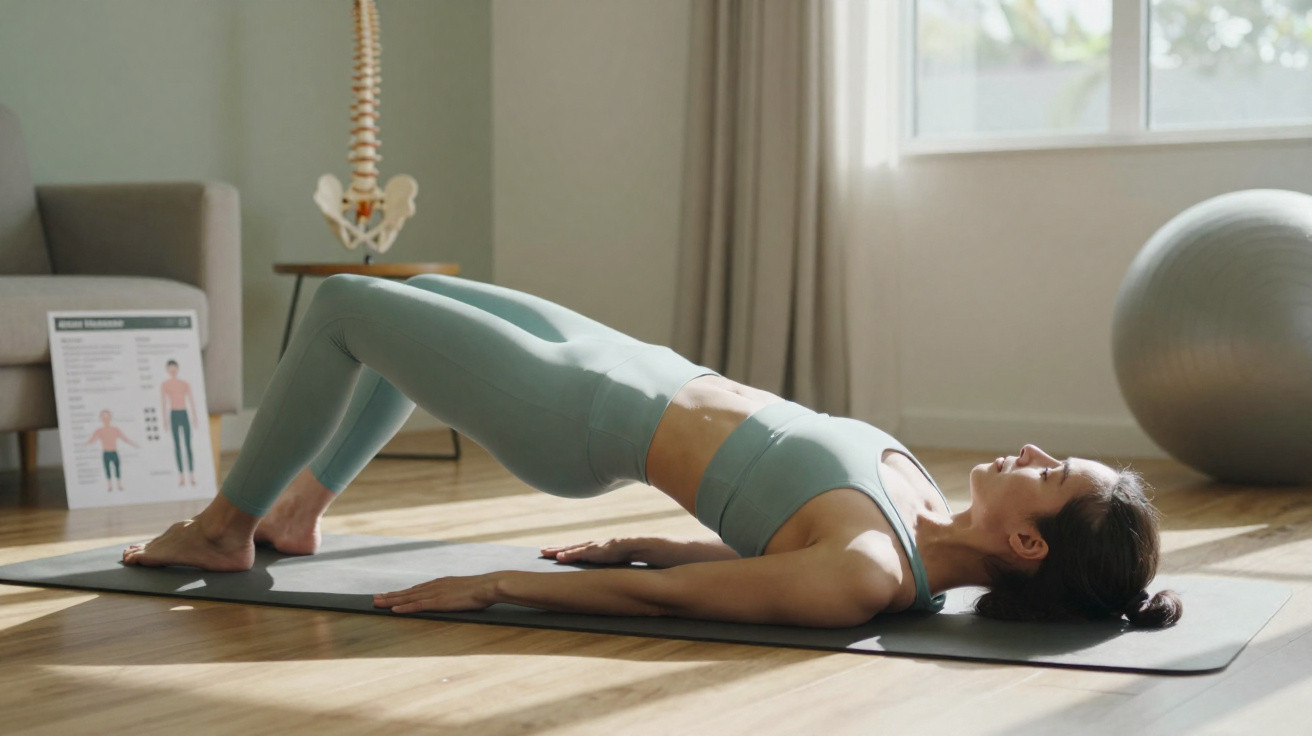
The deep core supports the lumbar spine like an active brace, comprising the transversus abdominis, multifidus muscles, diaphragm, pelvic floor and hip muscles. For chronic lower back pain, specialists generally focus on stability, motor control and a neutral spine, as this form of training improves function and may ease pain in cases of non-specific low back pain.
Why is the deep core more important than traditional abdominal exercises?
Traditional abdominal exercises largely involve trunk flexion, but they do not always teach the spine to remain stable during everyday movements. Stabilisation exercises, by contrast, train the body to resist rotation, excessive extension and pelvic dropping.
This control matters because the lower back is put under strain when it has to compensate for weakness in the deep abdominal muscles, glutes and muscles surrounding the pelvis. The aim is not to complete a high number of fast repetitions, but to maintain breathing, alignment and gentle tension without bracing the body rigidly.
How do you perform a dead bug to activate the deep abdominal muscles?
The dead bug is one of the safest movements to begin with because it is performed lying down, keeping the lower back supported and avoiding impact. It engages the transversus abdominis and deep stabilisers while the arms and legs move without allowing the pelvis to rock.
- Lie on your back with your knees bent at 90 degrees and your arms pointing towards the ceiling.
- Breathe out and engage your abdominal muscles as though you were fastening a zip below your navel.
- Slowly extend one leg and the opposite arm, without arching your lower back.
- Return to the starting position, then repeat on the other side.
- Start with 2 sets of 6 to 8 repetitions on each side.
Why does the bird dog stabilise the lower back?
The bird dog targets the multifidus muscles, glutes, deep abdominal muscles and shoulder-blade control. It teaches the body to move an arm and leg without rotating the torso, precisely the kind of stability the spine needs when walking, carrying a backpack, lifting objects or climbing stairs.
Begin on all fours, with your hands beneath your shoulders and your knees beneath your hips. Reach one leg back and the opposite arm forwards, keeping your pelvis parallel to the floor; hold for 3 seconds, then return. Complete 2 sets of 6 to 10 repetitions on each side, without lifting the leg above hip level.
How does the side plank protect the spine?
The side plank strengthens the obliques, quadratus lumborum, gluteus medius and lateral trunk stabilisers. These muscles prevent the pelvis from “dropping” to one side, which is particularly important for people who experience lower back discomfort on long walks, during gentle running or after standing for extended periods.
- Start with the knees-down version, resting your forearm on the floor.
- Keep your elbow directly below your shoulder and your neck in line.
- Lift your hips until your body forms a line from your shoulders to your knees.
- Hold for 10 to 20 seconds, breathing without holding your breath.
- Perform 2 to 3 repetitions on each side, gradually increasing the hold time.
Progression should relieve pain, not cause more
For chronic lower back pain, the ideal frequency is usually 3 to 5 times a week, using short sessions of 10 to 15 minutes. Start with the dead bug, bird dog and knees-down side plank; then increase repetitions, holding time or leverage, but never all at once.
The spine responds better to consistent stimulus than aggressive workouts. If pain travels down the leg, strength is lost, numbness occurs, there is a fever, a recent fall has happened or symptoms progressively worsen, seeking professional assessment before continuing the exercises is the safest option.






Comments
No comments yet. Be the first to comment!
Leave a Comment