
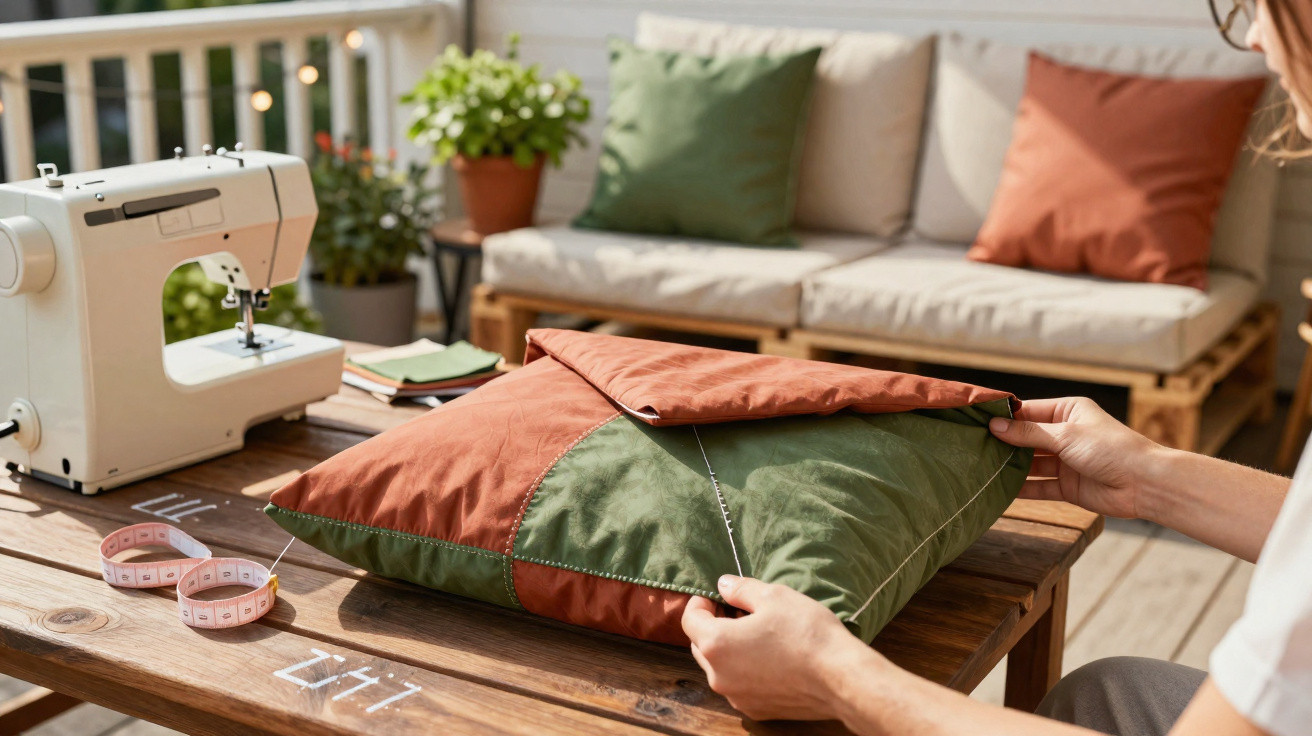
Many garden owners throw away worn patio cushions far too soon. Yet the foam inserts usually still have plenty of life left in them. A clever sewing technique gives the cushions a sturdy, contemporary cover – without a zip, a complicated pattern or a large budget.
Why old patio cushions are far too good for the bin
Stained covers, faded colours and split seams: after several seasons, patio cushions often look like this. The first reaction is usually to throw them out and buy replacements. That is precisely the problem. The filling – the foam – is generally still perfectly usable. It continues to provide good support and retain its shape; only the outer fabric looks tired.
Throwing everything away in this situation means paying twice: first for new cushions at the till, then environmentally through needless waste. New outdoor cushions are rarely cheap, especially in common sizes for lounge furniture or pallet sofas. Replacing several cushions can quickly cost several hundred pounds.
“The simplest solution: keep the cushion inserts and only change their ‘clothes’ – saving both money and waste.”
This idea fits perfectly with the principles of the circular economy: rather than discarding products while most of them still work, repair or replace individual parts. With patio cushions, this is easier than with almost any other home accessory, as the foam inserts can be removed and recovered with little effort.
The clever solution: an envelope-style cover
The principle is remarkably straightforward: instead of using a zip or buttons, make an envelope-style cover – much like a traditional pillowcase, where the cushion is slipped in from the back.
Why this cut is so durable
Zips can quickly fail on outdoor cushions. Sunlight, rain and the strain caused by sitting all put pressure on the teeth. Buttons can tear away, while press studs may rust or become loose. An envelope-style cover avoids these weak points. The fabric overlaps at the back, spreading the pressure across simple, straight seams.
“No zips, no buttons, just overlapping fabric – making the cover almost indestructible.”
The cover is therefore easy to remove and put back on, while still fitting securely around the cushion insert. It is ideal for families, pet owners and anyone who wants to wash their cushions regularly.
Step by step: sewing a new patio cushion cover
For an envelope-style cover, you need only a tape measure, fabric, pins and a sewing machine – or, if necessary, a needle and thread. The pattern consists of one large rectangle.
Calculating the measurements correctly
- Width of the rectangle: cushion width + approximately 3 cm seam allowance
- Length of the rectangle: 2 × cushion length + around 20 cm for the overlap section
This extra length ensures that the fabric layers overlap generously at the back, so the insert cannot slip out.
Sewing the cover in a few simple steps
- Remove the foam insert from the old cover and measure it accurately.
- Cut the fabric using the formula above.
- Hem the two short edges of the rectangle to prevent fraying.
- Fold the rectangle so that the short edges overlap – about 15 cm of overlap is a useful guide.
- Pin the open long sides in place and stitch each one approximately 1.5 cm from the edge.
- Turn the cover right side out, slide in the cushion insert and you are finished.
This creates a neat rectangular cushion shape with an invisible opening at the back. If required, you can later secure this opening with textile tape, although in practice this is seldom necessary.
A calculation example: a new look for a pallet sofa
Take a standard 60 × 60 cm cushion. For this, cut a piece of fabric measuring roughly 63 × 140 cm. The 63 cm width comes from the 60 cm cushion width plus 3 cm seam allowance. The 140 cm length is made up of twice the 60 cm cushion length plus 20 cm for the overlap.
In practice, the process works like this: hem the short sides, fold the fabric so the ends overlap by around 15 cm at the back, pin it in place, sew the two long sides and turn it right side out – then the foam can go straight back in.
“With just a few straight seams, a worn pallet sofa can suddenly look like a new lounge set.”
The financial saving can be considerable. Depending on their size and quality, new outdoor cushions cost £40 to £80 each – sometimes more. Anyone with several seat and back cushions can quickly save a three-figure sum by buying fabric by the metre and doing the sewing themselves.
Which fabric stands up to sun, rain and barbecues?
For outdoor use, choose a hard-wearing outdoor fabric from the roll. These materials are more densely woven, often coated, and much more resistant to UV radiation and moisture than ordinary cotton fabrics.
What to consider when buying fabric
- Dense weave: the denser the weave, the longer the cushions will hold their shape.
- Lightfastness: labels such as “outdoor” or “UV-resistant” offer useful guidance.
- Care: it should be washable at at least 30°C and ideally resistant to stains.
- Feel: the fabric should feel pleasant, rather than too hard or stiff.
The envelope-style cover itself greatly reduces points of stress because no vulnerable fastenings are sewn in. With a good-quality fabric, the seams will usually outlast the next colour trend.
A trick against damp from underneath: an integrated barrier layer
Outdoors, moisture does not only come from above. Many cushions sit on wooden benches, pallets or stone surfaces. When damp collects there, it can seep into the fabric and eventually reach the foam.
To prevent this, a simple barrier layer can be incorporated into the underside of the cushion. Materials already left over around the home are ideal for this:
- an old wipe-clean tablecloth
- an unwanted shower curtain
- leftover water-repellent sheeting
Sew this material onto the inside of the cover on the underside, or secure it at selected points. This creates a kind of invisible protective base. Moisture cannot travel into the foam, helping the cushion stay dry for considerably longer.
“An old tablecloth or shower curtain can significantly extend the life of cushion inserts – at no extra cost.”
Other things to consider: safety, care and design
If you use pallets, run your hand briefly over their edges: splinters or sharp screws can damage both fabric and skin. It may be worth sanding down heavily used areas lightly.
For care, the key point is that the covers remain removable. The envelope design makes this easy. Stains from sun cream, red wine or barbecue grease can then be washed from the fabric regularly, without putting the foam in the washing machine every time.
There is also a design benefit. Anyone who has always wanted a coordinated colour scheme for the patio can now select fabrics in their preferred shades. Stripes, plain colours or subtle patterns: once the covers are sewn, the entire seating area will look cohesive.
This solution is particularly useful in rented homes with limited storage space. Keeping the foam inserts reduces winter storage volume, while the covers can be removed quickly, folded and stored in a box. The following spring, you can even choose a new fabric design without having to buy the costly foam again.




Comments
No comments yet. Be the first to comment!
Leave a Comment