
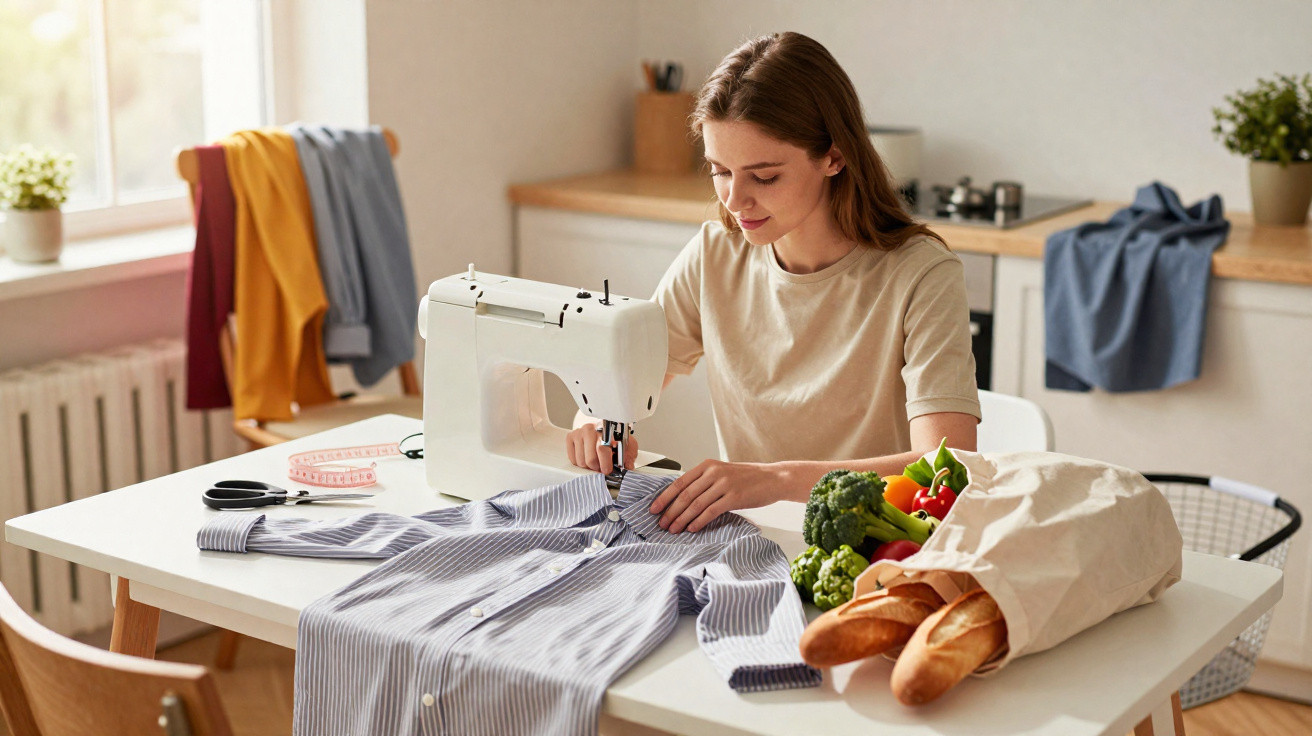
A simple sewing idea can give them a completely new lease of life.
Overstuffed wardrobes, rising supermarket prices and ever more restrictions on plastic bags: many households face the same dilemma. What should be done with old textiles, and how can shopping be carried home without buying fresh bags every time? This is where a surprisingly straightforward trick comes in, giving worn men's shirts a second and highly useful purpose.
Why an old shirt makes an ideal shopping bag
At first glance, a traditional men's shirt is nothing remarkable in everyday life: collar, button placket and cuffs are simply the features of an ordinary garment. Yet these items are often made from hard-wearing, long-lasting fabrics. Many manufacturers use tightly woven cotton, such as poplin or fil-à-fil cloth, designed to withstand rubbing and pulling.
Once the collar has yellowed, the cuffs have frayed or several buttons have gone missing, a shirt may no longer be suitable office wear. As a source of fabric, however, it remains extremely valuable. Its large surface area and sturdy material make it an excellent starting point for a reusable shopping bag.
"A discarded shirt does more than replace a bag – it becomes a lasting companion for the weekly market or supermarket."
There is also a point that is often overlooked: across Europe, several kilograms of clothing are thrown away per person each year. Every textile kept in use for longer saves resources, energy and disposal costs. With one easy sewing technique, waste becomes a useful everyday item, without any extra spending on materials.
Turn a shirt into a carry bag: making a sturdy shopping bag
A larger men's shirt is particularly well suited to this project, ideally in size L, XL or an even looser fit. It can certainly be old, provided the main fabric has no holes. Minor flaws, such as slight discolouration around the collar, do not matter because that section will be cut away anyway.
Step-by-step instructions for a quick shirt bag
Anyone with a sewing machine can complete the conversion in around an hour. With patience and hand stitching, though, it can also be done without one. The basic principle is simple: the body of the shirt becomes the bag itself, while the sleeves are used to make the handles.
- Button up the shirt fully and lay it flat on a table, smoothing both the front and back.
- Cut off the sleeves directly along the armhole seam, creating two large openings.
- Cut a semicircular shape from the upper section below the collar. This will form the bag opening.
- Turn the shirt inside out so that the inner side faces outwards.
- Align the bottom edge, secure it with pins and sew straight across it using a straight stitch.
- Then sew a zigzag stitch along the same seam to stop the fabric from fraying.
The main body of the bag is now complete. All that remains is to add sturdy handles, which can conveniently be made from the shirt itself as well.
Making comfortable handles from the sleeves
The detached sleeves provide enough material for two strong handles. Their length and width can be adjusted to suit individual preferences.
Practical method:
- Cut a fabric strip approximately 10 centimetres wide lengthways from each sleeve.
- Fold each strip lengthways towards the centre, turn the cut edges inwards and fold it again to create a four-layer strip.
- Topstitch close to the long edges to produce a durable, lightly padded strap.
- Position the handles on the inside of the bag edge, one on each side of the opening.
- Stitch each handle several times in a rectangle with a cross through it, so it can support heavy weight.
Then turn the bag right side out and the improvised shopping bag is ready to use. There is another practical advantage: the shirt's original breast pocket stays in place and is now on the outside. It is ideal for a shopping list, loose change, a trolley token or a front-door key.
"The shirt's breast pocket becomes a secret weapon: an extra compartment for small items that comes included with no additional work."
How much money and waste a shirt shopping bag can save
Buying high-quality fabric bags can easily cost £15 to £30 each in shops. Especially robust versions with reinforced handles and dense cotton can cost even more. An old shirt from the household costs nothing, and most people will already have a little sewing thread available.
The calculation is straightforward: three unused shirts can become three sturdy shopping bags. Buying the equivalent in a shop would cost between £45 and £90. That money stays in the wallet while the need for new bags is reduced. Over time, the avoided disposable bags add further savings – even if they cost only a few pence each, the total builds up over a year.
The environmental benefit is equally clear. Every shirt that is used as a bag rather than thrown away reduces the volume of textile waste. When the bags are used regularly, they replace countless paper and plastic bags. This approach plays a part in many climate protection strategies: using products for longer and reusing them rather than constantly producing new ones.
Which shirts are worth using – and which are not
Not every shirt is equally suitable. These selection criteria can help identify a good item to use:
- Size: The bigger, the better. Oversized and XL shirts provide more capacity for the finished bag.
- Fabric type: Choose tightly woven cotton rather than thin, transparent fabric.
- Condition: Small stains or signs of wear do not matter, but holes across the torso area do.
- Fabric blend: A small proportion of polyester can improve tear resistance, while pure viscose is usually too delicate.
- Pattern: Checks, stripes and subtle plain colours often look more premium as a bag than loud prints.
Anyone with several shirts can even organise them by purpose: one bag for baked goods, one for fruit and vegetables, and one for jars and bottles. This keeps shopping more orderly and makes unpacking at home quicker.
Tips for sewing machine beginners
Many people avoid sewing because they assume it requires specialist skills. This shirt project is particularly good in that respect, as it needs only a few straight seams. Anyone feeling unsure can practise on an old tea towel or discarded T-shirt before using the “good” shirt.
For a neat result, the following are helpful:
- Sharp fabric scissors, so the cut edges do not fray.
- Pins or fabric clips to hold the edges in place.
- A medium stitch length to prevent seams from tearing.
- Thread in a similar colour to the shirt, should small mistakes need disguising.
Without a sewing machine, the bottom edge and handles can be sewn by hand with small backstitches. It takes more time, but when done carefully it is still surprisingly durable.
Fitting the shirt bag into everyday life
To ensure the new bag becomes more than just a pleasant project and is used regularly, one simple habit helps: give it a fixed place near the front door or directly in the car. That way, it is less likely to be forgotten before shopping.
Many people also use the bag as an everyday helper:
- for lunch breaks at the office
- for sports clothes or shoes
- for children's books on the way to the library
- as a laundry bag while travelling
Over time, these uses create individual routines. Some households label their bags with small tags, while others use the shirt colours as a guide: blue for drinks shopping, white for bread and pastries, and brightly patterned bags for fruit and vegetables.
Getting more use from a garment
Anyone who likes the idea can extend the same principle to other clothes. Trouser legs can become bottle covers, old T-shirts can be turned into lightweight bags for bread rolls or fruit, and bed linen can make large laundry sacks. The underlying logic remains unchanged: the fabric already exists, and the only requirements are a little time and sewing thread.
This approach becomes particularly relevant when living costs are rising. Every bag sewn at home saves real money when shopping and reduces reliance on impulse purchases at the supermarket checkout. Children can be involved too: choosing fabric, planning the bag design, watching the sewing or trying it themselves later. It offers a very practical introduction to sustainable consumption – not through moralising, but with a tangible result to hold in their hands.





Comments
No comments yet. Be the first to comment!
Leave a Comment