
If you have a treasured old linen or linen-cotton sheet tucked away in a cupboard, you are holding much more than outdated bed linen. With a smart sewing approach, it can become a genuine statement piece for your wardrobe or home: sustainable, beautifully made and full of history.
Why vintage embroidered sheets are so valuable today
Traditional trousseau sheets are very different from modern mass-produced alternatives. They were commonly made from pure linen or a substantial cotton-and-linen blend. This gives them strength and longevity while keeping them wonderfully comfortable against the skin.
“These sheets were made to last for decades – and it shows: tightly woven, with strong fibres and hardly any pilling.”
Textile specialists attribute several benefits to fabrics of this kind:
- They can withstand washing temperatures of 60 to 90 °C.
- Their long fibres are far less likely to shed lint.
- They become softer with every wash without matting together.
- Linen naturally manages both moisture and temperature.
There is an environmental benefit, too. Enormous quantities of textile waste are produced across Europe each year. Upcycling, meaning the high-quality reuse of existing fabrics, conserves resources and keeps valuable materials out of the bin. Old embroidered sheets are particularly well suited to this because they offer a durable base alongside decorative details.
Step one: preparing an old sheet correctly
Before the scissors get anywhere near the fabric, the sheet needs a little care. This is the only way to work accurately and establish how much of the material can genuinely be used.
Wash, brighten and inspect
Start with a thorough wash to remove dust, storage odours and any mildew marks. Measure the sheet again afterwards, as natural fibres can shrink slightly.
If parts of the sheet have yellowed, two approaches can help:
- Hot water with lemon juice: a gentle option that works well for mild yellowing.
- Oxygen-based bleach: for instance, sodium percarbonate in water at a minimum temperature of 60 °C. It is considerably more effective while being kinder to the fibres than chlorine.
Avoid conventional chlorine bleach, as it damages linen and cotton over time. Once the sheet is clean, taut and bright again, iron it carefully. Accurate cutting is only possible when the fabric is laid out completely smooth.
Mark the treasures in the fabric
Now comes the most exciting stage: identifying the highlights woven into the sheet. Typical features include:
- openwork inserts, such as ladderwork or drawn-thread sections
- intricate embroidery, including floral motifs
- curved edges or ornamental borders
- large initials or monograms positioned centrally or around the edge
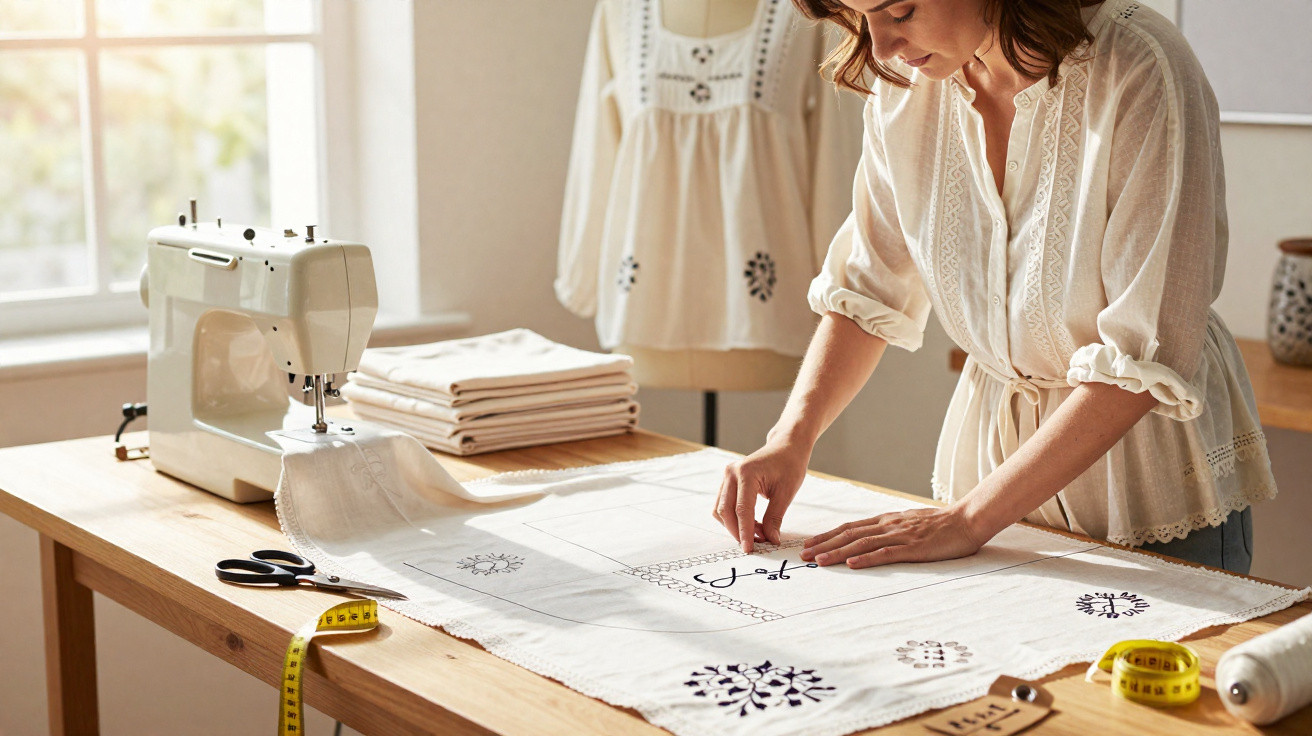
Mark these areas with tailor’s chalk. Keep the larger plain sections aside for expanses such as the front and back of a garment, or for bigger home-textile projects. Do not cut anything yet; first develop a plan, either in your mind or on paper, for where every detail will be used.
“The most important rule is: design first, cut afterwards – never the other way round.”
The key technique: using embroidery as eye-catching inserts
The essential idea is to handle embroidered sections as though they were premium appliqués or inset panels. They will become the defining signature of the new piece.
Placement makes all the difference
Lay the pattern pieces on the pressed sheet so that its loveliest details fall exactly where they will draw attention, for example:
- a monogram placed directly on, or in the centre of, a breast pocket
- openwork bands along a blouse hem or at the ends of sleeves
- a wide embroidered border used as a back shoulder yoke
- delicate broderie anglaise running along a button placket
Only cut the fabric when these positions look right, allowing generous seam allowances around every motif. This leaves room for adjustments and ensures that no stitch is lost.
If one area is already slightly thin or fragile, reinforce the reverse with lightweight fusible interfacing. Finish the raw edges immediately after cutting, using a zigzag stitch or an overlocker, to prevent fraying.
An example you will want to copy straight away
Imagine a 3-metre sheet with a large central monogram. Rather than leaving the lettering hidden in a cupboard, carefully cut it out, place it onto a prepared front panel and use it as a decorative breast pocket. The result is a lightweight mid-season jacket with clean lines and a distinctly personal feature.
You could create an airy kimono in much the same way. Use the plain sections for the body, then highlight the cuffs, front edges and back yoke with embroidery. The finished look feels contemporary, while the fabric continues to tell its own story.
“The art lies in not hiding old embroidery, but displaying it confidently like a logo.”
Elegant home pieces made from old sheets
Not everyone will want to begin with a jacket. Projects for the home make an excellent starting point, as their cuts are simple yet the visual impact is still considerable.
From duvet cover to headboard
Two well-preserved sheets can quickly be transformed into a high-quality duvet cover set. Place both pieces right sides together and sew along three edges. On the fourth edge, leave a 40 to 60 cm opening in the middle. Sew around 20 cm closed at both the left and right sides, then add buttons or press studs to the central opening.
Other options for the home include:
- A tablecloth with hotel-style elegance: arrange the embroidery as a border around the edges and emphasise the corners.
- Fabric napkins and tea towels: position small monograms in one corner and use decorative borders at the hem.
- An upholstered headboard: stretch the sheet over a foam-padded board, aligning the embroidered section in the centre.
- Curtains: use existing hems as rod pockets, allowing any lace edge to hang at the bottom.
Quick projects for sewing beginners
If you have limited sewing experience, begin with cushion covers or simple tote bags. Place a large monogram in the middle and leave the reverse plain. Choose a hotel closure, zip or buttons depending on your preference and ability.
If the sheet is still almost flawless, a more traditional use is worthwhile, too: it can easily be cut into fresh bedding for a cot. This puts an elegant natural material back into everyday use and replaces newly manufactured fabric.
Practical tips for a successful upcycling project
A few basic rules from the sewing room will help turn old fabric into a piece you truly love:
- Always make a sketch before you start cutting.
- Cut along the grainline to prevent distortion.
- Cover delicate embroidery with tissue paper while sewing so it does not catch on the feed dogs.
- Use fine needles, such as size 70 or 80, to avoid making holes.
- Plan seams so that a thick embroidered edge does not sit directly in a high-stress seam.
Patterned or heavily embellished sections can sometimes benefit from a second opinion. Photographing the sheet laid out flat makes it easier to assess placement, balance and proportions.
What to know about linen, linen-cotton and care
Many old sheets of this type are made from linen or linen-cotton. Linen comes from flax and is regarded as especially durable, temperature-regulating and antibacterial. Although it creases easily, that is also what gives it its lively character. Linen-cotton combines linen and cotton fibres, bringing together durability with a little more resistance to creasing.
For caring for modern upcycled pieces made from these fabrics, keep the following in mind:
- Use a laundry bag where embroidery is visible.
- Do not apply harsh detergent powder containing optical brighteners directly to the fabric.
- Avoid fabric conditioner where possible, as it coats the fibres like a film.
- Shake items out well and dry them on a line whenever possible to protect their structure.
Occasionally ironing or steaming your new pieces will preserve their crisp surface and prevent deep creases. That little extra care is especially worthwhile for decorative inserts: every piece contains not only fabric, but also family history and a great deal of handwork.


Comments
No comments yet. Be the first to comment!
Leave a Comment