
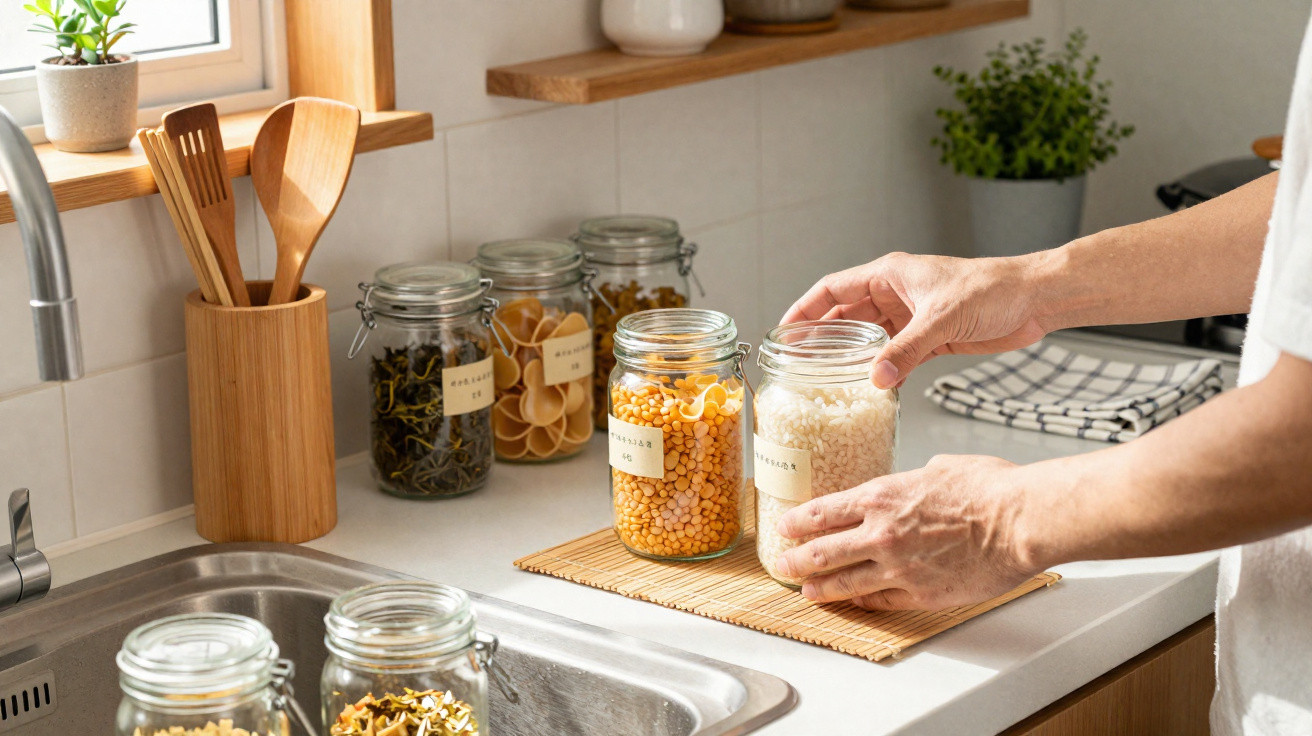
Turning preserving jars into organisers is an easy way to bring more order to the kitchen without spending money. Inspired by Japanese methods that favour functionality, practicality, a clean look and the reuse of materials that would otherwise be discarded, this approach makes use of what is already available.
How should preserving jars be prepared for safe kitchen use?
Before a jar can serve as an organiser, it must be cleaned thoroughly to prevent contamination and lingering odours. Removing all traces of food and smells prevents spices, dry goods or utensils from being affected, while also helping the jar last longer in everyday use.
Check each jar for chips or cracks as well, since damage can make it unsuitable for use. Once the outside has been cleaned, sterilise the glass in hot water for a few minutes, then allow it to air-dry upside down on a clean tea towel.
- Remove labels: soak the jar in warm water until the paper loosens.
- Get rid of glue residue: use a little cooking oil or rubbing alcohol to lift away the adhesive.
- Clean thoroughly: wash inside and out with a soft sponge and mild washing-up liquid.
- Dry completely: never store a jar while it is damp, as this can lead to mould and rust on the lids.
Watch this video from the Decorando Meu Apê YouTube channel, which shows how matching glass jars with minimalist labels can organise cupboard staples and spices:
https://www.youtube.com/watch?v=Xn72Xq6qL90
How can preserving jars organise dry foods?
A practical way to reuse these jars is to store dry foods, including grains, flours, sugars and small pasta shapes. Clear glass makes the contents easy to recognise, speeds up meal preparation and helps with stock control.
To create a functional system, arrange jars by category and size, keeping the most frequently used items at eye level. Simple labels stating the food name and use-by date keep everything clear, helping to prevent waste and duplicate purchases.
- Select the dry foods that will be kept in the jars.
- Transfer them into similarly sized jars to make stacking easier.
- Label each jar with its contents and, where possible, the use-by date.
- Arrange them on shelves by food type, from the largest packages to the smallest.
How can preserving jars become utensil organisers?
Preserving jars can also be used as holders for utensils, cutlery and small accessories, freeing up drawer space. Keeping everyday items together in upright containers makes them easier to take out and put away, while keeping worktops tidy.
Larger jars are suitable for wooden spoons, spatulas and ladles; medium-sized ones can hold everyday cutlery; and smaller jars work well for cocktail sticks, teaspoons, scissors and bottle openers. For a decorative touch, they can be customised with ribbon or glass paint, provided this is kept restrained so the room does not look visually cluttered.
- Large utensils: keep spoons, ladles and spatulas in one or two sturdy jars.
- Cutlery: sort forks, knives and spoons into separate containers.
- Small accessories: group together bottle openers, elastic bands, clips and bag-sealing ties.
How can Japanese-style organisation be achieved without spending anything?
The key principle of this type of organisation is to remove excess and make the most of what is already there, which fits perfectly with reusing preserving jars. Rather than buying new containers, adapt the ones available, create visual order and reduce plastic use at the same time.
To begin at no cost, gather all the jars, sort them by size and condition, and assign a purpose to each: some for food, others for utensils, and others for smaller items such as sachets and capsules. Gradually, the kitchen becomes lighter and easier to use, with visible objects, defined categories and a more practical routine, demonstrating that a well-organised space can be created with simple, affordable solutions.



Comments
No comments yet. Be the first to comment!
Leave a Comment