
A workout video is playing on your laptop, the instructor fires motivational lines at the camera – while you are trying to look half at the screen and half at your knees. By the second set of squats, your thighs are burning, you tuck in your chin and your back slowly folds like a pocket knife. Just keep going, you tell yourself; the seconds seem louder than what your body is telling you.
We all know that point when ambition drowns out the quiet warning voice at the back of our minds. Nobody is standing beside you, nobody is correcting your arched lower back. Eventually, you collapse sweaty onto the sofa, convinced you have “trained well” – until your back hurts more than your muscles the following day. Something has gone wrong.
The plain truth is that, during home workouts, many people watch everything except their posture.
Why posture goes wrong so often when we train at home
Training at home feels liberating. There is no wall of mirrors like at the gym, no pressure and no curious looks. You move the coffee table aside, press ‘play’ and get started. It sounds relaxed, and it is – but sometimes your body pays the price.
Without visual feedback, your posture gradually slips. Your knees drift inwards, your shoulders creep forwards and your head moves towards the screen. It does not happen in a second; it creeps in. Because exertion and beneficial discomfort can sometimes feel similar, we often notice only once something pulls, pinches or locks up completely.
A brief lapse in concentration, one set too many on your mind, and a “workout” can quickly turn into a “wonk-out”.
The figures reflect this: after the pandemic, many physiotherapists reported more patients with back and neck problems who had “simply” wanted to get fitter at home. A physiotherapist from Cologne told me that she hears the same stories every Monday: “YouTube workout, poor posture, and it has been niggling ever since.”
One example sticks in the mind. Jonas, 34, who works in an office, wanted to “finally do something”. He did planks and press-ups in his living room every day for four weeks. There was no mirror, only his phone on the floor. In photos his girlfriend happened to take, the mistake is immediately clear: a sagging back, an overextended neck and shoulders pulled up towards his ears. He himself was convinced he was doing everything “properly”. His body saw it differently – hello, slipped disc.
Let us be honest: nobody records phone videos from five angles before every exercise. Most people choose a 15-minute workout and see it through as best they can. That is human. Yet the combination of ambition, fatigue and a lack of feedback has an unforgiving effect on posture.
There is a straightforward mechanism behind it: in daily life, our bodies usually choose the easiest route, not the healthiest one. Hours spent sitting at a laptop, shoulders rounded forwards and head slightly lowered – the body often carries precisely this posture into a workout. When you move into a squat or forearm plank, your system starts in its familiar pattern. Your back rounds, your head moves forwards and your core forgets to work. Without correction, you remain stuck in your everyday shape, only now under load.
There is another classic issue: we overestimate our body awareness. Many people think they can “feel” whether they are standing upright or keeping their pelvis neutral. In reality, perception and fact are often far apart. You believe you are “straight”, but you are actually arching your lower back. This is exactly where a mirror can become your quiet coach.
How a mirror takes your home workout to the next level
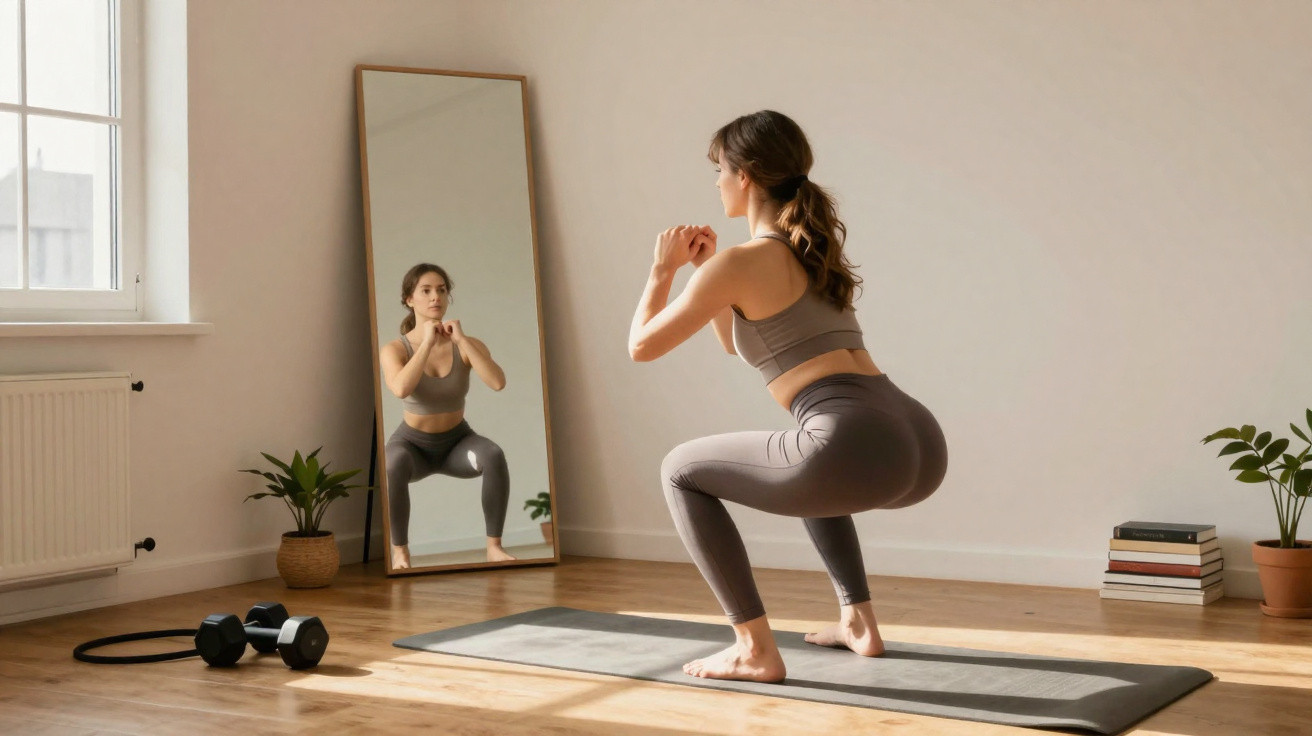
A mirror in your training area is not a decorative item; it is a tool. Position it so that you can see yourself from the front and side during key movements: squats, planks, lunges and resistance-band rows. As a guide, stand around one to two metres away so that your full body is in view. Then something interesting happens: instead of simply “counting”, you begin to “read” your movement.
Start with one exercise, such as squats. Complete a few repetitions as you normally would while looking in the mirror. Can you see your knees moving beyond your toes? Does your back stay neutral, or does it round? Where is your head positioned? Use the reflection not to judge yourself, but to adjust yourself. Make a small correction, then do another repetition. With every glance, your body learns a little more truth about itself.
After a few sessions, you will notice that you make adjustments automatically, even without the mirror. That is the moment your home workout grows up.
Many people feel uneasy about watching themselves exercise. “I do not like seeing myself in the mirror” is something trainers hear all the time. That is precisely why it is worth trying. The mirror is not there to comment on the size of your waist; it is there to show your joint angles.
The most common mistake is staring only at muscles and never at alignment. A biceps curl may look “impressive”, but nobody checks whether the shoulder is tipping forwards or the back is wobbling. The second mistake is standing too close to the mirror. You then see only details, not the overall lines. A better distance lets you see yourself from head to toe. This makes it easier to tell whether your spine remains aligned, your hips are tilting or your knees are stable.
One useful thought is this: the mirror does not judge; it only shows. It is neutral. That neutrality protects you from the familiar “Oh, it will probably be fine” mindset that so often ends in overuse and frustration.
An experienced trainer once said to me:
“The mirror does not praise you, but it does not lie either. And that is exactly what we need when training at home.”
You can turn this into a small ritual. Before beginning any new exercise, take a quick look in the mirror, check your starting position and only then begin. There are three points to keep returning to:
- Back: Keep your spine in a gentle line, with no extreme arch in the lower back and no hunched back.
- Knees and feet: Your knees should track in the same direction as your feet; do not let them collapse inwards.
- Shoulders and head: Keep your shoulders away from your ears, with your gaze slightly forwards and down rather than craning your neck.
This shifts the focus from “sweat until you are done” to “move intelligently”. You do not need an app or a sensor, only a piece of glass on the wall – and a little patience with yourself.
Why your home workout mirror does more than perfect your pose
A mirror in your training routine gives you an unfamiliar perspective: you no longer see yourself only as a mind working through to-do lists, but as a body in space. Many people notice only when they look that there is already so much tension in their shoulders and neck before the first repetition has even begun. That honesty can feel unsettling at first. But it is the point at which routine can turn into genuine self-care.
You will never have the luxury of a personal trainer during a home workout, commenting on every movement. What you can create is a form of quiet support. The mirror shows you when you are slipping out of alignment and reminds you that your back is not a machine. You may even catch yourself sitting differently and walking differently in everyday life because you have become familiar with your lines. Then your living-room workout has changed more than just your pulse.
And perhaps one day you will tell a friend complaining of back pain about this simple trick: a mirror beside the yoga mat. Sometimes it is not new equipment that changes everything, but an honest look at what has been there all along.
| Key point | Detail | Benefit for the reader |
|---|---|---|
| Loss of posture during home workouts | Without visual feedback, bodies slip into familiar, often unhealthy everyday patterns | Understands why pain after workouts does not have to be “normal” |
| Mirror as a training tool | Intentional positioning and a conscious focus on alignment rather than appearance | Learns to self-correct and train with cleaner form over time |
| A simple ritual with a powerful effect | Check your starting posture in the mirror briefly before every exercise, keeping three points in mind | A routine that can be used immediately, reduces injury risk and makes progress more consistent |
FAQ:
- Do I need a large fitness mirror, or is an ordinary one enough? An ordinary full-length mirror is completely sufficient. What matters is that you can see yourself from head to toe and have enough distance to recognise your lines.
- How often should I look in the mirror while training? Focus particularly at the beginning and when doing new exercises. Check your posture briefly, get started, then take one or two quick checks during the exercise rather than watching your reflection every second.
- Will a mirror make me overly self-critical? That risk exists if you focus only on appearance. Deliberately direct your attention to joints and alignment, not your figure or body shape.
- Can a mirror replace a trainer completely? No, but it fills a major gap. A trainer sees more, while a mirror helps you apply what you have learned consistently in everyday life.
- What if I do not have space for a large mirror? Two smaller mirrors positioned slightly offset can work too. For floor exercises, even a wall mirror angled slightly can be extremely useful.




Comments
No comments yet. Be the first to comment!
Leave a Comment