
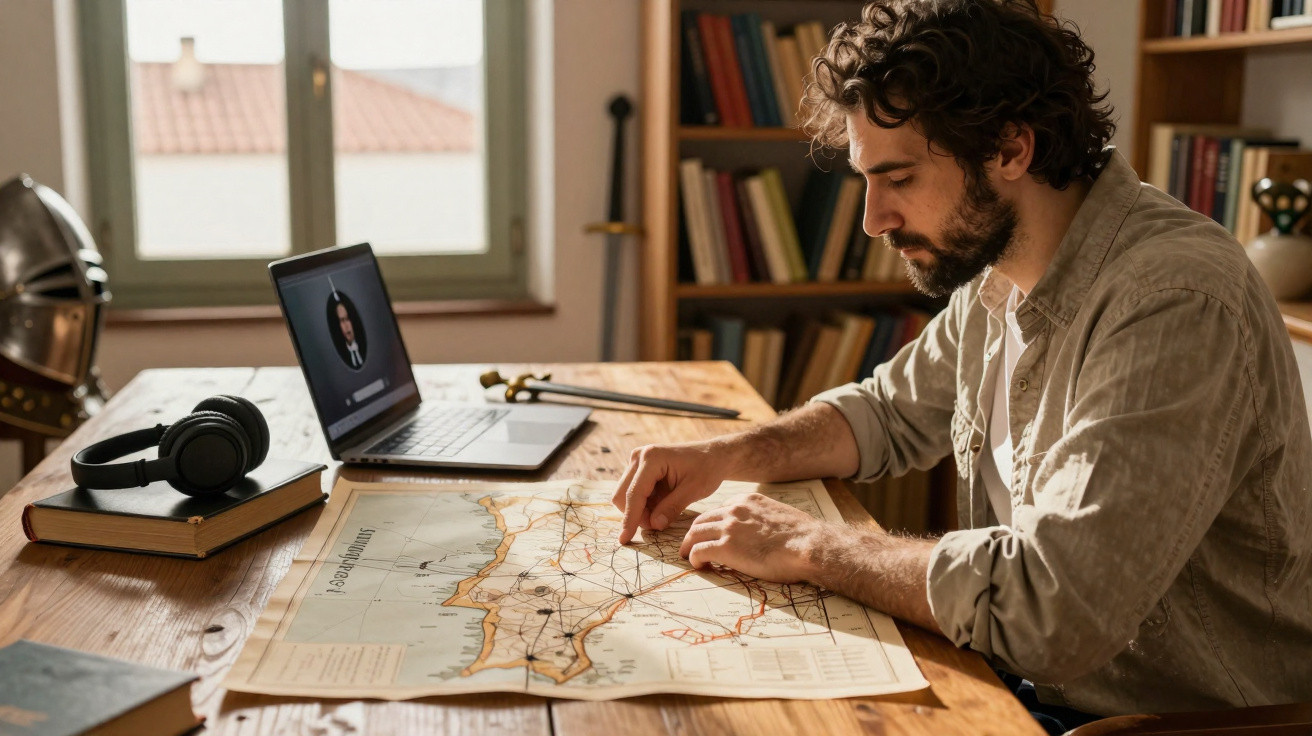
At the age of 11 or 12, I wanted to become a History teacher; by 13, I had decided that journalism was what I wanted instead: reporting what is happening is more exciting than recounting what has already happened. Yet alongside my fondness for History, I understand how essential it is to know what happened in order to make sense of what is happening now.
“After all, what is History for?” This is the question asked by so many pupils, by Rui Tavares in the Time After Time podcast, and by Marc Bloch’s son. It prompted the historian to write a book - The Historian’s Craft, or Apology for History - which he never completed because the Gestapo shot him ten days before the Normandy landings. Bloch, a defining figure in modern historiography, shifted attention towards the history of mentalities and change rather than a sequence of dates and events; he is the first historian to enter the French Panthéon.
In Portugal, it happened much earlier. The first historian to be ‘pantheonised’ was Alexandre Herculano in the 19th century. He wrote what is regarded as the first History of Portugal produced with a concern for scientific rigour. He was also responsible for restoring the Battle of São Mamede to public memory. Little is known about it, although preparations are already under way for its 900th anniversary. “São Mamede only begins to be valued in the 19th century, starting with Alexandre Herculano,” stresses Mário Barroca, one of the coordinators of the scientific committee appointed by Guimarães Council.
As Barroca tells Expresso, “Portugal’s autonomy is a process that is gradually built”, taking more than a century to reach the end of the Reconquista in 1248–49. Other historians argue that the process lasted even longer, with autonomy only being confirmed in 1383–85 - admittedly one of my favourite historical periods, largely because of Alice Vieira and This King I Chose, which I must have read when I was 11 or 12.
The national commemorations of the battle’s 900th anniversary - a battle in which, as Barroca puts it, “the infante rebels against his mother” and about which there are “more doubts than certainties” - will be coordinated by Paulo Portas, as announced after Friday’s Council of Ministers. In his weekly TVI commentary, the former minister called it an “important mission”, saying that there are “three essential dates”: 1128, 1143 and 1179. They “only make sense together” and deserve to be marked by shedding light on the established facts while also “acknowledging those that are uncertain”. Portas, whose appointment has already been criticised by the PCP, promises to “seek what unites us” and “appeal to everything that can unite us as members of the same community”.
Unlike the Prime Minister at the PSD congress, the former minister and current commentator avoided referring to 900 years of Portugal. Both, however, drew the obvious and unavoidable parallel with the 250 years the United States celebrated this weekend. Portugal, they noted, is a far older nation.
What History is for
But what if years are, after all, highly relative? Writing in Expresso this week about the human body, scientist Maria Manuel Mota said that “for centuries we measured age by counting birthdays”, yet “biology is showing us that perhaps that was always the wrong clock”.
In one study, “scientists analysed data from more than 160,000 people and reached an intriguing conclusion: people born more recently appear to age biologically faster than people born one or two decades earlier”.
Could the same apply to countries? Could the United States, which gained independence 600 years after Portugal and enjoyed its golden century only yesterday, in the 20th century, be ageing faster and less well? Or are we looking at different processes of change and different mentalities?
This, too, is why History matters. As Rui Tavares says, History is there “so that we may know other humans like ourselves better, whether they are from the present, the past or the future”. Depending on the times, it can also help foster empathy, courage and hope.
Other news
World Cup 1. Norway, absent from a World Cup for 28 years, knocked out Brazil, who are heading home and must wait another four years to pursue their sixth title. In the other last-16 match yesterday, England beat Mexico in a game Pedro Barata considers a contender for match of the year.
World Cup 2. Portugal play today at 20:00 Lisbon time, live on RTP. Looking ahead to the match, Cristiano Ronaldo acknowledged that Spain are a team with “a lot of talent” and spoke mainly about himself. Martinez, meanwhile, regretted that today’s match is not the World Cup final.
World Cup 3 and NATO. The Prime Minister is going to the football again today, despite needing to be in Turkey tomorrow for the NATO summit, where he will bring Portugal’s fulfilment of spending targets and the opening of Lajes, praised by Rubio. Dallas, after Houston and Toronto and before Ankara, where tomorrow and the day after leaders of the Atlantic Alliance countries will gather for a meeting that Raquel Vaz Pinto believes will be the “summit reaffirming the European pillar”.
New rules. New rules governing access to the National Health Service came into force on Saturday. They aim to update a data register that currently contains 20 million entries. Under the new rules, users are placed in five categories, and failing to update personal details may result in charges for services.
Lives on hold. The new timetable for the second phase of school examinations for Years 9, 11 and 12 was published on Saturday. The “chaos” surrounding the marking of exams has already led the Left Bloc to call for a parliamentary inquiry, an option the PS has not ruled out.
Appeal. The Supreme Court of Justice declined to consider an appeal that could have overturned Ricardo Salgado’s convictions. It was an appeal for the “standardisation of case law”, lodged by the family of a man assaulted by his neighbour after an argument over stray cats.
Fires. Over the weekend, the fire that began in Vouzela kept moving up and down Caramulo. Experts interviewed by Expresso explain that in these fires, known as sixth-generation fires, the blaze is no longer merely affected by weather conditions: it also begins to affect them. They argue that prevention must start much earlier, through land-use planning and prescribed burning. Here, you can follow the operational situation and Civil Protection warnings in real time.
Quotes
“We are better than ever.”
Donald Trump, at celebrations marking 250 years of the United States, where the heat cancelled the festivities
“We are not here for a funeral, but for revenge.”
One of the eulogists at Ali Khamenei’s funeral ceremonies
What I am reading
Hitler’s Circle of Traitors, by Jonathan Freedland
It is a work of non-fiction, yet it reads like a detective novel. This Sunday, I finished Hitler’s Circle of Traitors, a book that had been waiting on my shelves for me to read it for a long time. During the horrors of Nazism, there were Germans who did not yield: people who hid Jews and helped them escape, and who conspired to overthrow the dictator. They were betrayed and tortured. Some were liberated by Allied bombs.
The book introduces us to several of them: the daring, arrogant Countess Maria Maltzan; the aristocrat Elizabeth von Thaden, who initially sympathised with the order imposed by National Socialism; the diplomat Otto Kiep; the Solf family; as well as government officials, Armed Forces officers, priests and pastors prepared to risk their lives to confront evil. It is an unsettling read at several points, but also an account of courage and a sign of hope.
Listen
Expresso Morning. Paulo Baldaia speaks with Joana Pereira Bastos about “supervised romances”.
CEO Is the Limit. Joana Ferraz da Costa tells Cátia Mateus how a stroke changed her relationship with work and with life.
That is all from me today, but you will find much more to read and hear in your Expresso. Have a good week, follow the authorities’ guidance on the heat, and drink plenty of water.


Comments
No comments yet. Be the first to comment!
Leave a Comment