
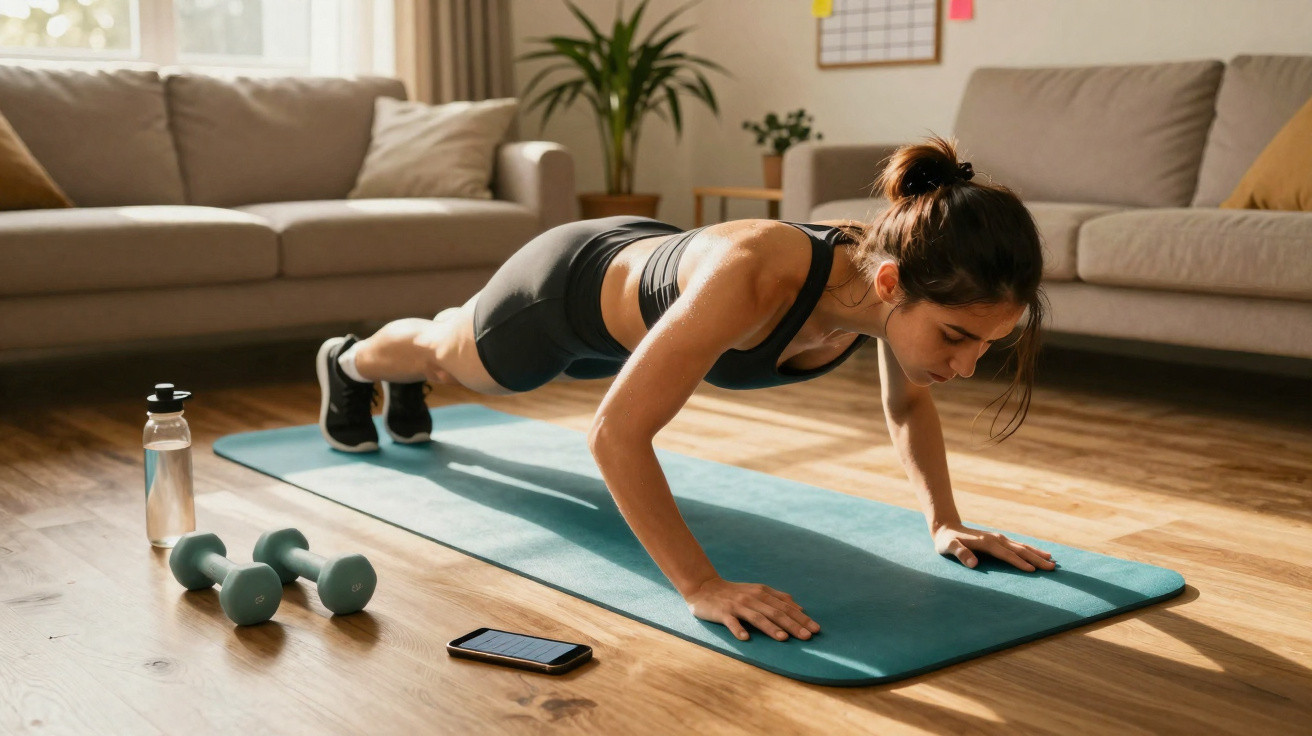
Forget it. A straightforward ten-minute programme in your living room can get your body moving remarkably quickly.
Anyone with a job, a family, or simply no desire to deal with crowded gyms knows the issue: there is often a huge gap between good intentions and a genuine exercise routine. That is where a minimalist approach comes in. It needs no equipment, yet works every key muscle group – right at home, wearing socks and a T-shirt, with only a little clear floor space.
Why living room workouts often work better than the gym
Working out at home can seem like a lazy compromise. In reality, it is a far smarter option for many lifestyles. There is no journey, no excuses and no pressure from opening hours.
“The fewer barriers there are between you and your workout, the more likely you are to actually do it.”
Replace travel stress with a routine
The main enemy of exercise plans is not muscle soreness but organisation. Packing a bag, travelling there, looking for a parking space and waiting for equipment to become available all drain willpower. And willpower is limited.
At home, the equation changes: put on your joggers, move the coffee table aside and begin. That low barrier to starting turns “I really should” into “I’ll do a quick session now” – and these small workouts, repeated regularly, create visible changes.
Rather than pushing through one brutally intense gym session a month in a burst of motivation, four or five short home sessions each week often work better. Your body responds to consistency, not heroic efforts.
Why bodyweight exercises are so effective
Bench presses and heavy machines have their place, but everyday life makes different demands. Climbing stairs, lifting children, carrying shopping and gardening all require functional strength, stability and good body awareness.
That is precisely what bodyweight exercises provide:
- Several muscle groups work at the same time.
- Your core must stabilise continuously.
- Tendons and joints adapt gradually and gently.
- The risk of injury remains manageable.
You learn to move your own bodyweight with control – and that matters more for health than adding yet another kilogram to the barbell.
The 10-exercise circuit: a full-body living room workout
The principle is simple: complete ten uncomplicated movements one after another as a circuit. All you need is some space and the edge of a sturdy chair. Depending on your pace, it takes around 15–25 minutes.
“A manageable, clear plan stops you overthinking for ages – you simply get started.”
Block 1: Legs and cardio – getting the engine going
This block raises your heart rate and activates your lower body. It is ideal for “waking up” after a day at the office.
- Squats
Stand with your feet roughly shoulder-width apart, keep your back straight and lightly brace your stomach. Imagine lowering yourself onto an invisible chair. Keep your weight through your heels. 10–15 repetitions. - Reverse lunges
Step backwards, bend both knees and keep your front foot fully on the floor. Maintain an upright torso. Alternate sides. 8–12 repetitions per leg. - High knees on the spot
Standing upright, bring your knees up alternately. Adjust the pace to your fitness level and swing your arms with the movement. 30–45 seconds. - Glute bridge
Lie on your back with your feet hip-width apart and your arms beside your body. Drive your hips upwards, squeeze your glutes firmly, hold briefly and lower again. 12–15 repetitions. - Side steps or jumping jacks
To be kinder to your joints, take quick side steps with slightly bent knees. If you feel fit, do standard jumping jacks. 30–40 seconds.
Block 2: Core and upper body – a strong centre and upright posture
Now it is time for your abs, back, chest and arms. The aim is to build stability and restore balance to muscles tightened by sitting.
- Forearm plank
Place your forearms on the floor, with elbows beneath your shoulders, and form a straight line with your body. Brace your stomach, keeping your hips neither sagging nor lifted too high. Hold for 20–40 seconds. - Press-ups
Choose your level: standard press-ups, press-ups from the knees or with your hands against a wall. Avoid letting your elbows flare fully outwards, and keep your core engaged. 6–12 repetitions. - “Superman”
Lie on your front with your arms stretched forward. Lift your upper body and legs slightly off the floor as if you were flying. Hold briefly, then lower with control. 10–15 repetitions. - Chair-edge dips
Place your hands behind you on the edge of a sturdy chair, extend your feet forwards and position your bottom just in front of the chair. Bend and straighten your elbows. The closer your feet are to your body, the easier the exercise becomes. 8–12 repetitions. - Mountain climbers
Start in a press-up position. Draw your knees towards your chest one at a time. Begin slowly, then build up speed. 20–40 seconds.
How to structure your workout effectively
To ensure this programme becomes more than a one-off attempt, you need a simple framework you can follow.
Recommended duration and frequency
| Level | Duration per session | Circuit rounds | Sessions per week |
|---|---|---|---|
| Beginner | 15–20 minutes | 1–2 | 2–3 |
| Intermediate | 20–25 minutes | 2–3 | 3–4 |
| Experienced exerciser | 25–30 minutes | 3 | 4–5 |
You can rest for 15–30 seconds between exercises and for one to two minutes between rounds. If time is short, keep breaks brief and focus on performing each movement properly.
Small adjustments to increase the difficulty
Your body adapts quickly. When the circuit starts to feel easier, there is no need to buy equipment immediately. A few modifications are enough:
- Vary the tempo: lower into squats slowly, pause for two seconds at the bottom, then drive back up powerfully.
- Add jumps: turn lunges into jumping lunges – but only if your landing and technique are genuinely stable.
- Introduce instability: during the forearm plank, lift one leg or arm at a time to challenge your side core muscles more.
- Extend the timings: gradually add 5–10 seconds to the plank and mountain climbers.
“Progress does not mean exhausting yourself completely; it means moving up a small gear week by week.”
Mental strategies to help you stay consistent long term
Discipline alone rarely gets you very far. It works better to create an environment in which exercise fits into daily life as naturally as possible.
Rituals instead of willpower
Schedule fixed time slots, such as Mondays, Wednesdays and Fridays straight after work. Leave your exercise clothes somewhere visible. The clearer the routine, the less you negotiate with yourself internally.
Small “starting signals” can help: a particular playlist, a candle or a glass of water before the session. Your brain links these cues with movement, and inner resistance decreases.
Make progress visible
After each session, write down the following on paper or in a notes app:
- Date
- Number of rounds
- Perceived effort (scale 1–10)
- One brief observation (“Plank noticeably more stable today”)
After a few weeks, you will be able to see in black and white what has changed. That is more motivating than any set of scales.
What to consider: technique, safety and everyday benefits
Because you are exercising at home without a trainer, technique matters. If a movement feels painful – which is not the same as effort – reduce the volume or adapt the exercise.
Many of the movements described can easily be made less demanding: wall press-ups, shorter lunges or mountain climbers at a very slow pace. The goal is to challenge yourself without overwhelming your body.
The welcome side effect is that you notice changes beyond the mirror. Stairs become easier, sitting for long periods causes fewer problems and your back feels more stable. That is exactly what this programme is designed for – everyday capability rather than appearance alone.
Over time, you can expand the concept: a small resistance-band set, a kettlebell or a dumbbell can usefully supplement the exercises, but none is essential. These ten movements remain the foundation, turning your living room table into a workout area in no time.





Comments
No comments yet. Be the first to comment!
Leave a Comment