
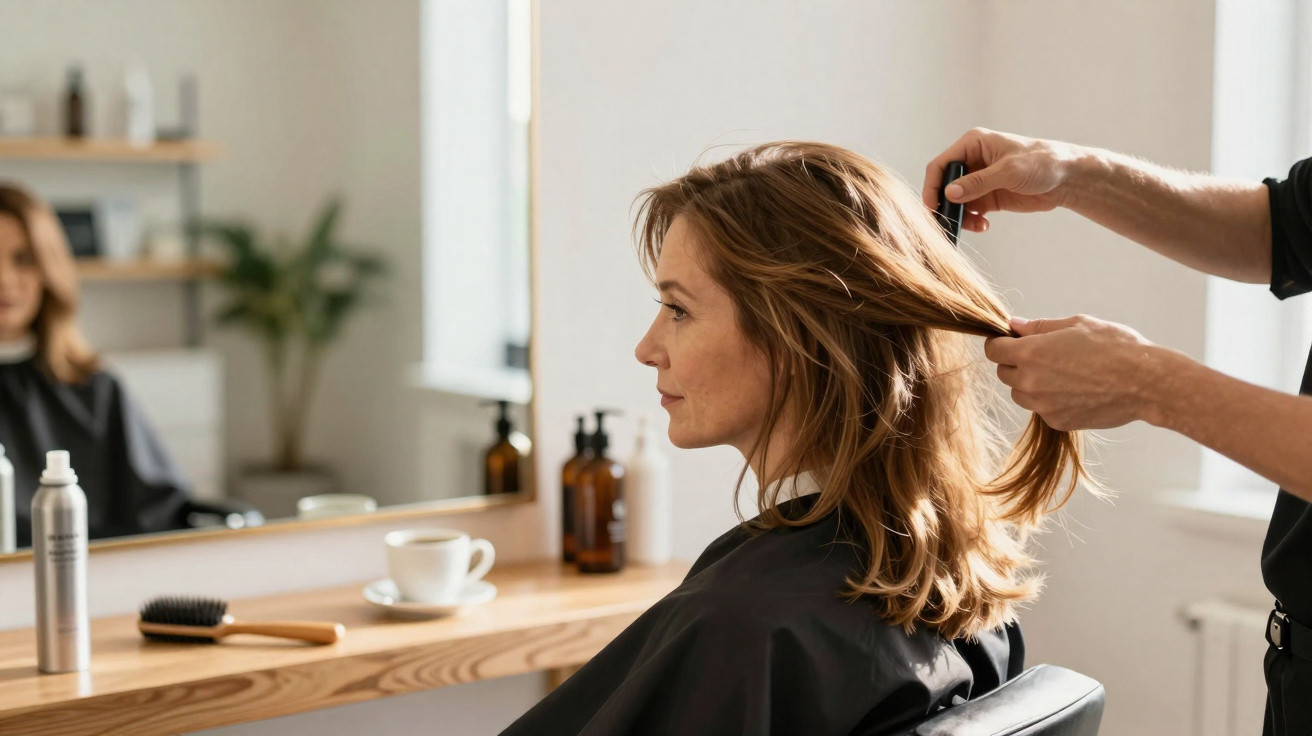
Invisible layers haircut is one of the most suitable techniques for people with fine hair after 50 who want greater volume without turning to harsh treatments. Rather than heavily thinning the hair or over-refining the ends, the stylist creates subtle internal layers that lift the roots, spread the weight more evenly and retain the look of density.
Why does fine hair lose volume after 50?
Over time, hair commonly becomes drier, more fragile and less supported at the roots. Hormonal changes, a history of colouring, heat styling and the natural reduction in density can all leave the lengths shapeless and with less movement.
The problem arises when this is countered with aggressive thinning, very hot blow-dries or volumising chemical treatments. On fine hair, removing weight indiscriminately can make the ends look sparse and leave the overall style appearing even less full-bodied.
How do invisible layers create volume without causing damage?
Invisible layers are cut within the body of the hair, without producing visible steps across the surface. The length keeps a full outline, while the inner sections gain enough lightness for the hair to move and lift away from the roots more easily.
- They remove internal weight without excessively thinning the ends.
- They provide subtle support close to the roots and crown.
- They keep the outline looking full, which is important for fine hair.
- They make blow-drying and styling easier with less heat.
- They add movement without requiring bleaching, a perm or harsh chemicals.
Why does this technique last longer than conventional tricks?
Volumising products, a shaped blow-dry and mousse can help, but their effect disappears when the hair is washed. Invisible layers alter the cut’s architecture, so the hair has more potential for movement as it dries, even before it is styled.
The effect is also more natural than heavily defined layers. Since the layers are blended into the shape, the cut grows out more softly and does not require touch-ups as quickly as heavy fringes or highly disconnected ends.
How should you ask for invisible layers at the salon?
Be specific: ask for more volume and movement without losing density at the ends. Take reference images of cuts with a full baseline, such as a bob, long bob or shoulder-length style, as these lengths often suit fine hair after 50.
- Ask for internal layers or invisible layers, rather than excessive thinning.
- Explain where volume is lacking: at the crown, sides, nape or ends.
- Avoid asking to “remove lots of weight” if your hair is already sparse.
- Pair the cut with a soft fringe or curtain bangs only if they suit your face and routine.
- Have it finished with gentle drying at the salon so you can see how the cut truly falls.
Beautiful volume starts with the cut and continues with your routine
To preserve the result at home, choose a lightweight shampoo, apply conditioner only from the mid-lengths to the ends, and use low-weight styling products. Very oily products or rich masks near the roots will flatten the volume created by the cut.
Invisible layers work because they respect the structure of fine hair: they remove weight where it weighs the hair down, retain density where it is visible and allow for styling with less heat damage. With regular trims, drying at a moderate temperature and lightweight products, hair gains body without compromising its health.





Comments
No comments yet. Be the first to comment!
Leave a Comment