
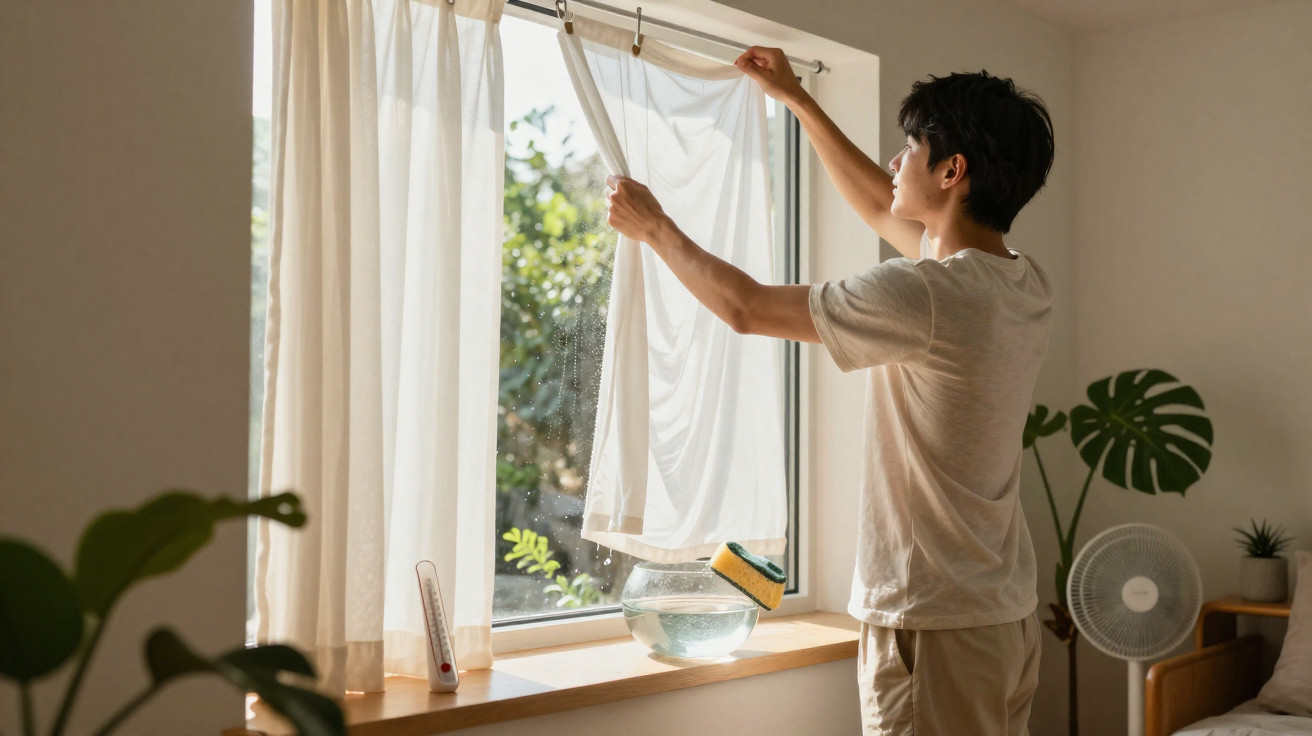
Keeping the home cool without air conditioning can be easier with a technique drawn from hot, dry regions: hanging damp curtains at the windows to cool incoming air. This approach relies on evaporative cooling, in which water draws heat from the air as it evaporates, producing a cooler feeling where there is airflow and low humidity.
How does the damp-curtain technique work?
A damp curtain forms a natural barrier between the hot outdoor air and the room indoors. As a breeze passes through the wet fabric, some of the water evaporates and takes heat from the air, much like the chill felt when leaving a swimming pool wet on a hot day.
This technique is most effective in dry conditions or at times when the air is less humid. If humidity is already high, evaporation slows down, the cooling effect is reduced, and the room may feel stuffy rather than comfortable.
Which type of curtain works best?
The most suitable curtains are lightweight, washable and able to hold moisture without dripping. Very thick fabrics take longer to dry, place more weight on the curtain rail and may encourage mould if they remain wet for many hours.
- Use thin cotton, lightweight linen or cotton voile.
- Avoid blackout curtains, velvet or tightly woven synthetic fabrics.
- Choose curtains that are easy to remove, wash and dry in the sun.
- Select light colours to limit heat absorption at the window.
- Use clean water only, with no fragrance, fabric conditioner or cleaning products.
How should you use damp curtains at windows?
To use this method, wet the curtain and wring it out thoroughly before hanging it. It should feel damp rather than saturated, preventing drips onto the floor, sockets, walls, furniture or window tracks.
Ideally, maintain an airflow passing through the curtain. Open another window, door or top-hinged vent on the opposite side to create cross-ventilation, as air must enter through one opening and leave through another to carry the heat away.
How can the cooling effect last longer?
The effect continues for as long as the curtain stays damp and air is circulating. On very hot days, the water evaporates quickly, so the technique can be repeated at useful times, such as late morning, during the afternoon and in the early evening.
- Dampen the fabric again once it starts to dry.
- Close blinds or dry curtains on the side receiving direct sunlight.
- Point a fan towards the window, without allowing the appliance to get wet.
- Put a dry towel on the floor if there is a risk of drips.
- Take the curtain down to dry fully at the end of the day.
Why can it work better than a standard fan?
A fan simply moves the air already in the room; when the space is very hot, it circulates that heat. A damp curtain adds evaporation to the process, so air travelling through the fabric can feel cooler, provided the room’s humidity allows the water to evaporate.
For safe use, keep this method away from sockets, extension leads, electronic devices and walls that already show mould. In modern houses and flats, it works best as a temporary solution: a lightweight curtain, clean water, a ventilated window and thorough drying afterwards to cool the space without creating a build-up of moisture.





Comments
No comments yet. Be the first to comment!
Leave a Comment